Early January has a particular feeling in a Tamil Nadu school.
The half-yearly break is over. Classrooms that sat quiet over the holidays fill again with noise. Teachers are planning the final stretch of the academic year, the one that leads to annual exams. For students, especially those in Classes 10 and 12, the months ahead matter a great deal.
And in many classrooms, a familiar problem returns with them. Notebooks from the first term are full. Pencils have worn down to stubs. Erasers have vanished. Rulers have snapped. For families already stretched by school fees, transport and everyday costs, replacing them isn't always simple.
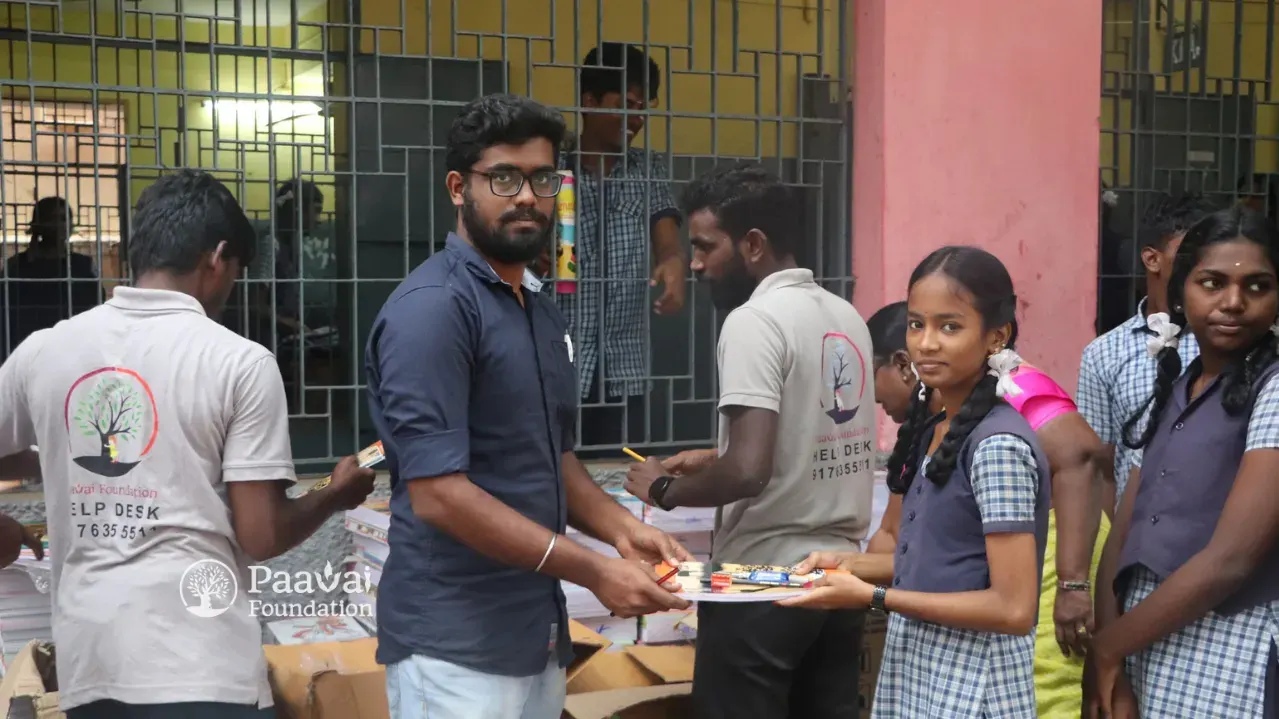
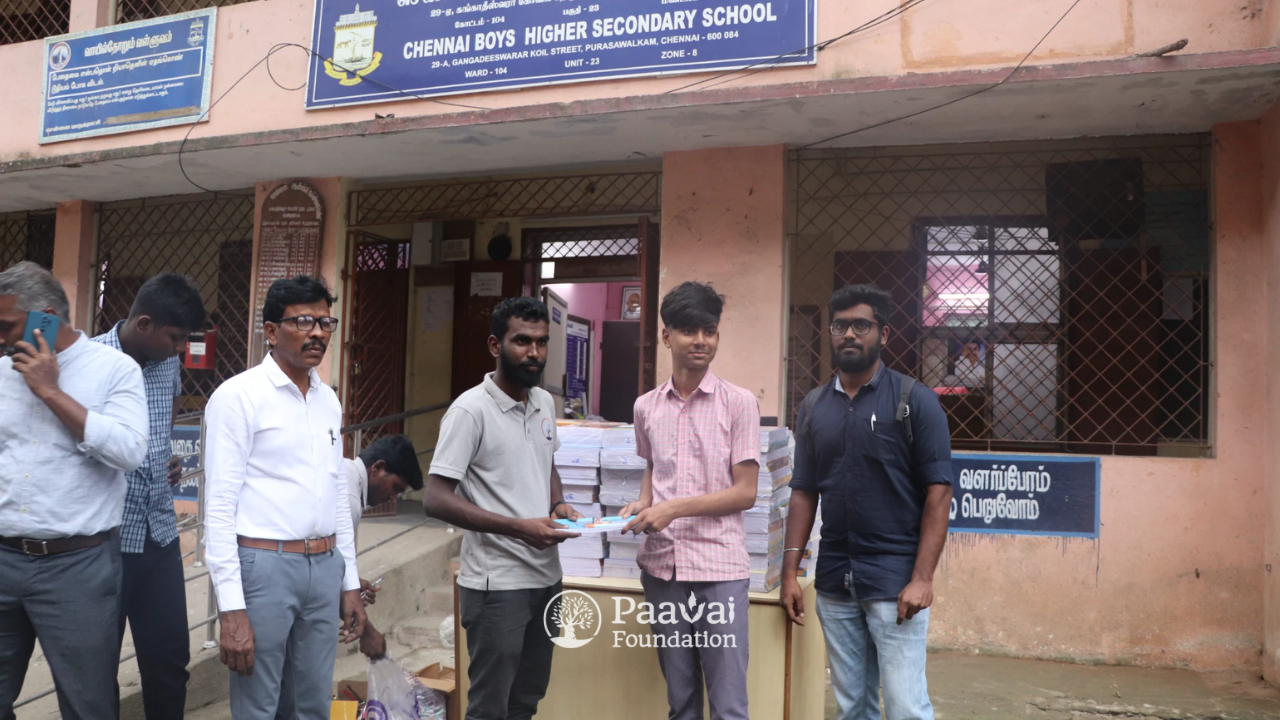
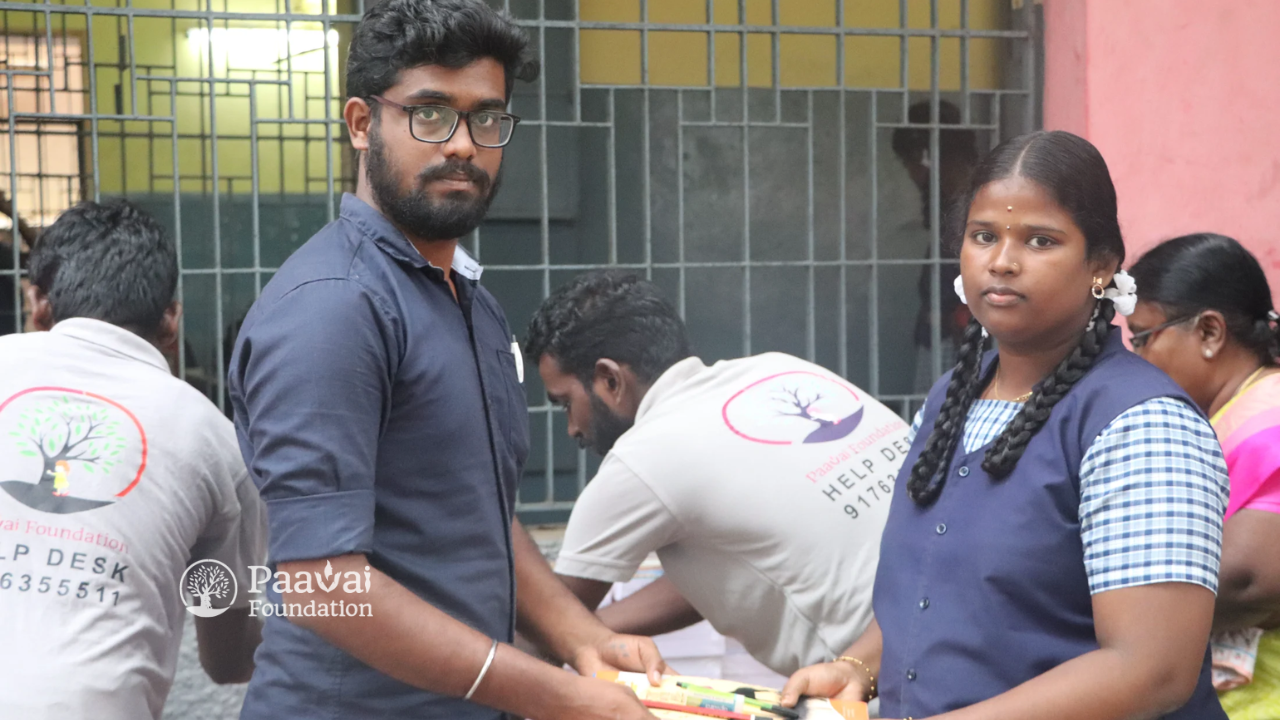
On 4 January 2024, as the new term was getting under way, Paavai Foundation's education initiative, Paavai Gurukul, organised a multi-school stationery distribution in Chennai. Volunteers in Paavai Foundation help-desk T-shirts set up tables, unpacked boxes and handed each student a kit with a writing pad, pencil, eraser and ruler, simple tools for the term ahead.
The day is recorded in a set of 25 photographs in Paavai Foundation's Look Book, under the title Multi School – Stationery Items Distribution – Chennai. This article looks at what happened that day, and why something as ordinary as a pencil can matter more than it seems.
What the photographs show
The images tell a simple story.
Students in their school uniforms, lilac pinafores and checked shirts, stand in line in a school corridor. Behind them, the familiar architecture of a Chennai government school: patterned window grilles, painted pillars, a long verandah. Cardboard boxes are stacked on tables. Volunteers sort and hand out supplies, one student at a time.
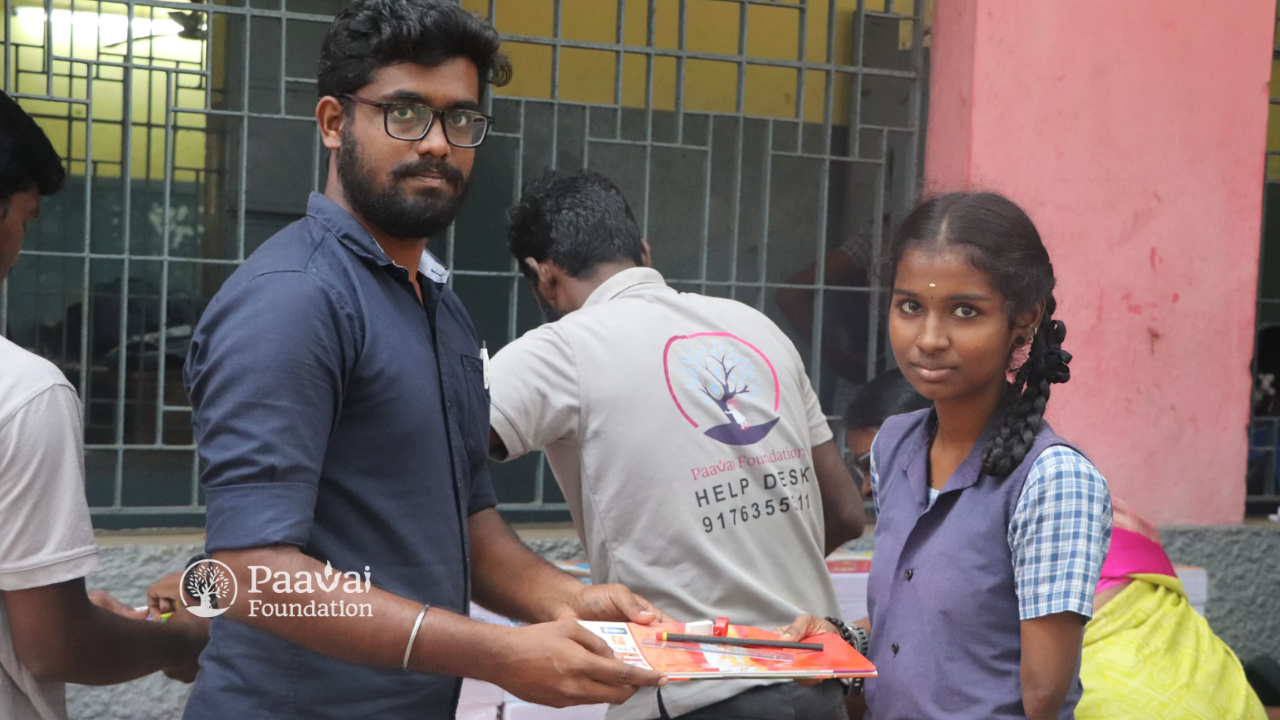
In one photograph, a volunteer holds out a writing pad with a pencil, eraser and ruler resting on top. A student in a school uniform reaches to take it. Around them, other volunteers keep the line moving, and more students wait their turn.
There's nothing dramatic here. No speeches, no stage, no banners. Just an organised, practical effort to make sure students start the term with what they need to write, draw, measure and learn.
That ordinariness is the point.
Why stationery matters more than it seems
It's easy to think of stationery as a small thing. A pencil costs very little. A notebook isn't expensive.
But for many families, small costs add up, and they arrive at the worst possible times.
Free education still has hidden costs
Government schools in India provide free education, and schemes cover many essentials, including textbooks and uniforms in many states. Information on national school education programmes is available from the Department of School Education and Literacy.
Even so, families often face other expenses: extra notebooks, geometry boxes, pens and pencils, chart paper for projects, exam supplies, bus fares. For a household living on daily wages, these smaller costs come on top of rent, food and medical bills. When money is tight, school supplies are often the thing that gets postponed.
A missing pencil is a missing lesson
A student without a working pencil can't take notes. A student without a ruler can't draw a geometry diagram. A student without a notebook falls behind on classwork, then on homework, and slowly loses confidence.

Teachers in government schools often notice this: a child sitting quietly at the back, not writing, too embarrassed to say they don't have what they need. Over time, small gaps like these can turn into larger ones.
It's also about dignity
Arriving in class prepared matters to children. Having your own pencil and your own pad, rather than borrowing from a classmate, gives a quiet sense of readiness and belonging. It removes one small reason for a child to feel different from everyone else.
That's why education support for children often begins with practical basics. Learning can't start if a student doesn't have the tools to take part.
Why the start of term is the right moment
Timing matters as much as the supplies themselves.
The return to school after the half-yearly break is a natural reset. It's when supplies from the first half of the year have run out, when teachers are planning revision, and when students preparing for board exams are beginning their most demanding months.
A kit given at this point arrives exactly when it's needed: at the start of the term, not halfway through it. It lets students begin the second half of the year on the same footing as their classmates.
Why "multi-school" matters
The event's title, Multi School – Stationery Items Distribution, points to something important about how the work was organised.
Rather than focusing on one school, the distribution reached students across more than one school in Chennai. Working this way has practical advantages:
It reaches more students with the same organisational effort.
It treats schools as partners. Distributions are planned with headteachers and staff, who know their students' needs.
It avoids singling out individual children. When every student in a class or group receives the same kit, no child is marked as "needing help".
That last point matters a great deal. Help that singles children out, however well meant, can leave them feeling embarrassed in front of their classmates. Help given equally to everyone in the room simply becomes part of the school day.
Responsible giving: how distributions should be done
A stationery distribution looks simple, but doing it well takes care. A few principles help make such efforts genuinely useful:
Work with the school. Teachers and headteachers know what students need, which classes need it most, and when the right time is.
Give everyone in the group the same thing. Equal kits for every student in a class avoid comparison and embarrassment.
Choose useful items. Practical supplies that students will actually use, matched to their class level.
Respect children's dignity and privacy. Children shouldn't be made to perform gratitude or pose for photographs. Where photographs are taken to record an event, schools and organisations should follow their consent and safeguarding policies.
Keep the school day running. Distributions should be organised quickly and calmly, so lessons can continue.
Paavai Gurukul: education that continues
The Chennai distribution was organised under Paavai Gurukul, Paavai Foundation's education initiative.
Paavai Gurukul is built around one central idea: what often breaks a vulnerable child's education is not lack of ability but repeated interruption. A student who leaves school and returns again and again hasn't had several years of learning. They've had several fresh starts.
So the initiative focuses on continuity, through:
uninterrupted access to formal education
academic support for children and mentoring
digital and future-ready learning
inclusive education that recognises different learning needs
confidence building, so students who've fallen behind believe they can catch up
A stationery distribution is one practical part of that larger picture. It removes a small barrier at a crucial moment, so students can keep learning without interruption. The fuller story of the initiative is told in Paavai Gurukul: Transforming Education Into a Pathway for Confidence, Independence and Leadership.
Paavai Foundation's education work also includes the Gurukul Promise, an educational campaign you can learn more about on the Paavai Gurukul Promise page.
Small kits, larger questions
A stationery kit can't solve every challenge a student faces, and it doesn't claim to.
Many of the reasons children struggle at school run deeper: household finances, distance from school, family responsibilities, illness, or the pressure to start earning early. Literacy itself is more than enrolment; it depends on whether every child can actually take part in learning. That wider picture is explored in International Literacy Day 2026: Literacy Is Not Literacy Until It Includes Every Child.
When education is interrupted, the consequences can be serious. Children who fall behind or drop out are more vulnerable to being pulled into work. Why keeping children in school matters so much is explained in How Education Can Help End Child Labour in India.
Seen this way, a kit given at the start of term is one small piece of a much larger effort: making sure children stay in school, keep up, and keep believing that education is worth it.
How you can support child education
If this story makes you want to help, there are many ways to do it, at almost any level.
Fund educational kits for students. Stationery, geometry boxes, notebooks and exam supplies help students start each term ready to learn.
Support a school adoption program. Some donors and companies choose to support a particular school over several years, helping with supplies, learning resources for children, and academic support.
Give regularly. A small monthly contribution helps education programmes plan ahead, so support arrives on time every term, not just once.
Give your skills. Teachers, tutors, counsellors and professionals can volunteer their time to support students' learning.
Involve your workplace. Companies can support education through CSR, combining funding with employee volunteering.
Whichever way you choose, check that the organisation is registered and works with schools responsibly.
Paavai Foundation and Chennai
Paavai Foundation is an Integrated Child Development Foundation working across South India, with children's homes in Trichy, Hyderabad and Tirupati and community programmes across Tamil Nadu, Andhra Pradesh and Telangana. Its Look Book records activities across these regions, including this Paavai Gurukul distribution in Chennai.
For readers in Chennai who want to understand the wider landscape of children's care and education in the city, including how to choose an organisation to support, see Better Care and Brighter Futures for Children in Chennai.
Support Child Education With Paavai Foundation
The quiet power of being ready
Most of the students in those photographs won't remember the date. They probably won't remember the volunteers' faces or the boxes on the tables.
What they may remember is a term that started well. A fresh writing pad. A pencil that was theirs. Arriving in class ready to take part, rather than waiting to borrow.
Education for every child doesn't begin with grand gestures. It begins with making sure no student is left out of the lesson because of something as small as a missing pencil. Sometimes, a future through education starts with a simple kit, handed over at the right moment, to a student who's ready to learn.
FAQs
What was the Multi School Stationery Items Distribution in Chennai?
It was an education support activity organised by Paavai Foundation's Paavai Gurukul initiative on 4 January 2024, in which students across more than one school in Chennai received stationery kits including a writing pad, pencil, eraser and ruler.
What is Paavai Gurukul?
Paavai Gurukul is Paavai Foundation's education initiative. It focuses on continuity in learning through access to formal education, academic support and mentoring, digital learning, inclusive education and confidence building.
Why is stationery distribution important for students?
Even when schooling is free, families often face costs for notebooks, pencils and exam supplies. Providing these removes a barrier to participation, helps students keep up with classwork, and allows them to start each term ready to learn.
Why distribute stationery at the start of a term?
Supplies from earlier in the year are often used up by then, and students, especially those preparing for exams, need them most at the start of the term.
How should stationery distributions in schools be organised?
In partnership with the school, giving the same kit to every student in a group, choosing useful items, keeping disruption to a minimum, and respecting children's dignity and privacy.
How can I donate educational kits for students?
You can support an education organisation's stationery or school-kit programmes, give regularly, or support a school over several years through a school adoption approach.
Can companies support school stationery distributions?
Yes. Companies can fund educational kits through CSR and combine this with employee volunteering for academic support.
Where can I see photos of Paavai Foundation's activities?
Paavai Foundation's Look Book on its website records activities and events across its programmes and regions.

Comments
Loading comments...
Leave a comment
Your email address will not be published. Only your name is shown with your comment.