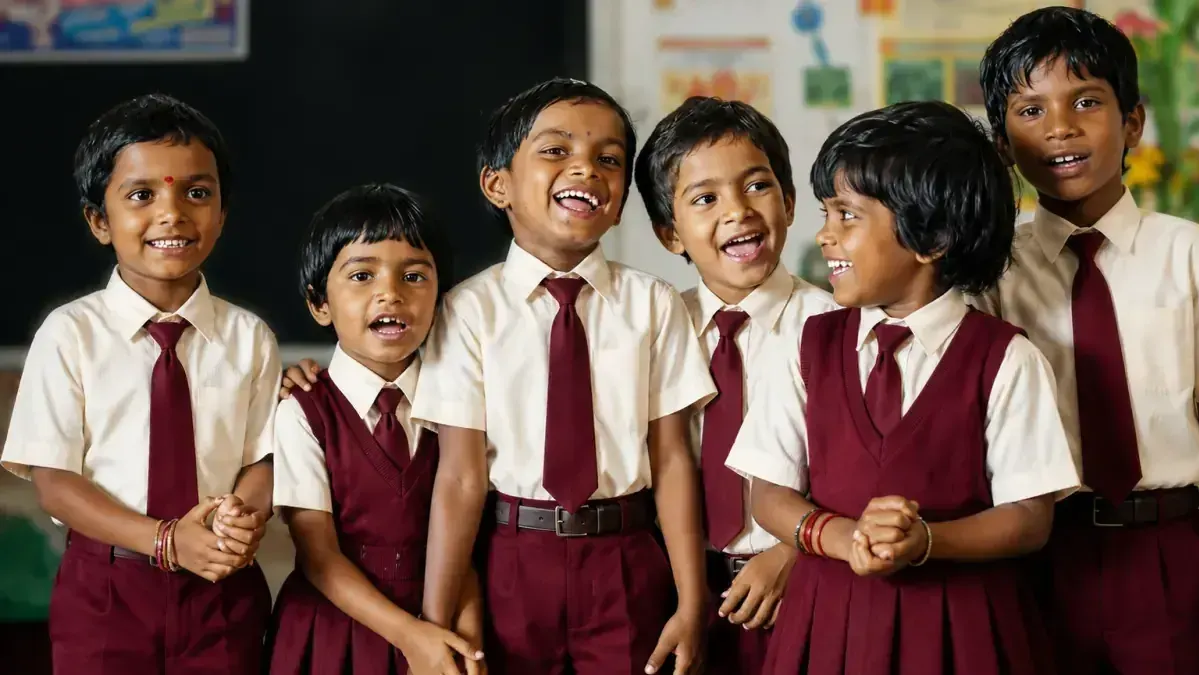
Every year on 8 September, literacy gets a day. Schools hold assemblies, children make posters, and somewhere a figure is quoted about how many people in the world still cannot read.
The figure is always an average. And an average is a way of describing a group by ignoring the people at its edges.
That is the difficulty with how literacy is usually discussed. A district reports a literacy rate. A state improves by a few points. The number rises, the headline is positive, and nobody asks the more uncomfortable question: which children were counted, and which ones were never in the count to begin with?
A deaf child in a classroom with no sign language. A child with an intellectual disability whose parents were told the local school could not manage. A child with dyslexia was marked as lazy for eight years.
A child who works during harvest season and returns to find the class has moved on without her. These children exist inside literacy statistics as rounding errors, or they exist outside them entirely.
International Literacy Day 2026 is a reasonable moment to say something plainly. A literacy rate that leaves these children out is not a measure of literacy. It is a measure of who we decided to look for.
What International Literacy Day marks, and when it falls
International Literacy Day is observed on 8 September every year. In 2026, that falls on a Tuesday.
UNESCO proclaimed the observance at its General Conference in 1966, and it was first marked the following year. The date traces back to a world conference of education ministers on eradicating illiteracy held in September the year before, and it has stayed fixed ever since. The day is not a celebration so much as an annual accounting, a point at which governments, educators and organisations are asked to look at what has changed and what has not.
You will see the same day referred to as World Literacy Day. Both names describe the same 8 September observance, and neither is wrong.
Is National Literacy Day the same thing?
Largely, yes, in the way people use the phrase. In India, 8 September is often described as literacy day in school circulars and assembly notices, and searches for a "national literacy day" usually lead back to the same international observance.
What is genuinely separate is National Education Day, observed in India on 11 November to mark the birth anniversary of the country's first education minister. If you are planning a school calendar, those are two different dates with two different purposes.
And World Computer Literacy Day is a different day altogether
This one causes real confusion, and the search data shows it clearly.
World Computer Literacy Day is observed on 2 December, not 8 September. It began as an industry-led initiative in India in the early 2000s to draw attention to digital skills gaps, and it focuses specifically on computer and technology literacy rather than reading and writing.

The two days are related in spirit and separate on the calendar. If a school assembly is being planned for September, International Literacy Day is the one.
If the subject is digital skills and computer access, 2 December is the appropriate date, though the digital dimension of literacy belongs in both conversations, as the next sections argue.
What is the theme for 2026?
UNESCO announces a theme for International Literacy Day each year, usually in the weeks before 8 September, and it shapes the global events and awards associated with the day. Recent themes have addressed multilingual education and the changing nature of literacy in a digital environment.
Rather than repeat a theme that may since have been superseded, the reliable source is UNESCO's own International Literacy Day page, which carries the current year's theme, concept note and official materials. If you are preparing a speech, a poster or a school programme, take the wording directly from there.
What a literacy rate does not tell you
India's most recent full Census, conducted in 2011, recorded a national literacy rate of just over 74 per cent, with a significant gap between men and women.
That figure is now more than a decade old, and literacy has certainly risen since. But even a current, accurate number would carry the same limitation.
Literacy, as it is usually measured, asks whether a person can read and write a simple statement with understanding. It is a threshold, and thresholds are blunt.
They do not tell you whether a fourteen-year-old can read her science textbook, follow a government notice, fill a hospital form, or read the terms of a loan agreement before signing it.
They also do not tell you whether the classroom that produced the number was reachable by every child in the village.
Enrolment figures compound the problem. A child on a school register is counted as being in education. Whether she is present, whether she can follow the lesson, whether anyone noticed she stopped reading aloud two years ago, none of that appears in the register.
National learning assessments have repeatedly found that the number of children enrolled and the number of children reading at their grade level are very different numbers.
The children literacy statistics tend to miss
If literacy is to mean anything, it has to be measured against the children who are hardest to reach, not the ones easiest to count.
Children with disabilities. This is the largest and least discussed exclusion. A child with a visual impairment cannot become literate in a school with no Braille material or screen reader. A deaf child cannot become literate in a classroom where no adult signs. A child with an intellectual disability may be admitted and then quietly left at the back of the room with nothing adapted for her. The Rights of Persons with Disabilities Act, 2016 requires educational institutions to provide accessible materials, individualised support and trained teachers, and gives children with benchmark disabilities the right to free education between six and eighteen. The obligation exists. The delivery is uneven.
Children with specific learning disabilities. Dyslexia, dysgraphia and dyscalculia do not announce themselves. Without early screening, a child who cannot decode text is read as inattentive, careless or slow, and eight years later has learned mainly that school is a place where she fails. The law requires schools to detect specific learning disabilities and take suitable measures. Most classrooms have no mechanism to do so.
Children who are out of school. Migration for work, seasonal agricultural labour, illness in the family, caregiving responsibilities and simple distance all pull children out of classrooms. Many return. Returning to a class that has moved on without you is its own form of exclusion.
First-generation learners. A child whose parents cannot read has no homework help, no one to notice a wrong answer, and no household culture of print. She is not less capable. She is starting a race several hundred metres behind, and the school day is not usually designed to account for that.
Girls, in specific contexts. The gender gap in literacy has narrowed considerably, but where household duties, safety concerns over travel distance or early marriage still apply, girls remain the first to be withdrawn.
These groups overlap. A first-generation learner with an undiagnosed learning disability in a rural school with no resource teacher is not one problem. She is four, arriving together.
Reading a sentence is not the same as understanding it
There is a version of literacy work that stops at decoding. A child sounds out the words on a page, is recorded as reading, and the metric is satisfied.
Foundational literacy asks for more than that: the ability to read fluently with comprehension by the end of the early primary years, and to use reading to learn everything that comes afterwards.
India's national foundational literacy and numeracy mission was built on this premise, targeting reading with meaning and basic numeracy by the end of Grade 3, and the National Education Policy places the same emphasis on getting the foundation right before anything else is attempted.
The reason this matters so much for inclusion is timing. A child who does not become literate in the early primary years does not fail one subject. She fails every subject after it, because every subject is taught through text.
Mathematics becomes word problems she cannot read. Science becomes a textbook she cannot follow. By Grade 6, the original literacy gap has become a general academic collapse, and it is usually described as the child's failure rather than the system's.
This is also why early identification of learning difficulties and disabilities is not a specialist concern but a literacy concern. You cannot fix in Grade 8 what went unnoticed in Grade 2.
What inclusive literacy actually requires
The word inclusion is used so often that it has started to sound like an attitude rather than a set of arrangements. In a classroom, it is very concrete.
It requires materials in more than one format, which means Braille, audio, large print and simplified text sitting alongside the standard textbook rather than being ordered specially after a parent complains.

It requires teachers trained to teach differently, including in sign language and Braille, and in working with children with intellectual disabilities.
Training a teacher in inclusive method changes what happens to every child she teaches for the next thirty years, which makes it among the highest-return investments in the entire education system. That argument runs through Teachers' Day 2026: The Special Educators Who Teach Children the World Overlooks in more detail.
It requires screening as routine, so that a child who cannot decode text is assessed rather than scolded.
It requires accommodations offered without being requested. Extra time and the facility of a scribe are statutory provisions for students with disabilities, not favours negotiated by whichever parent knows to ask.
It requires physical access, because a ramp is a literacy intervention when its absence is what keeps a child out of the library.
And it requires language that does not exclude at the door. A child taught in a language she does not speak at home is being asked to learn to read and to learn a new language simultaneously, and one of the two usually gives way. Multilingual and mother-tongue-based early instruction is not a cultural gesture. It is a comprehension strategy.
Literacy in a digital era
The rise in searches around computer literacy points at something real. Reading and writing are no longer sufficient on their own.
A person who can read a printed page but cannot use a government portal is locked out of scholarships, certificates, pensions and welfare entitlements that now exist primarily online. Digital literacy has quietly become a precondition for accessing the very schemes designed to help the least advantaged.
For children with disabilities, technology cuts both ways. Screen readers, text-to-speech, speech-to-text and communication applications have removed barriers that were immovable a generation ago. But an inaccessible website, an app that a screen reader cannot navigate, or a learning platform designed only for sighted users rebuilds those barriers in a new medium.
National learning platforms such as DIKSHA have made large volumes of school material freely available, and the question that decides their value for inclusion is whether every child can actually operate them.
Digital literacy belongs in the literacy conversation for the same reason print literacy did. It determines who can participate.
Marking the day in a school, without the clichés
Interest in speeches, posters and drawings rises sharply every September, and most of what circulates is interchangeable. A few ways to make a school observance actually land:
For a speech, avoid opening with a dictionary definition. Three stronger starting points: begin with a single question to the audience about what they read yesterday that was not a textbook or a phone screen; open with the observation that a literacy rate is an average and averages hide people; or begin with a specific barrier, such as what happens to a deaf child in a classroom where no adult signs. Then make one argument and finish. A three-minute speech with one clear idea is better than eight minutes of statistics.
For posters and drawings, the standard image is a book with rays of light coming out of it. More interesting visual ideas: a classroom where every child has a different tool for reading, one with Braille, one with headphones, one signing; a staircase leading to a library door, with a ramp added beside it; the same sentence shown in print, Braille and sign, with the caption that all three are reading. Design that carries the inclusion argument does more than decoration.
For classroom activity, a reading buddy system between older and younger students, a simple book drive for the school library, or a survey of which languages children speak at home compared with the language of instruction. The last one produces uncomfortable and useful conversation.
Practical guidance and current school-level material for literacy programmes is published by the Department of School Education and Literacy under the Ministry of Education.
Where our work sits in this
At Paavai Foundation, education is treated as a continuity problem rather than an access problem alone.
The argument behind Paavai Gurukul, our education initiative, is that what usually breaks a vulnerable child's schooling is not a lack of ability but repeated interruption.
A child who leaves and returns three times has not received three years of education. She has received three beginnings.
The programme focuses on uninterrupted access to formal education, academic support and mentoring, digital and future-ready learning exposure, inclusive education for diverse learning needs, and the confidence-building that decides whether a child who has fallen behind believes it is worth catching up.
That work connects directly to disability inclusion, because the children most likely to have their education interrupted are the ones the system was least designed for.
The practical shape of that challenge is set out in Understanding the Needs of Children with Disabilities: A Guide to Care, Inclusion and Support, and the case for inclusive classrooms specifically in Every Child Can Thrive: How Inclusive Care and Education Empower Children with Disabilities.
Our wider work spans child care, education, health, nutrition, disability inclusion, youth leadership, elderly care and community development across districts in Tamil Nadu, with presence extending into Telangana and Andhra Pradesh. Guiding all of it is a phrase we use as a standard rather than a slogan: Care for Life.
The question worth asking on 8 September
There is a version of International Literacy Day that is entirely comfortable. Statistics are recited, progress is acknowledged, posters go up, and the day passes.
There is a more useful version, which involves a single question asked in every school that marks it: which children in this catchment are not in this room today, and why?
The answer will usually include a child with a disability whose family was told the school could not manage.
It will include a child who stopped coming and nobody followed up. It will include a child sitting in the room who has not been able to read the board for two years and has never been asked.
Every one of those children is inside somebody's literacy statistic, or outside it. Neither position helps her.
Literacy becomes real not when a rate improves but when the last child in a community can read. Until then, what we have is an average, and an average is not the same as everyone.
Care for Life. Learning for Every Child.
FAQs
When is International Literacy Day 2026?
International Literacy Day is observed on 8 September every year. In 2026 it falls on Tuesday, 8 September.
What is World Literacy Day?
World Literacy Day and International Literacy Day are two names for the same observance on 8 September, established by UNESCO in 1966 and first marked the following year.
Is National Literacy Day the same as International Literacy Day?
In common usage in India, yes. Searches for a national literacy day generally lead to the same 8 September observance. India's separate National Education Day is observed on 11 November.
Which day is celebrated as World Computer Literacy Day?
World Computer Literacy Day is observed on 2 December, a different date from International Literacy Day. It began as an industry-led initiative in India and focuses on digital and computer skills rather than reading and writing.
What is the theme of International Literacy Day 2026?
UNESCO announces a theme each year, usually shortly before 8 September. The current theme and official materials are published on UNESCO's International Literacy Day page.
Why is International Literacy Day celebrated on 8 September?
The date originates from a world conference of education ministers on the eradication of illiteracy held in September 1965, after which UNESCO proclaimed the observance in 1966.
What is India's literacy rate?
The 2011 Census recorded a national literacy rate of just over 74 per cent, with a notable gap between men and women. That figure is now more than a decade old and literacy has risen since, but no full Census has been conducted in the intervening period.
How can schools celebrate International Literacy Day?
Assemblies, speeches, poster and drawing activities, reading buddy programmes between older and younger students, book drives for the school library, and classroom discussions about which children in the community are not in school are all appropriate. Activities that examine exclusion tend to be more valuable than those that only celebrate reading.
Why is inclusive literacy important?
Because a literacy rate is an average, and averages conceal the children hardest to reach: children with disabilities, children with undiagnosed learning difficulties, out-of-school children and first-generation learners. Literacy programmes that do not reach these groups improve the statistic without improving the situation.