Chennai grows outward faster than it grows evenly.
The city that appears in economic reports is a metropolitan hub of manufacturing, IT corridors, hospitals and universities, one of the more prosperous urban centres in south India.
The city that a social worker sees on a weekday morning contains something else as well: construction sites where families live on the job, resettlement colonies on the southern periphery that were built quickly and connected slowly, fishing hamlets along the coast, and neighbourhoods where a single flooded season can undo a year of schooling.
Children live in both cities. Their childhoods look very different depending on which one they were born into.
This article is written for people in Chennai who want to do something about that. It covers what child welfare work in the city actually involves, how to evaluate an organisation before trusting it with your money or your time, and the practical routes available to support children through education, healthcare, protection and special education.
The childhood a city like Chennai shapes
Urban poverty is often assumed to be milder than rural poverty because services are closer. Proximity is not the same as access and in a large city the barriers change shape rather than disappear.
Migration is the defining feature. Chennai draws working families from districts across Tamil Nadu and from other states.
Their children arrive mid-year, sometimes mid-term, often into a school where the language of instruction is not the one spoken at home. Continuity is the first casualty.
A child who changes schools three times before Class 5 has not had five years of education; she has had a series of restarts.
Housing determines almost everything else. Families relocated from waterway-side settlements to housing on the city's outer edges gained a roof and lost a location. Distance to school lengthens, transport costs rise, and a parent working in the city centre now spends three hours commuting instead of one.
Children in these settlements are not less capable. They are further from everything.
Weather is a recurring interruption. Chennai's flood and cyclone events have repeatedly disrupted schooling, damaged homes and pushed families back into debt. For a household living on daily wages, a fortnight of lost work is not an inconvenience. It is the reason a child is withdrawn from school and sent to earn.
Work pulls children early. The city's informal economy — small manufacturing units, roadside eateries, domestic work, waste sorting, construction — offers immediate income to an adolescent whose family is short. Every rupee earned that way is paid for with a future.
And some children are simply not planned for. A child with cerebral palsy in a building with no ramp. A deaf child in a classroom where no adult signs. A child with an intellectual disability whose parents were told, politely, that the local school could not manage.
Tamil Nadu has one of the stronger public education records in the country, with a school nutrition programme it pioneered decades before most states, and that record is real. It still does not automatically reach the child the system was not designed around.
What to look for before you decide on the best NGO in Chennai
Searching for the best NGO in Chennai usually produces a ranked list. The lists are useful for discovering names and almost useless for making a decision, because "best" is not a property an organisation has. It is a relationship between what an organisation does and what you actually want to change.
A far more productive first step is deciding what you care about. An organisation running children's homes and one running community health camps are both doing serious work, and neither is a substitute for the other.
Once you know that, these are the things worth checking.
Registration and legal standing. Any credible organisation should be able to tell you its registered name, its registration number, and the year it was established. Many are listed on the government's NGO Darpan portal, maintained by NITI Aayog, which is a reasonable first verification step and takes about a minute.
Tax exemption status, if that matters to you. Donations to organisations holding valid registration under Section 80G may qualify for a deduction. If you intend to claim it, ask for the registration details and confirm them through the Income Tax Department portal rather than relying on a claim made on a website. Ask for a receipt every time.
Programme continuity. This is the test most people skip and the one that matters most. Ask whether the organisation works with the same children over years or runs disconnected events. A donation drive in December and a health camp in March are not a programme. Children's outcomes change through sustained contact, not through appearances.
Child safeguarding. Any organisation working directly with children should have a written child protection policy, staff screening and background verification, a clear internal reporting procedure, and training for anyone who has contact with children. If an organisation cannot describe its safeguarding arrangements when asked, treat that as significant information.
Honest reporting. Be more trusting of an organisation that describes what it does carefully than one that publishes impressive round numbers with no methodology behind them. Vagueness dressed as scale is a warning sign, not a credential.
Willingness to be visited. A genuine child NGO in Chennai or anywhere else should be able to arrange a visit, a conversation with programme staff, or at minimum a detailed explanation of how a specific rupee is used.
What good child welfare work actually involves
Organisations working for children tend to describe their work in categories. The categories are useful, but the connections between them matter more, because the problems arrive together.
Care and protection comes first, because nothing else functions without it. Safe living environments, consistent nutrition, medical attention, hygiene support and emotional security are the base layer. A hungry child cannot concentrate. A frightened child cannot learn. Protection is not one programme among several; it is the precondition for the rest.
Education is where most public attention goes, and the useful work here is less about enrollment than about continuity. Getting a child onto a school register is straightforward. Keeping her there through a family crisis, a relocation, a flood, or two years of falling behind is the actual job. That means academic support, mentoring, learning materials, and someone who notices when a child stops turning up.
Health and nutrition run underneath both. Preventive care, screening, timely medical intervention and consistent nutrition affect school attendance more directly than most educational interventions do. A child treated for an untreated ear infection may start hearing the teacher.
Special education and disability inclusion is the most under-served area in almost every Indian city. Finding a special education NGO in Chennai with genuine capacity trained special educators, therapy and rehabilitation support, individualised learning plans and long-term rather than episodic care — is considerably harder than finding a general child welfare organisation, and it is where additional support tends to go furthest. Children with intellectual disabilities, autism or specific learning disabilities need continuity measured in years, and comparatively few organisations are structured to provide it.
Family and community support determines whether any of the above lasts. A child cannot be helped in isolation from the household she returns to each evening. Work that supports parents, connects families to government entitlements they are eligible for and have never claimed, and builds awareness at neighbourhood level tends to hold long after a project cycle ends.
Where children's rights and government systems fit
A great deal of what children in Chennai are entitled to already exists in law and in scheme documents, unclaimed.
The Right of Children to Free and Compulsory Education Act guarantees free education for children between six and fourteen.
The Rights of Persons with Disabilities Act, 2016 extends the right to free education for children with benchmark disabilities up to eighteen, and requires schools to provide accessible materials, individualised support and examination accommodations including extra time and the facility of a scribe.

Disability certification and the Unique Disability ID open the door to scholarships, reservation and social security.
Families frequently do not know these provisions exist. Some of the most valuable work an organisation does is not delivering a service at all but telling a parent what her child is already owed and helping her obtain the paperwork to claim it.
For child protection concerns specifically, the National Commission for Protection of Child Rights provides guidance and complaint routes, and the national child helpline number 1098 operates round the clock. Any organisation working with children should have these routes understood by its staff rather than filed somewhere.
Making a Chennai NGO donation count
If you have decided to give, a few practical points make the contribution more effective than an impulse transfer.
Recurring beats one-time. A modest amount given monthly is worth considerably more to a programme than a larger one-off gift, because it lets an organisation commit to a child for a year rather than a month. Continuity on the giving side is what makes continuity on the delivery side possible.
Unrestricted giving is usually more useful than earmarked giving. Donors like funding visible things: books, uniforms, meals. Organisations also need to pay trained staff, run transport, maintain buildings and keep records. Restricting every rupee to the photogenic parts of the work quietly starves the parts that hold it together.
Give time as well, if you can. A Chennai NGO donation is one form of support; a professional skill is often scarcer. Teachers, doctors, therapists, accountants, designers, IT professionals and lawyers can contribute things money struggles to buy in a nonprofit budget.
Companies should think beyond a cheque. CSR partnerships work best when they combine funding with employee expertise and a multi-year commitment. A three-year programme partnership achieves things a single annual grant cannot.
Keep your records. Receipts, registration details and correspondence matter both for tax purposes and for your own ability to follow what your money did.
Where Paavai Foundation fits for Chennai supporters
Paavai Foundation is an Integrated Child Development Foundation working across Tamil Nadu, with community development activities in districts including Tiruchirappalli, Madurai, Namakkal, Krishnagiri, Tiruvannamalai, Theni, Dindigul, Sivagangai, Karur, Tirupathur, Perambalur, Pudukkottai, Ramanathapuram and Virudhunagar, and a presence extending into Telangana and Andhra Pradesh.
That is a deliberately precise statement, because Chennai readers deserve accuracy about where an organisation actually operates.
Much of the need in Tamil Nadu sits outside the capital, in districts where a child's nearest special school may be an hour away and where the professionals and funding concentrated in Chennai rarely reach.
Supporters in Chennai are often best placed to fund exactly that gap.
The Foundation's work is organised around a philosophy it states in three words: Care for Life.
Its programmes span child protection and care, education, health and wellness, nutrition, disability inclusion, youth leadership, elderly care and district-level community development, designed to connect to one another rather than run as separate projects.
For families and supporters specifically interested in special education and disability, Paavai ID Care is the initiative dedicated to children with intellectual disabilities.
It is built around lifelong rather than episodic support: safe and supportive living environments, special education and assisted learning, therapy, rehabilitation and functional support, continuous medical monitoring, emotional and psychological well-being, and the everyday life skills that build assisted independence.
This is the category of work that is hardest to fund and slowest to show results, which is precisely why it needs committed supporters.
If you are weighing how to contribute, the practical routes are set out in more detail in How to Support a Child NGO in India: A Complete Guide to Giving and Volunteering.
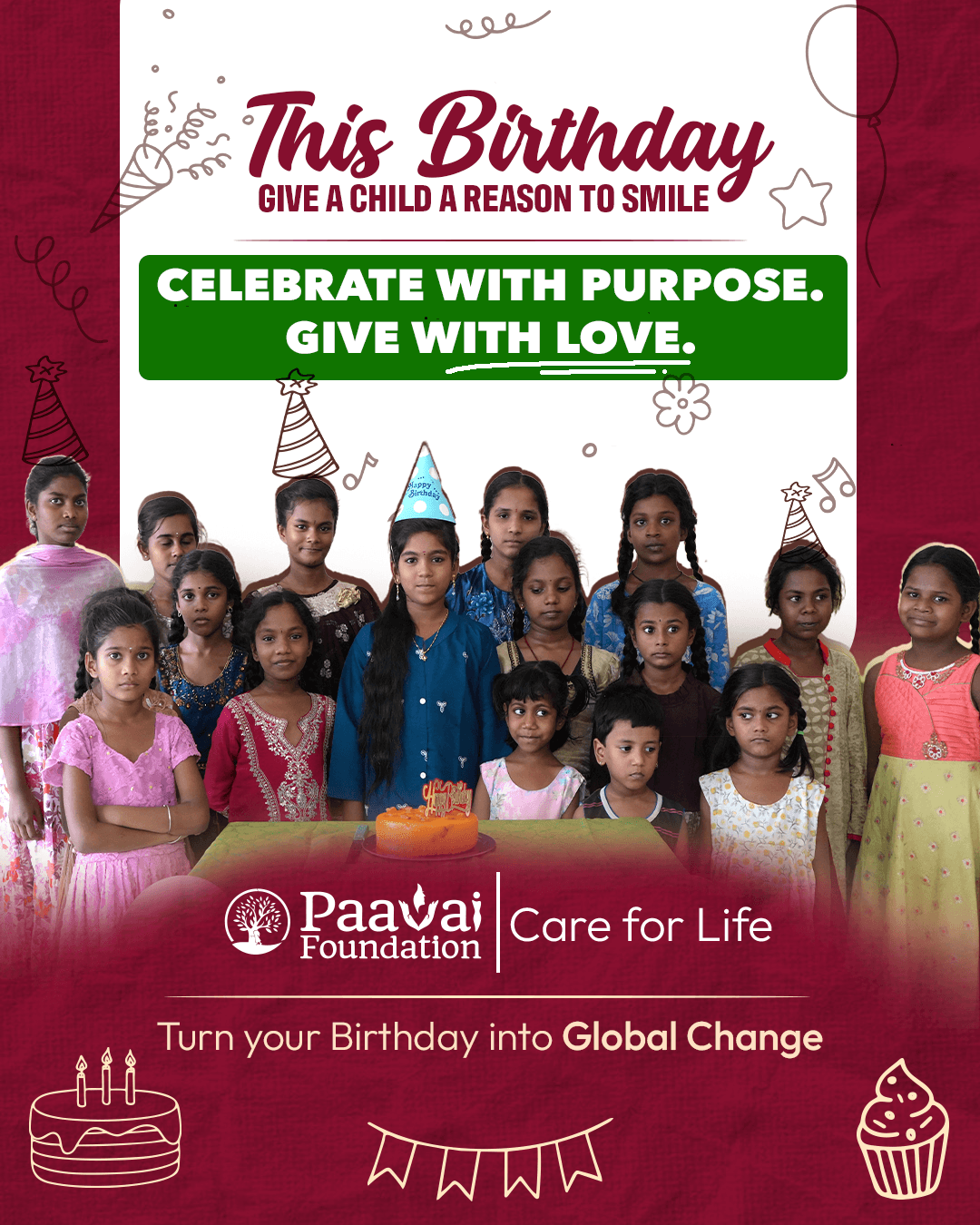
Ready to help a child? Donate now to support child care, education, healthcare, nutrition and disability inclusion programmes.
Prefer to give time or partner with us? Support Paavai to explore volunteering, professional contribution and CSR partnership.
The question worth asking
The best NGO in Chennai, for you, is the one whose work matches what you actually want to change, whose accounts and registration you can verify, whose programmes continue after the photographs are taken, and whose staff can explain their safeguarding arrangements without hesitating.
That will not always be the organisation at the top of a search result. It will be the one that answers your questions properly.
Children in and around Chennai do not need a great deal that is complicated. They need school to stay uninterrupted.
They need someone to notice when they stop attending. They need a health problem addressed before it becomes a reason to drop out.

They need, in the case of children with disabilities, an adult who has been trained to teach them and a system that expects them to learn.
None of that happens automatically. It happens because people decide to fund it, staff it and stay with it.
Care for Life. A Brighter Future for Every Child.
FAQs
How do I choose the best NGO in Chennai for child welfare?
Start by deciding what you want to support: education, healthcare, nutrition, child protection or special education. Then verify registration through the NGO Darpan portal, confirm 80G status if you intend to claim a deduction, ask about programme continuity and child safeguarding policies, and request a visit or a detailed conversation with programme staff.
How can I find an NGO in Chennai for children with disabilities?
Look specifically for organisations with trained special educators, therapy and rehabilitation capacity, individualised learning support and long-term rather than event-based programmes. Ask directly how long they work with each child. Genuine special education work is measured in years.
Are donations to a child NGO in Chennai tax-deductible?
Donations to organisations holding valid registration under Section 80G of the Income-tax Act may qualify for a deduction, subject to conditions and limits. Always ask for the organisation's registration details, verify them on the Income Tax Department portal, and keep the receipt.
Is a monthly donation better than a one-time gift?
Usually, yes. Recurring giving allows an organisation to commit to a child over a full school year rather than a single month, which is what actually changes outcomes.
Can I volunteer instead of donating?
Yes, and professional skills are often scarcer than funds. Teaching, medical, therapy, legal, accounting, design and IT expertise are all valuable to child welfare organisations.
What should a company look for in a CSR partnership?
Multi-year commitment rather than annual grants, clear reporting, alignment between the company's expertise and the programme, and opportunities for employee involvement beyond funding.
Does Paavai Foundation work in Chennai?
Paavai Foundation's documented community development presence covers districts across Tamil Nadu including Tiruchirappalli, Madurai, Namakkal, Krishnagiri and others, with activities extending into Telangana and Andhra Pradesh. Supporters based in Chennai can contribute to programmes running across these districts. For current locations and any Chennai-based activity, contact the Foundation directly.
Where do I start if I want to help but have very little to give?
Small recurring contributions, sharing verified information about entitlements with families who may not know about them, and volunteering a few hours of a professional skill all matter. The barrier to useful contribution is lower than most people assume.