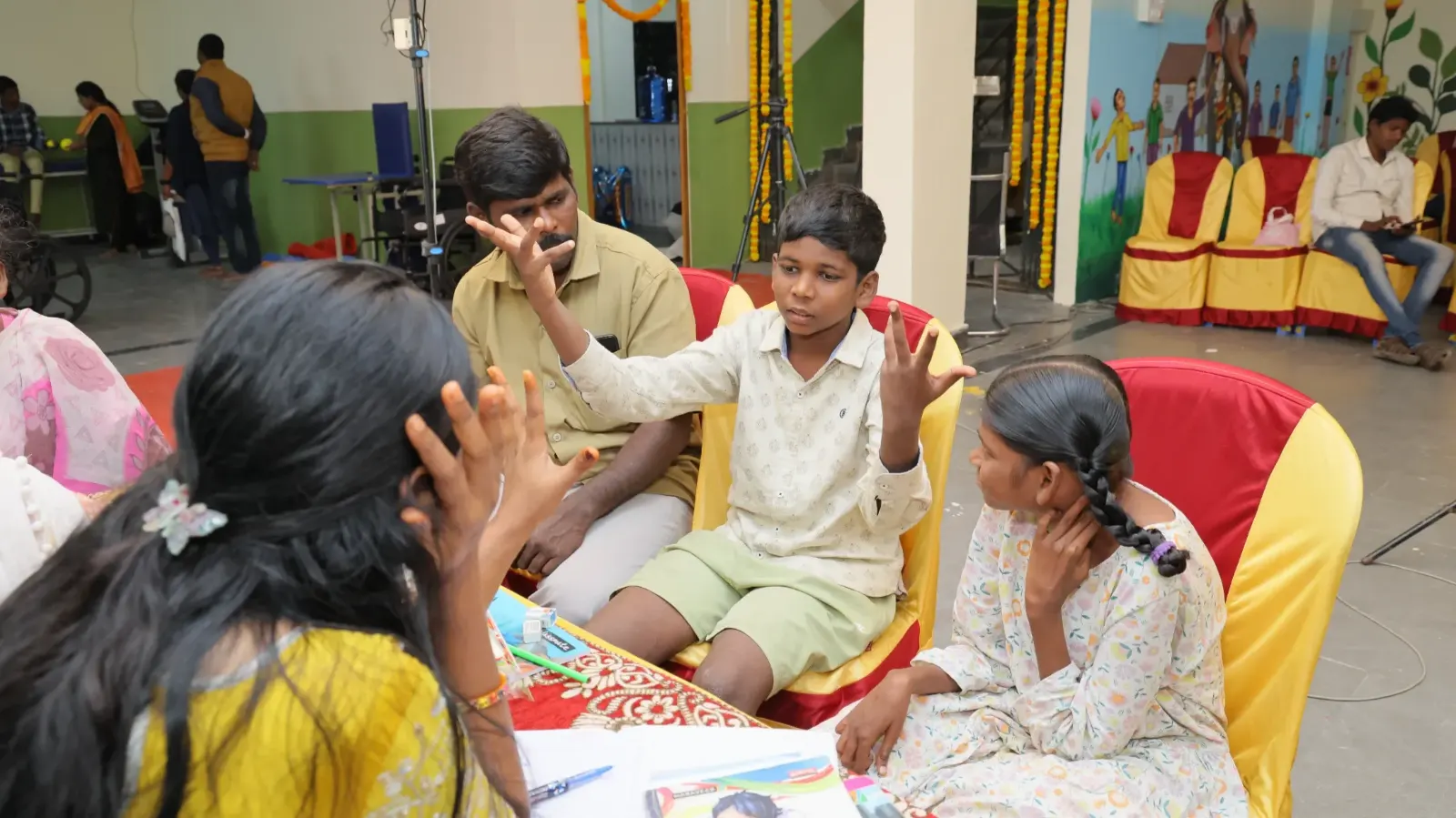
A child points at the door.
Nobody understands.
She points again, then becomes frustrated. Perhaps she pulls an adult towards what she wants. Perhaps she cries. Perhaps, over time, she simply stops trying to explain.
Adults may describe her as quiet. A teacher may say she does not participate. A relative may assume she will speak when she is older.
But there is another possibility that deserves attention:
The child may have something to say. She may simply not have been given a communication system that works for her.
For a deaf child, language is not a luxury added after food, healthcare and education. It is part of how a child learns, forms relationships, expresses needs, develops confidence and participates in the world.
That is why International Day of Sign Languages 2026, observed on 23 September, is about much more than learning a few signs. It raises a deeper question about whether deaf people have meaningful access to language, education, information and human rights.
The United Nations has chosen “Declaring Deaf People’s Human Rights” as the theme for 2026, highlighting the importance of recognising, protecting and promoting sign language rights. The year also marks 20 years since the adoption of the UN Convention on the Rights of Persons with Disabilities and the 75th anniversary of the World Federation of the Deaf.
For children, that conversation begins very early.
When silence is mistaken for absence
A child who does not speak may still be communicating constantly.
A look can mean recognition.
A movement can mean refusal.
A gesture can mean hunger.
A repeated sign can mean a favourite activity.
A facial expression can communicate fear, excitement, discomfort or affection.
The problem is not necessarily that the child has nothing to say.
The problem may be that the people around the child do not yet know how to listen.
This is one of the most important ideas behind sign language inclusion. Communication should not be measured only by whether a child can produce spoken words.
Children communicate in different ways and deaf children may use a national sign language as a primary language.
The United Nations notes that sign languages are equal in status to spoken languages under the Convention on the Rights of Persons with Disabilities and that states have obligations relating to access to sign language and the linguistic identity of Deaf people.

For a child, early access matters because language is connected to much more than conversation.
It is connected to learning.
To asking questions.
To making choices.
To telling an adult that something hurts.
To making friends.
To understanding the world.
And to being understood.
International Day of Sign Languages 2026 is about rights, not just awareness
International days can sometimes become a poster, a social media graphic or a one-day school activity.
Those things can create awareness, but the issue is larger.
The United Nations established 23 September as the International Day of Sign Languages to raise awareness of the importance of sign language in the full realisation of the human rights of deaf people.
The date commemorates the establishment of the World Federation of the Deaf in 1951.
The 2026 theme, “Declaring Deaf People’s Human Rights,” brings the focus back to rights.
That distinction matters.
A child does not need sign language because sign language is fashionable.
A child may need accessible communication because without it, everyday participation can become harder.
Can the child understand what is happening at school?
Can the child communicate with a doctor?
Can the child tell a parent what happened during the day?
Can the child ask for help?
Can the child participate in classroom activities?
Can the child build relationships with other children?
These are not small questions.
They are questions about participation.
Language is part of education
Education is often discussed in terms of classrooms, books, teachers and examinations.
But before a child can fully benefit from education, there has to be a way to understand and express ideas.
This is particularly important for deaf children.
India's Rights of Persons with Disabilities Act, 2016 specifically states that educational institutions funded or recognised by the appropriate government should ensure that education for people who are blind or deaf or both, is provided in appropriate languages and modes and means of communication.
The Act also provides for teacher training, including teachers qualified in sign language and Braille.
That means inclusive education cannot simply mean placing a child with a disability inside a classroom and expecting the same system to work unchanged.
Inclusion requires communication.
It may require trained teachers.
It may require appropriate learning materials.
It may require individualised support.
And it requires an environment in which the child is not treated as a problem for needing a different mode of communication.
Paavai Foundation's existing work on inclusive education and disability support similarly frames inclusion around education, communication, healthcare, life skills, family support and meaningful participation rather than treating disability as a single issue.
The first language should not have to wait
One of the most important questions for families is not simply:
“Will my child ever speak?”
A more useful question can be:
“How can my child communicate now?”
Waiting indefinitely for spoken language can mean waiting for a child to have a way to express basic needs, thoughts and emotions.
This does not mean that spoken language, speech therapy or hearing technologies are irrelevant. Different children have different circumstances, needs and preferences. Families may make different choices based on professional advice, available services and the child's own development.
But communication should not be postponed while everyone waits for one particular outcome.
If a child can communicate through sign language, that communication has value now.
If a child uses speech alongside signs, both forms can have value.
If a child requires another form of augmentative or alternative communication, that communication matters too.
The goal should be meaningful communication and participation, not forcing every child into exactly the same communication pathway.
What happens when communication is missing?
Imagine being unable to tell the people around you that you are hungry.
Or frightened.
Or in pain.
Or being bullied.
Or confused about an instruction.
Now imagine that experience continuing at school, at home and in public spaces.
For a young child, repeated communication failure can affect participation and confidence.
Adults may interpret frustration as difficult behaviour.
A child who does not respond may be described as inattentive.
A child who avoids classroom interaction may be considered shy.
A child who struggles to follow spoken instructions may appear academically weak.
But without understanding the communication barrier, it is easy to misunderstand the child.
This is why deaf education cannot be separated from language access.
The question is not only whether a child is present in school.
It is whether the child can actually participate.
Indian Sign Language belongs in the conversation
India has its own recognised national sign language resource ecosystem.
The Department of Empowerment of Persons with Disabilities provides access to the Indian Sign Language Dictionary and information related to services for people with hearing and speech impairments. Its website also lists resources such as the Indian Sign Language Research and Training Centre and the Indian Sign Language Dictionary.
This matters because accessibility is not only about translating spoken words into gestures.
Languages have structure, vocabulary and cultural identity.
A child who uses Indian Sign Language is not simply using a collection of hand movements. Sign language can be a genuine linguistic pathway through which the child understands and expresses the world.
For parents, teachers and communities, learning even basic communication can be meaningful.
But the larger goal should be to build environments where children are not constantly forced to bridge the communication gap alone.
The classroom has to change too
Imagine a teacher explaining a lesson while a deaf child sits in the room but cannot access the explanation.
Physically, the child is present.
Educationally, the child may still be excluded.
Inclusive classrooms need to consider how information reaches different learners.
For deaf students, depending on their individual needs and educational setting, this may involve:
Teachers trained in sign language
Sign language interpretation where appropriate
Visual learning materials
Accessible videos and captions
Clear classroom communication
Appropriate assistive technologies
Peer awareness and inclusion
Individualised educational support
The Rights of Persons with Disabilities Act also places responsibilities on educational institutions concerning reasonable accommodation, accessibility and support for students with disabilities.
The principle is simple:
A child should not have to earn access by becoming more like everyone else.
The environment should become more accessible.
Parents need support too
A child's communication journey does not happen only at school.
It happens at breakfast.
On the way to school.
During homework.
At the doctor's office.
At family gatherings.
While playing.
Before sleeping.
If parents and siblings cannot communicate effectively with a deaf child, the child can become isolated even inside a loving family.
That is why family education matters.
Parents may need support to understand:
How their child communicates
How to learn basic signs
How to make everyday routines accessible
How to communicate with teachers
How to advocate for educational support
How to encourage social interaction
How to protect the child's dignity and independence
Siblings matter too.
A brother or sister who knows how to communicate with the child can become one of the most important people in that child's everyday world.
Inclusion often begins at home before it reaches the classroom.
Don't make the child responsible for everyone's accessibility
There is a subtle problem in the way disability is sometimes discussed.
The child is asked to adapt.
Learn to speak.
Learn to read lips.
Learn to cope.
Learn to fit in.
But accessibility is a shared responsibility.
A classroom can learn signs.
A family can learn to communicate.
A school can provide appropriate support.
A community can become more aware.
Public services can improve accessibility.
Technology can be designed with communication needs in mind.
The responsibility should not fall entirely on the child.
The purpose of inclusion is to reduce the barriers surrounding a person, not simply to train the person to tolerate those barriers.
What can communities do?
Sign language inclusion does not have to remain a specialist subject.
Communities can begin with practical steps.
Schools can introduce age-appropriate awareness about Deaf culture and sign languages.

Teachers can learn basic signs and understand accessible communication practices.
Community organisations can organise sign language awareness sessions.
Public events can include accessible communication.
Digital content can use captions and accessible formats.
Families can encourage children to interact naturally with deaf peers rather than treating disability as something uncomfortable to discuss.
Even learning a simple greeting can change a social interaction.
But awareness should not stop at learning a few signs for one day.
The more important question is whether accessibility continues after the awareness campaign ends.
Why disability inclusion belongs inside child development
Child development is often divided into categories.
Education.
Health.
Nutrition.
Protection.
Skills.
Disability.
But children do not experience their lives in categories.
A deaf child needs education.
The child needs healthcare.
The child needs safety.
The child needs friendships.
The child needs family relationships.
The child needs opportunities to play.
The child needs confidence.
And the child needs a way to communicate.
That is why disability inclusion should be part of wider child development rather than treated as a separate subject that only specialists need to understand.
Paavai Foundation's broader child-development approach brings together care, education, healthcare, disability inclusion and community support. Its work through Paavai ID Care is specifically described as supporting children with intellectual disabilities through areas including special education, assisted learning, therapy, rehabilitation, healthcare, emotional support, life skills and assisted independence.
Its recent work on special educators and children with disabilities also highlights an important point: progress cannot always be measured through conventional academic milestones.
For one child, progress may be a new academic skill.
For another, it may be greater independence.
For another, it may be finding a reliable way to communicate.
All of those forms of progress deserve recognition.
A child should be heard before they are judged
When a child cannot communicate easily, adults can fill the silence with assumptions.
“She doesn't understand.”
“He isn't interested.”
“She is difficult.”
“He doesn't want to participate.”
Sometimes the more useful question is:
“Have we given this child a way to participate?”
That change in question can alter everything.
Instead of asking why a child is not speaking, we can ask how the child communicates.
Instead of asking why a child is not participating, we can ask what barrier is preventing participation.
Instead of asking what the child cannot do, we can ask what support would allow the child to do more.
This is not about lowering expectations.
It is about making expectations fair.
What International Day of Sign Languages 2026 should leave us thinking about
On 23 September, campaigns around the world will talk about sign languages.
Some will teach signs.
Some will organise events.
Some will share stories.
Some will discuss Deaf culture and human rights.
All of these can have value.
But the deeper purpose is to think about what happens on the other 364 days.
Does a deaf child have a language they can use confidently?
Can they communicate with their family?
Can they access education?
Can they tell someone when they are afraid?
Can they participate in play?
Can they ask questions?
Can they imagine a future without communication barriers deciding what is possible?
The United Nations' 2026 theme, “Declaring Deaf People’s Human Rights,” makes the message particularly clear: sign language access is connected to the full enjoyment of human rights, not simply to awareness.
For children, that right begins with something incredibly basic.
Being able to say:
I am hungry.
I am scared.
I want this.
I don't understand.
I am happy.
Look at me.
Listen to me.
A child does not become less deserving of being heard because they communicate differently.
Sometimes, the child already has the words.
We just need to learn how to hear them.
How families and communities can support deaf children
There is no single pathway that works for every child, but families and communities can begin with a few principles:
Seek appropriate professional assessment and early support when a hearing or communication concern is identified.
Learn the child's preferred and accessible forms of communication.
Encourage communication rather than waiting for speech alone.
Work with teachers to understand the child's educational needs.
Make family routines accessible and inclusive.
Encourage friendships and participation rather than isolation.
Learn about disability rights and available government resources.
Use accessible digital content, including captions and visual communication.
Treat the child as an individual with abilities, preferences and aspirations.
Protect the child's dignity by avoiding language that defines them only by disability.
The Department of Empowerment of Persons with Disabilities maintains official information on disability legislation, schemes, services and accessibility resources in India.
Families can also explore the Rights of Persons with Disabilities Act, 2016 and its provisions on inclusive education to understand the broader legal framework around accessibility and education.
Building a world where every child can communicate
A truly inclusive society is not one where every child communicates in the same way.
It is one where different ways of communicating are respected.
Where a deaf child can enter a classroom without being treated as an inconvenience.
Where parents are supported rather than left to figure everything out alone.
Where teachers have the tools and training to teach diverse learners.
Where communities understand that inclusion is not charity.
And where a child's future is not limited by whether the people around them know how to listen.
At Paavai Foundation, this connects with a wider belief in integrated child development: care, education, health, inclusion and opportunity must work together if children are to grow with dignity.
Its disability-focused work through Paavai ID Care reflects that approach by supporting children with intellectual disabilities through structured care, education, development and opportunities for greater participation.
International Day of Sign Languages 2026 gives us a reason to pause.
But the real measure of inclusion will not be what happens on 23 September.
It will be what happens on 24 September.
And the day after that.
When a child reaches for a way to communicate, will someone be there who understands?
Because every child deserves more than a voice.