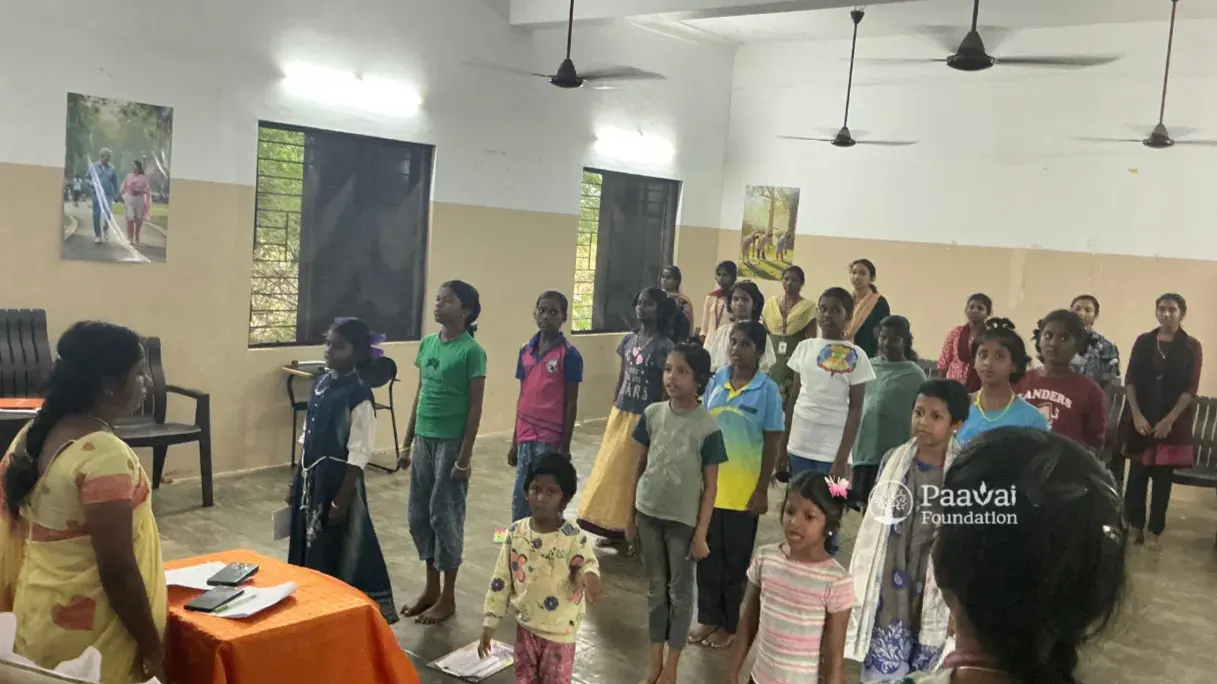
The question people ask about a girls' children's home is almost always the same one, and it is about safety.
Is she safe? Is the gate locked? Is someone watching?
Those are the right questions and the answer has to be yes before anything else matters. But safety is the floor of what a children's home is for, not the ceiling, and a home that provides nothing beyond it has given a girl a protected place to wait until she is eighteen.
What a girl actually needs, over the ten or twelve years she may live in one, is harder to describe and considerably harder to deliver. She needs to arrive somewhere frightened and leave able to speak for herself. She needs to stop checking every adult's face for signs of what is coming. She needs to find out what she is good at, something, and have someone notice. She needs to reach eighteen with an opinion about her own life.
That is what this article is about: not the walls, but what happens inside them over years.
A note before you read on: this article describes how residential care for girls is designed to work and what good practice looks like. It contains no individual residents' stories or identifying details, deliberately. Children in care have a right to privacy that fundraising frequently overrides.
Why girls arrive, and why it matters
A girls' care home in India is not primarily a home for girls with no families.
A substantial proportion of children in Indian institutions have at least one living parent. Girls come into care because a household could not manage poverty, a parent's illness or death, migration for work, a disability in the family, a crisis that left nobody able to cope or following an order where there were safety concerns at home.
Some have mothers who visit. Some will return home. Some will not.
This matters for how a home is run, because the staff of a girls' home are not replacing families. They are holding something steady while a family's circumstances are difficult, and sometimes permanently. A home that understands this keeps families in the picture wherever it is safe to do so. A home that positions itself as a rescue from bad families gets the relationship wrong and puts the girl in the impossible position of choosing.
It also matters for how visitors and donors should talk about residents. Calling a girl an orphan in front of her, when she has a mother, is a cruelty nobody intends.
What the first months are actually like
Adults tend to imagine arrival at a children's home as relief. For most girls it is not, at least not initially.
She has left everything familiar at once: her home, her street, her school, her language sometimes, the people who knew her. Whatever she left may have been difficult, and it was still hers.
What staff in good homes watch for in the early period is not distress, which is expected, but the quieter things. A girl who is extremely well behaved.
A girl who gives her belongings away. A girl who reads every adult in the room continuously, because reading adults accurately was once how she stayed safe. A girl who has already worked out which staff member is leaving and started withdrawing in advance.
None of that is a behaviour problem. All of it is a child managing a situation with the tools she has.
What helps is unspectacular: a predictable routine, honest age-appropriate answers about why she is there, the same adults appearing day after day, and nobody demanding gratitude.
A girl who has lost enough people needs to test whether this set of adults will also go, and that testing is the work. Homes with high staff turnover fail that test repeatedly.
The emotional reality underneath this is described in more detail in World Mental Health Day 2026: The Emotional Lives of Children Growing Up in Care.
The four things a girls' home is built on
At our Trichy campus, the girls' home is designed around four commitments safe and nurturing residential care, continuous education and personal development, emotional support and mentorship, and encouragement to build identity and self-belief.
Those are easy to state and the detail is where they live or die.
Safe and nurturing residential care
Physical safety is the baseline: secure premises, supervision including at night, screened staff, a written child protection policy, a reporting procedure every adult knows, and controlled access so residents are not available to visitors.
Psychological safety is the part that takes longer. It means a girl can make a mistake without fearing what follows. It means her belongings are hers. It means she is not spoken about in the third person while standing there.
It means she has some privacy, which is genuinely difficult in a shared living environment and matters more than most adults assume ordinary childhood privacy is a drawer nobody opens and a bad mood nobody examines, and its absence is corrosive.
Continuous education and personal development
The word that matters is continuous.
Girls who enter care have usually had their schooling interrupted, sometimes repeatedly. A child who left and returned three times has not had three years of education; she has had three beginnings.
The work is less about enrolment than about catching up, holding steady, and not losing her again at the transitions where girls are most likely to drop out the move to secondary school, and the move to Class 11.
In practice: school attendance is protected as non-negotiable, academic support for the gaps, materials and exam preparation, and someone who notices in week one rather than month three when a girl stops engaging.
The broader case for why interruption rather than ability ends most girls' education is set out in International Day of the Girl Child 2026: Empowering Girls, Building a Better Future.
Emotional support and mentorship
This is the component most residential care in India is weakest on, because it is invisible, unfundable and slow.
What it means concretely: adults who know each girl individually rather than managing a group, someone she can talk to who is not the person who disciplines her, attention to the quiet girls rather than only the difficult ones, and recognition that a sudden change in behaviour is communication rather than defiance.

It also means knowing that distress in a girl who cannot articulate it often presents physically recurring stomach aches, headaches, sleep problems and that the medical answer is not always the whole answer.
Identity and self-belief
The hardest to deliver and the one that determines what happens after eighteen.
A girl in institutional care is at risk of acquiring a single identity: the girl from the home. School classmates know. Teachers lower expectations. The community sees a category.
The counterweight is giving her something else to be. Something she is good at sport, music, drawing, a subject, a skill, a responsibility and an adult who notices it specifically rather than praising her generally.
Responsibility matters here too: a girl who is trusted with something real learns something about herself that no encouragement delivers.
What confidence actually looks like
Confidence is a word used loosely in this sector, usually to mean a girl who performs well in front of visitors.
The practical markers are different and less photogenic:
She disagrees with an adult. Respectfully, but she does it. A girl who never contradicts anyone has learned compliance, not confidence, and compliance is what a vulnerable child defaults to.
She asks for something she needs. Medical attention, help with a subject, a problem with another resident. Asking requires believing the request will be received.
She tries something she might fail at. The willingness to be visibly bad at something new is one of the clearest indicators that a child feels secure.
She has an opinion about her own future, a subject she wants to study, work she wants to do rather than waiting to be told.
She reports a concern. This is the most important and the hardest to build. A girl who will tell an adult that something is wrong, including about another adult, is a girl in a home where safeguarding actually functions. No written policy achieves this on its own.
Life skills for girls in residential settings should be judged against these, not against how well a group can sing for a donor.
Why elders are in the building
One feature of the Trichy campus is worth drawing out, because it addresses something institutional care is structurally short of.
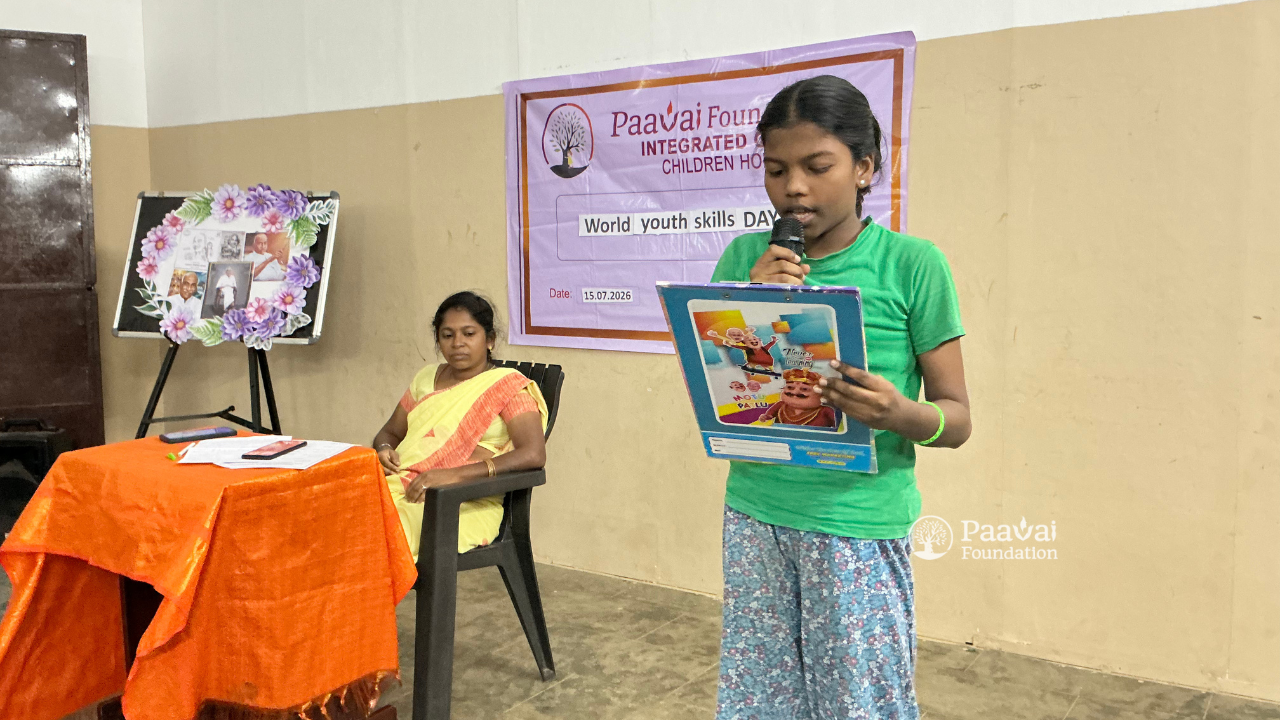
The campus brings together the children's homes and Anbucholai, the centre for senior citizens, in a single integrated environment with children and elders living on the same campus, with natural interaction between them rather than separate services running in parallel.
For a girl in care, the usual adult relationships are staff relationships. Paid, rota'd, time-limited, subject to someone's employment. That is not a criticism of staff; it is the structure.
An elder on the same campus is something different: an adult relationship that is not a job. Someone with time, no shift ending, no file on her, and no professional reason to be interested.
Children who spend time with people four generations older absorb, without anyone announcing it, that they belong to something longer than themselves and elders gain purpose from being needed rather than cared for.
The reasoning behind treating elders as contributors rather than recipients is set out in Anbucholai Elderly Care: Honoring Elders as Mentors, Preserving Dignity Across Generations.
Eighteen
Every girls' home is working towards a date it cannot change.
A girl leaving care loses, simultaneously, the place she lived, the adults she knew and the peers she grew up with. She has no household to return to on a bad month, no family to fund a course, nobody to call when a job falls through or a rental agreement needs explaining.
For a young woman specifically, the exposure is sharper housing, safety, pressure around marriage, and the absence of a family position from which to refuse anything.
Which means the years before eighteen are not simply years of care. They are preparation: completed education, a documented identity, bank access, a vocational direction, practical life skills, and ideally relationships that continue past the gate.
After-care provisions exist within the statutory framework and implementation varies, so the serious work is what a home does on its own account over the preceding decade.
A girls' home that treats eighteen as the end of its responsibility has not finished the job.
How to support a girls' home responsibly
Four things, and the first is the one most donors get wrong.
Give to the institution, not to the girls. Funds to the organisation, allocated where needed. Not gifts, sweets or cash handed to individual residents, which creates comparison within a group and bypasses the dietary and medical considerations staff manage.
Give regularly. A modest monthly contribution is worth more than a larger one-off, because it allows the home to commit to a girl for a full school year rather than fund isolated activity. Predictability on your side is what makes continuity possible on hers.
Fund the invisible things. Donors reliably offer uniforms, notebooks and food. Homes also need trained staff, transport, counselling, electricity, maintenance and audit. The things nobody offers to pay for are the things that hold everything else together.
And do not arrange a visit to meet the children. Visits where strangers come to spend time with residents and take photographs serve the visitors, not the girls, and a well-run home will decline.
If you are a prospective donor or partner who wants to see the work, that is a different and welcome request: arrange it in advance, expect to meet the administrator rather than the children, and expect to be screened. What to expect is covered in Visiting a Children's Home in Trichy for the First Time: What to Expect.
Before giving to any organisation, verify registration independently through the government's NGO Darpan portal, confirm 80G status if you intend to claim a deduction, and ask about child protection arrangements directly.
Where our work sits
The girls' children's home in Tiruchirappalli forms part of Paavai Foundation's Trichy campus, an integrated environment bringing together a children's home for girls, a children's home for boys, and Anbucholai for senior citizens on one campus.
The girls' home is built on the four commitments described above: safe and nurturing residential care, continuous education and personal development, emotional support and mentorship, and encouragement to build identity and self-belief.
The intention is a girl who grows with confidence, clarity and courage which is a statement of purpose rather than a claim about every outcome.
Our wider work spans child protection and care, education, health and wellness, nutrition, disability inclusion, youth leadership, elderly care and community development across South India, organised around a four-stage model: CARE, EDUCATE, EMPOWER, LEAD. The fourth stage exists because the first three are not the destination.
Statutory frameworks and child protection services are described by the Ministry of Women and Child Development, and concerns about any child or institution can be raised with the National Commission for Protection of Child Rights or the child helpline 1098.
Donate now to support residential care, education, emotional support and life skills work for girls and children across South India ideally as a monthly contribution rather than a one-time gift.
What she takes with her
A girl who has lived in a home for a decade leaves with the things everyone counts: a school certificate, a vocational direction, documents, a bank account.
She also leaves with things nobody records. Whether she believes an adult will listen when she says something is wrong. Whether she can ask for help without rehearsing it first.
Whether she has ever been good at something in front of people. Whether anyone stayed long enough to still be there on the day she walked out.
Those are not produced by a building, a donation drive or an afternoon with visitors. They are produced by the same adults turning up for years, noticing the quiet ones, holding a routine steady through the months when a girl is testing whether they will leave too, and treating her as a person with opinions rather than a child to be managed until eighteen.
That work is slow, unglamorous and almost impossible to photograph.
It is also the entire job.
FAQs
What is a girls' children home?
A residential facility providing care, protection, education and support for girls who cannot live with their families. Under the Juvenile Justice framework these are Child Care Institutions, housing children in need of care and protection.
Are all girls in a children's home orphans?
No. A substantial proportion have at least one living parent and are in care because of poverty, parental illness or death, migration, disability in the household, or an order following safety concerns. Many have families who visit, and some return home.
What does a girls' home provide beyond food and shelter?
Good residential care provides continuous education and academic support, emotional support and mentorship, life skills and responsibility, health monitoring, and deliberate work on identity and self-belief so that a girl has an identity beyond her circumstances.
How do you build confidence in girls in residential care?
Through consistency and opportunity rather than encouragement alone. The practical markers are a girl who will disagree with an adult, ask for what she needs, try something she might fail at, hold an opinion about her own future, and report a concern.
What happens when a girl turns 18?
She loses her residence, the adults she knew and her peer group at once, usually without a household to fall back on. The preceding years should therefore be preparation completed education, documentation, bank access, vocational direction and life skills rather than care that simply stops.
Can I visit a girls' home?
Casual visits to meet children are generally declined, and that reflects good safeguarding. Prospective donors, partners and skilled volunteers can usually arrange a visit in advance, meeting the administrator rather than the residents, with screening expected.
What is the best way to support a girls' home?
Regular contributions to the institution rather than items to individual girls, unrestricted where possible so staff, transport and counselling can be funded, and sustained over years rather than given once.
Why are elders present on the campus?
The Trichy campus brings children and senior citizens together in one integrated environment. For girls in care, elders offer an adult relationship that is not a staff role, not rota'd, not time-limited which is something institutional settings are otherwise short of.

Comments
Loading comments...
Leave a comment
Your email address will not be published. Only your name is shown with your comment.