Nobody in the village decided that Lakshmi should stop going to school.
There was no family meeting, no declaration, no moment anyone would recognise as a decision. What happened was that the secondary school was in the next town, the bus stopped running reliably after the monsoon damaged the road, her grandmother's health declined in February, her mother started a second shift of work, and somebody had to be at home. Each of those was temporary. Together they produced three weeks of absence, then a term, then the quiet understanding that she would not be going back.
Ask anyone in that household whether girls should be educated and they will say yes, and mean it.
This is the thing most writing about girls' education in India gets wrong. It frames the problem as a battle of attitudes, which is a battle that has substantially shifted. Enrolment of girls in primary education is now broadly comparable to boys across much of the country, and the proposition that daughters should be educated is no longer a minority view in most places.
The problem has moved. It is now a problem of logistics, safety, distance, water, timing and household economics and the reason it persists is precisely that none of those look like discrimination. They look like circumstances.
What the day marks
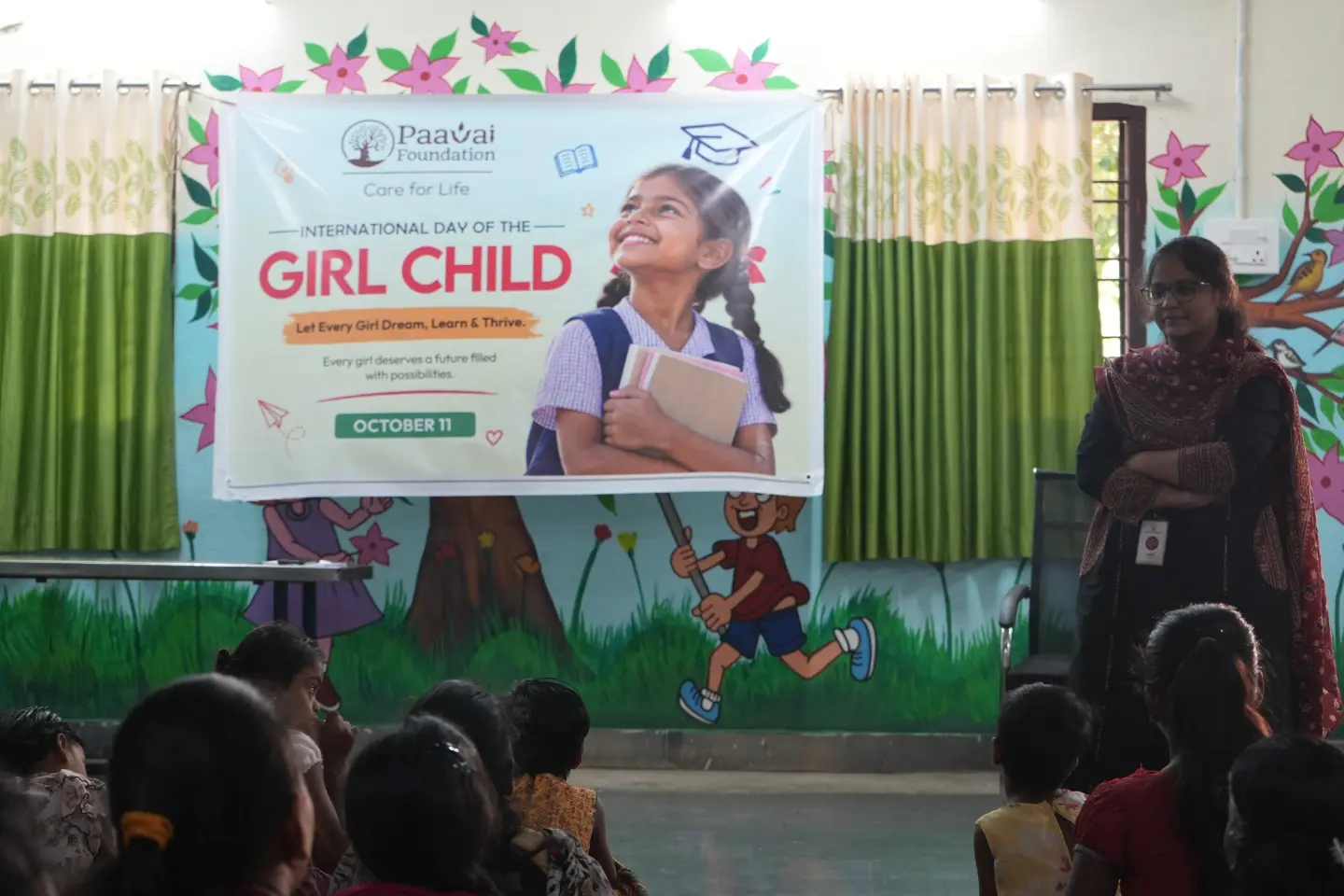
International Day of the Girl Child 2026 falls on Sunday, 11 October. The date is fixed at 11 October each year, following a United Nations General Assembly resolution in 2011 that established the observance from 2012 onwards, recognising girls' rights and the distinct challenges they face worldwide.
The UN announces a theme each year, published on the United Nations observance page along with campaign materials. In India, 11 October sits close to National Girl Child Day on 24 January, which is a separate domestic observance, so a school planning its calendar should treat them as two distinct dates with two different framings.
Where girls are actually lost
Follow the pipeline rather than the rhetoric, and the attrition has a shape.
Primary education is largely solved on paper. Girls enrol. Schemes support them. The village has a school.
The first fracture is the secondary transition. Primary schools are local; secondary schools frequently are not. The moment a girl's education requires travel, a cluster of considerations activates that did not exist before: the cost of transport, the safety of the route, the time of return, the acceptability of a daughter travelling alone, and the family's calculation about whether it is worth it. For boys, that cluster activates with far less force.
The second fracture is Class 10 to 12. Fewer institutions, longer distances, higher costs, and an age at which marriage enters the conversation in some families and household responsibility enters it in nearly all.
The third is after schooling. A girl who completes Class 12 and then has no access to further education or work frequently finds the achievement does not convert into anything, which affects how the next daughter in the family is treated.
At each fracture the deciding factor is rarely a stated belief about girls. It is distance, money, safety or an unplanned household crisis and crucially, in a household under pressure, the girl's education is the variable that flexes. Her brother's generally does not. That asymmetry is the discrimination, and it operates without anyone articulating it.
The barriers nobody calls barriers
Distance. This is the single most underestimated factor. A school three kilometres away and a school nine kilometres away are different propositions entirely for a family with a daughter, and the second one quietly ends more girls' education than any stated prejudice.
The toilet. A school without a functioning, private, water-supplied girls' toilet is a school a girl stops attending for several days each month once she reaches puberty. Missed days become falling behind, which becomes a reason to stop. Sanitation infrastructure is a girls' education intervention, and it is almost never described as one.
Menstrual management. Lack of products, lack of a private place to change, lack of disposal, and a culture of silence that makes asking for help impossible. Four or five days a month, multiplied across years, compounds into significant lost learning.
Water collection. Where water is distant, collection falls disproportionately to women and girls, and it happens on a schedule set by the water rather than by the school.
Care work. A sick grandmother, a disabled sibling, a mother working a double shift. The household's care deficit is absorbed by whoever is available and female, and that is usually the eldest daughter.
Safety on the route. Harassment on a road or a bus is sufficient on its own, and families are frequently right to be concerned. The intervention here is not advising girls to be careful. It is making the route safe.
Timing. Classes, coaching and school events scheduled without regard to when a girl can safely travel home effectively exclude her.
Documentation. Missing birth certificates, Aadhaar linkage problems and transfer certificates that were never issued block admissions and scholarships. This affects boys too, but girls in households under pressure are less likely to have someone pursue the paperwork on their behalf.
Every item on that list is fixable, and most are fixable locally. None of them require changing anyone's mind about whether girls deserve education.
What education actually changes
The case for girls' education is usually made in terms that are true but abstract. The specific mechanisms are more persuasive.
Age at marriage. Years of schooling is among the most consistent predictors of later marriage. A girl in school at sixteen is a girl who is not married at sixteen, and the school is doing that work simply by continuing to exist in her life.
Maternal and child health. Educated mothers have measurably better maternal and child health outcomes, including on immunisation, nutrition and healthcare-seeking. Some of this is literacy; much of it is confidence in dealing with institutions.
Household negotiating position. A woman who earns, or who could earn, has a different standing in decisions about money, children and her own healthcare.
Nutritional transmission. This connects to something covered elsewhere on this site: a malnourished adolescent girl becomes a nutritionally depleted young mother, and her child's lifelong metabolic and cardiovascular risk is partly determined before birth. Nutrition and education for adolescent girls is intergenerational health work, operating on a forty-year horizon.
What the next generation assumes. A village where one girl completed Class 12 is a village where the calculation changes for every family behind her. This is the slowest effect and probably the largest.
Information on national schemes for girls and women is published by the Ministry of Women and Child Development, and school education programmes by the Department of School Education and Literacy.
Three distinctions worth making
Empowerment is not motivation. A great deal of girls' programming consists of telling girls they can do anything. Girls generally know this already.
What they lack is a bus, a toilet, a scholarship and a household that can absorb a crisis without withdrawing them. Inspirational messaging aimed at girls places the responsibility on the person with the least power to change the situation.

Girls are not a homogeneous category. A girl with a disability faces compounded exclusion of all children out of school, girls with disabilities are among the least likely to be enrolled anywhere.
A girl in a tribal hamlet, a migrant household, or a family in a resettlement colony faces specific barriers that a general programme will miss entirely. A programme reaching accessible villages will reach the girls who were least at risk.
Boys are part of the solution, not the opposition. Programmes that work exclusively with girls sometimes produce young women with raised expectations entering households and communities that have changed not at all.
Work with boys, fathers, brothers and male teachers determines whether a girl's education converts into an actual change in her life.
What actually works
Patterns from effective programming, none of them dramatic.
Remove the specific obstacle. Transport. A functioning toilet. A hostel near the secondary school. Menstrual products and a private place to use them. These are unglamorous, cheap relative to their effect, and they outperform awareness campaigns consistently.
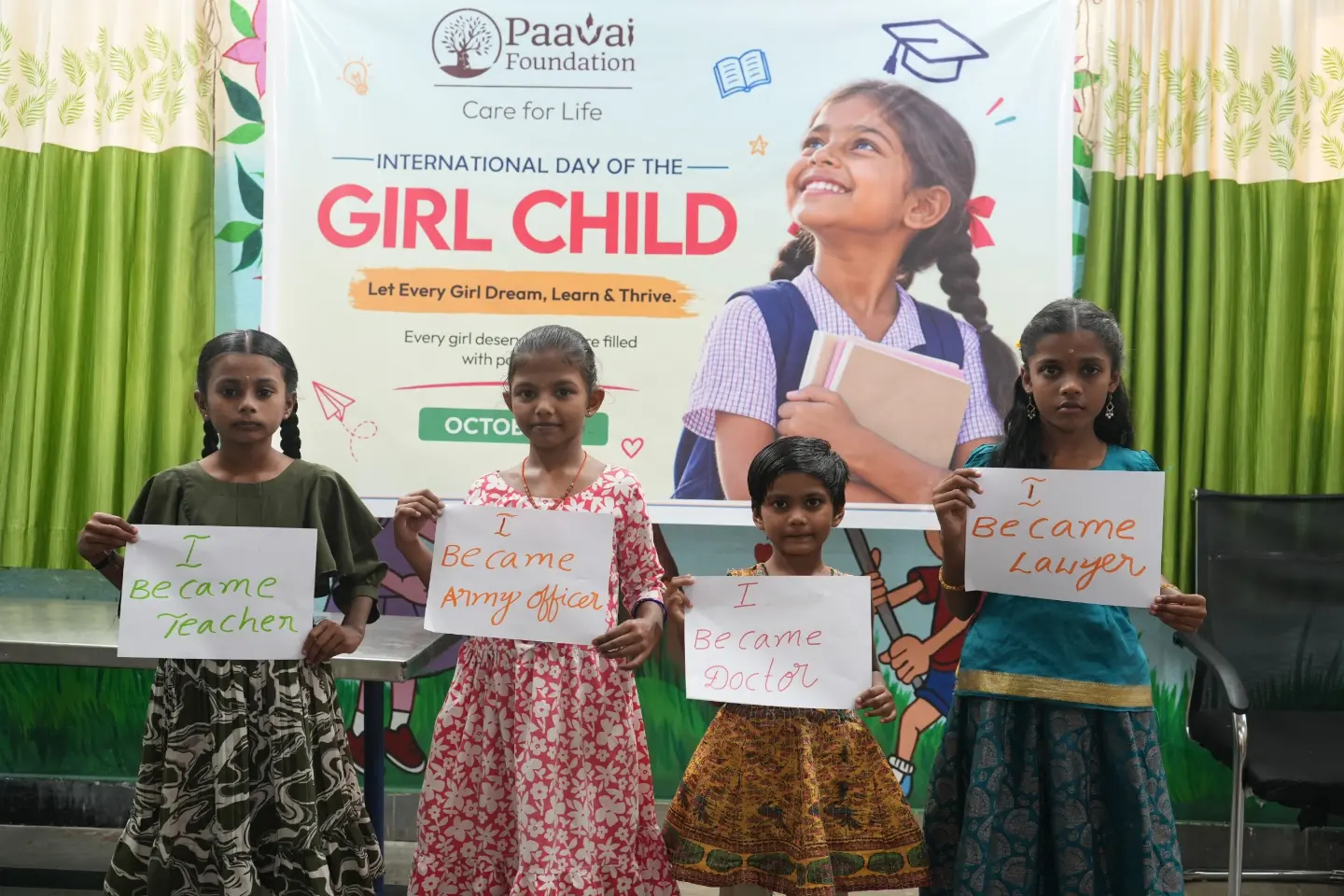
Track individual girls. Programmes that follow named girls and notice absence in week one do far better than those measuring aggregate enrolment. The decisive intervention is usually a conversation with a household in the first fortnight of a girl's absence, before leaving school has hardened into a settled fact.
Support the household, not only the girl. The reason she left is usually a household event. A programme that can respond to that event connecting the family to an entitlement, helping with a medical cost, arranging support for a dependent relative keeps more girls in school than one addressing only the girl.
Target the transitions. Resources concentrated at the Class 5 to 6 and Class 10 to 11 transitions are more effective than resources spread evenly, because that is where the attrition is.
Build a visible pathway. A girl who can see a woman from her own community working as a teacher, nurse or technician is answering the question "and then what?" that keeps many families from investing in a daughter's education.
Stay for years. This is the one that cannot be shortcut. The girls at highest risk are at risk repeatedly, and what keeps them in school is an organisation still present in the year the crisis arrives.
Where our work sits
At Paavai Foundation, work with girls is organised around our four-stage model CARE, EDUCATE, EMPOWER, LEAD on the reasoning that empowerment is a sequence rather than a message, and that a girl who has not had safety and stability established first cannot use anything offered afterwards.
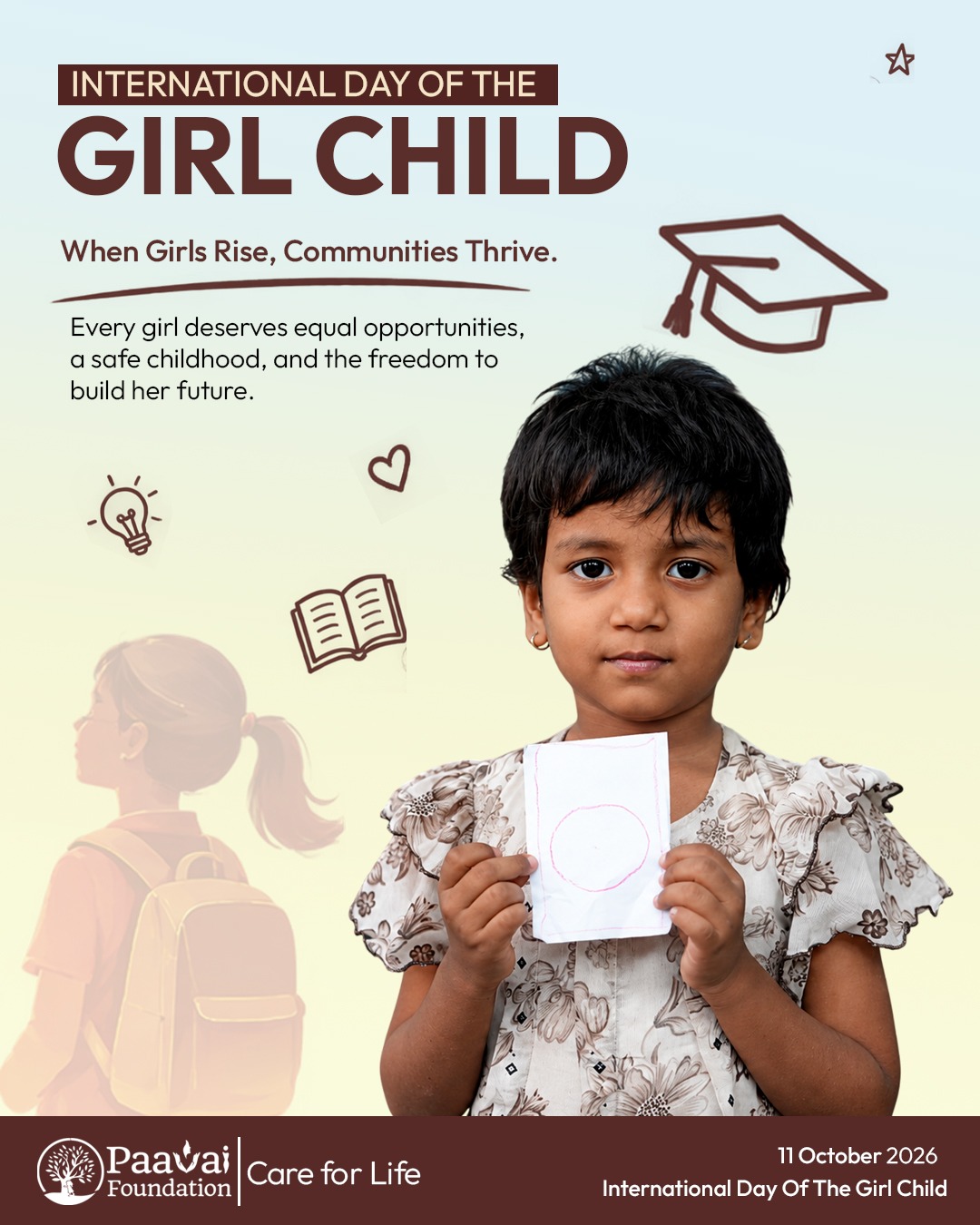
Paavai Shishumithra, our girl child development initiative, works on that progression directly. Paavai Gurukul, our education initiative, is built around a related premise: that what breaks a vulnerable child's schooling is usually not a lack of ability but repeated interruption, and that a child who leaves and returns three times has received three beginnings rather than three years.
One design feature is worth drawing out, because it addresses something in this article. Our elderly care work positions elders as mentors and storytellers within girl development programming rather than as a separate group receiving assistance, which creates the consistent adult relationships that girls under pressure most often lack people who are present, unpaid, unhurried and not leaving at the end of a project cycle.
The reasoning is set out in Anbucholai Elderly Care: Honoring Elders as Mentors, Preserving Dignity Across Generations.
Our work spans districts in Tamil Nadu with presence extending into Telangana and Andhra Pradesh, held together by the Paavai Community Connect 360 framework, within which a dedicated pathway focuses on women's empowerment and equality.
We publish what we can substantiate and decline to publish what we cannot, which is why this article contains no retention figures for our own programmes.
Donate now to support girl child development, education and community work across Tamil Nadu.
The decision nobody made
Return to Lakshmi.
There is a version of this article that would end by calling for a change in how society values daughters. That change is real, it is necessary, and it is also already further along than the commentary suggests. Her family valued her education. They said so, and they meant it.
What they did not have was a bus that ran in October, a secondary school within walking distance, anyone else to care for her grandmother, or an organisation that noticed in week two that she had stopped coming and asked why.
Every one of those is purchasable. None of them require anyone to be persuaded of anything.
That is the more hopeful reading of where India stands on girls' education, and also the more demanding one. When the barrier was belief, the work was argument. Now that the barrier is largely logistics, the work is money, infrastructure, attention and the patience to stay present through the years when a household's circumstances turn.
On International Day of the Girl Child 2026, the most useful question is not whether girls should be educated. It is which specific, boring, solvable obstacle stands between one girl you could name and the classroom she was in last year.
Then go and remove it.
Care for Life.
FAQs
When is International Day of the Girl Child 2026?
It falls on Sunday, 11 October 2026. The date is 11 October every year, established by a United Nations General Assembly resolution in 2011 and first observed in 2012.
Is International Day of the Girl Child the same as National Girl Child Day?
No. International Day of the Girl Child is observed on 11 October. India's National Girl Child Day is a separate observance on 24 January.
What is the theme for 2026?
The United Nations announces a theme each year, usually shortly before the date, published on its official observance page along with campaign materials.
Why do girls drop out of school in India?
Rarely because a family opposes educating daughters. More commonly because of distance to secondary school, transport cost and safety, lack of a functioning girls' toilet, menstrual management difficulties, household care responsibilities during a family crisis, and documentation problems blocking admissions or scholarships.
At what stage are girls most likely to leave school?
At transitions. The move from primary to secondary school, when education starts requiring travel, and the move from Class 10 to Class 11 or 12, when institutions are fewer and distances longer.
Why do school toilets matter for girls' education?
A school without a functioning, private, water-supplied girls' toilet is one a girl stops attending for several days each month after puberty. Repeated absence compounds into falling behind, which becomes a reason to leave.
What does educating girls actually change?
Consistent associations include later age at marriage, better maternal and child health outcomes, improved household negotiating position, and better nutritional status passed to the next generation. It also changes what families behind her assume is possible.
Should programmes work with boys too?
Yes. Working only with girls can produce young women with raised expectations entering households and communities that have not changed. Engaging boys, fathers, brothers and male teachers determines whether education converts into actual change in a girl's life.
What is the single most effective intervention?
There is no single one, but removing a specific physical obstacle transport, a toilet, a hostel near the secondary school consistently outperforms awareness messaging. Noticing an individual girl's absence within the first fortnight comes close behind.

Comments
Loading comments...
Leave a comment
Your email address will not be published. Only your name is shown with your comment.