
A child in a residential care home is counted carefully.
Her height and weight are recorded. Her attendance is marked. Her exam results are filed, her immunisations tracked, her meals provided on schedule. By every measure a system is designed to capture, she is doing adequately.
What no form records is that she wakes at three most nights. That she has worked out, without anyone telling her, which staff member is leaving and has already started withdrawing from her in advance. That she gives away her belongings, because things you own can be taken, and things you give away leave by your own decision. That she is unfailingly polite to visitors in a way the adults read as good manners and which is actually vigilance.
None of that appears in a report. All of it is her actual life.
World Mental Health Day exists partly for children like her, and this year is a reasonable moment to look honestly at what growing up in care does to a child's inner world without romanticising it, and without the pity framing that care-experienced adults consistently say they found more damaging than useful.
A note before you read on: this article provides general information and is not clinical advice or a diagnostic guide. Children's mental health needs professional assessment. If a child in your care is struggling, seek help from a qualified mental health professional, a paediatrician or a counsellor. If you or a child is in immediate distress, India's national mental health helpline Tele-MANAS is available on 14416, and the child helpline 1098 operates round the clock.
What the day marks
World Mental Health Day 2026 falls on Saturday, 10 October. The date is fixed at 10 October each year, first observed in 1992 on the initiative of the World Federation for Mental Health, and now marked globally with World Health Organization support.
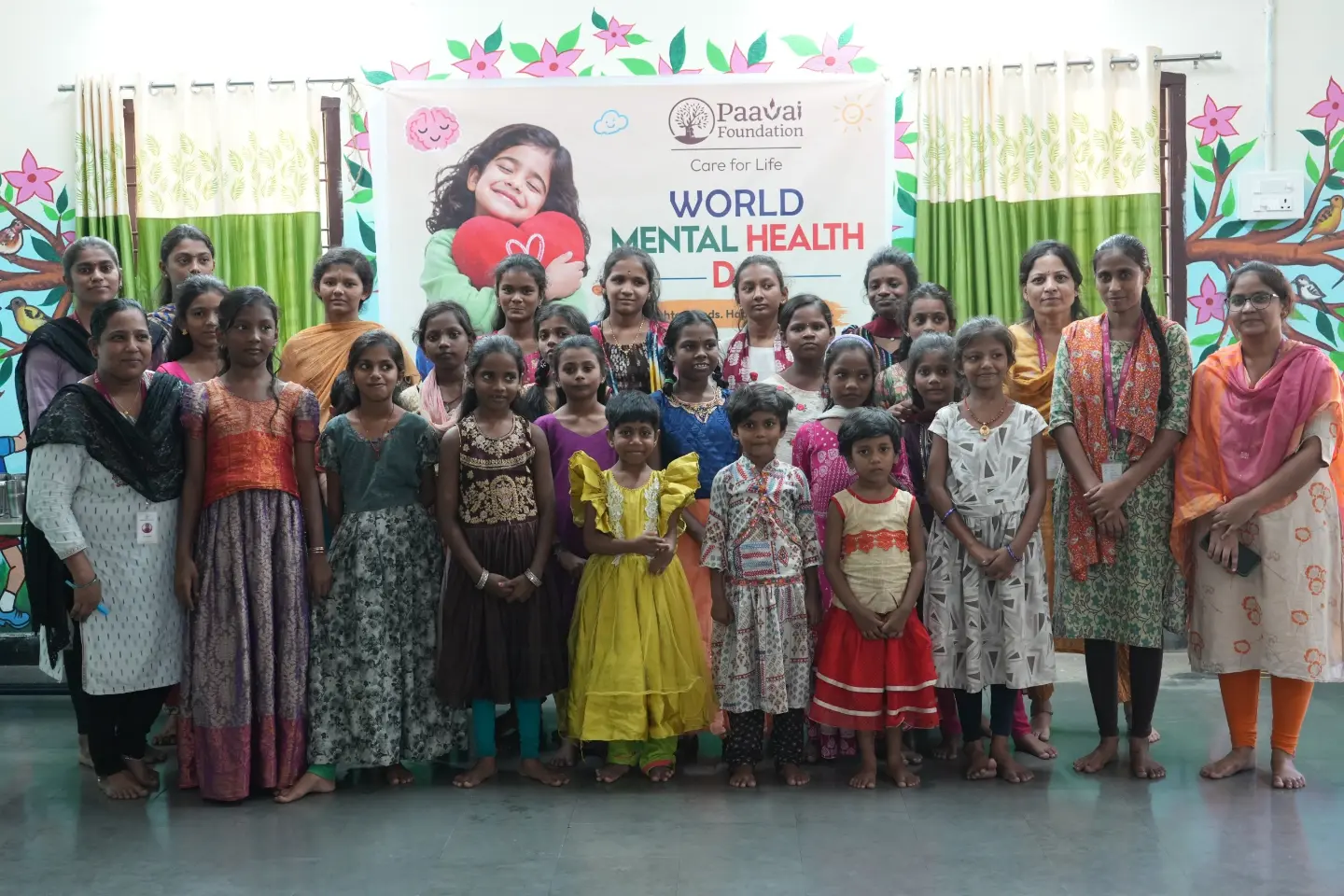
The campaign's framing has shifted over three decades from awareness of mental illness towards mental health as something everyone has, which can be supported or undermined by circumstances. That shift matters for this subject, because children in care are not a population with an unusual rate of disorder. They are a population whose circumstances place unusual demands on ordinary emotional development.
Current global information is published by the World Health Organization.
Who we are actually talking about
"Children in care" in India is a broader category than most people assume, and the differences within it matter.
Under the Juvenile Justice (Care and Protection of Children) Act, 2015, children in need of care and protection may be placed in child care institutions, or in non-institutional arrangements including foster care, sponsorship, after-care and adoption. Each child reaches that system by a different route.
Some have lost both parents. Many have not a substantial proportion of children in Indian institutions have at least one living parent and were placed because of poverty, illness, migration, disability in the household, or the belief that the institution offered education the family could not.
Read More: One Year of Change: What Long-Term Support Actually Looks Like for a Child in Care
Some were removed following abuse or neglect. Some arrived after a disaster or displacement. Some have a disability and were placed because no local support existed.
The emotional situation of a child whose mother visits twice a year is not the situation of a child with no living relative, which is not the situation of a child removed from a violent household.
Lumping them together as "orphans" a word that is both inaccurate for most and resented by many is where a great deal of well-meaning programming goes wrong.
National policy has moved steadily towards keeping children in family settings where possible, with institutional care positioned as a last resort. Information on statutory frameworks and child protection services is published by the Ministry of Women and Child Development.
What a child is actually managing
Not symptoms. Tasks. It is more useful to think of the emotional work a child in care is doing than to list the conditions she might develop.
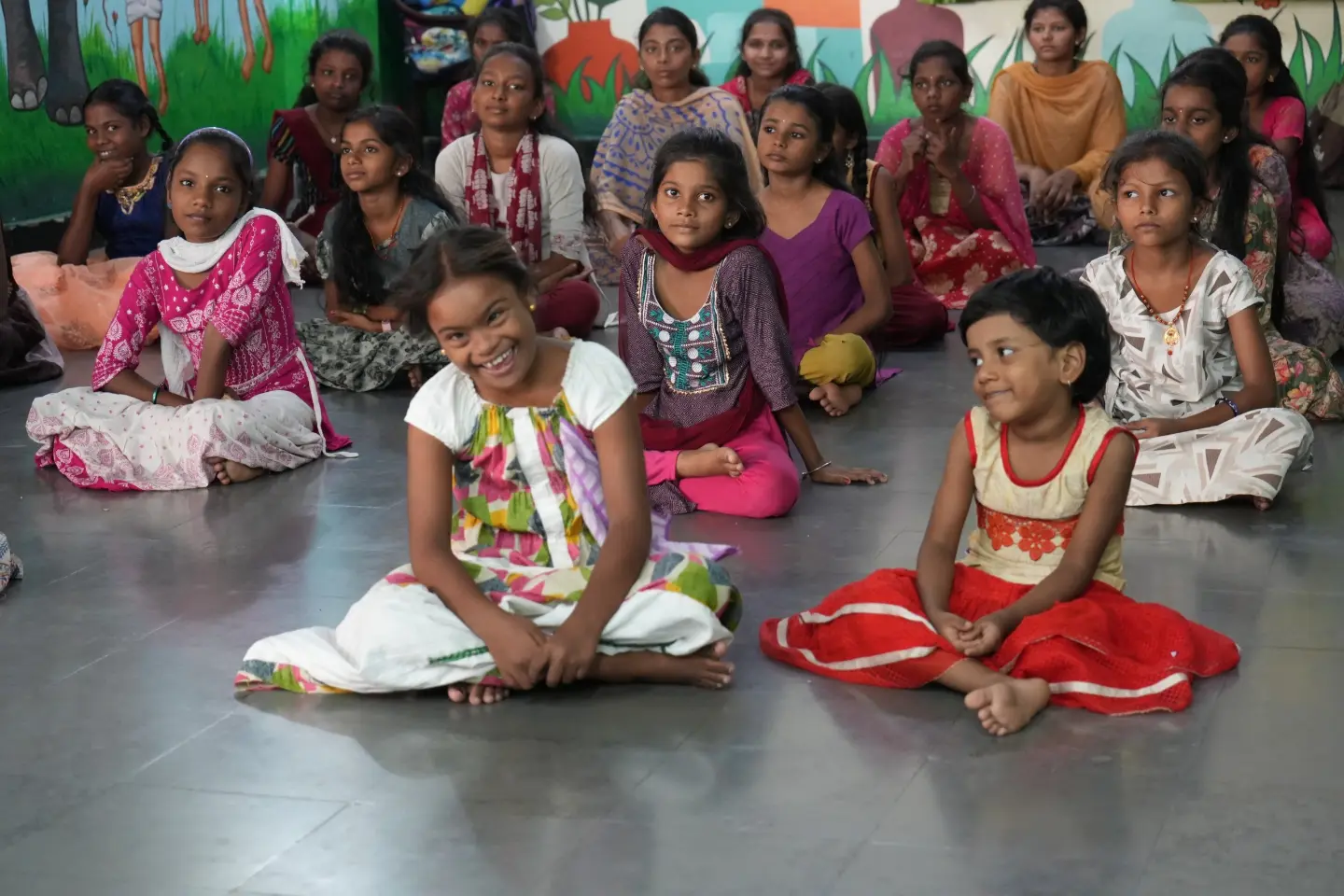
Making sense of why she is there. Children construct explanations for things adults leave unexplained, and the explanation a child reaches for is almost always about herself. I was too much. I was not worth keeping. A child told nothing will not conclude that her family faced an impossible economic situation. She will conclude she was the problem. Age-appropriate honesty about her own history is one of the most protective things an adult can offer, and one of the most commonly withheld.
Managing divided loyalty. A child who loves a parent who could not care for her, and who also wants to feel settled where she is, is holding two things that feel incompatible. Adults who criticise the birth family in front of her, however justified, force her to defend something painful or betray someone she loves.
Staying alert. A child whose early environment was unpredictable learns to read adults continuously, because reading adults accurately was once how she stayed safe. That vigilance does not switch off when the environment becomes stable. It is frequently misread as maturity in a well-behaved child and as defiance in a less compliant one.
Absorbing repeated goodbyes. Staff leave. Volunteers come for three months and go. Other children are reunified, adopted, or transferred. Each departure is ordinary from the institution's perspective and a loss from the child's. A child who has lost enough people stops investing in new ones, which adults then describe as being withdrawn or difficult to reach.
Carrying stigma. School classmates know where she lives. Teachers lower expectations. Community members treat her as a category. Children in care consistently report that the daily social experience of being known as "the hostel child" is harder than the circumstances that brought them there.
Having no private life. Shared rooms, shared belongings, scheduled days, and visitors who arrive to look at her. Ordinary childhood privacy — a drawer nobody opens, a conversation nobody overhears, a bad mood nobody examines is largely unavailable, and its absence is corrosive in a way that is easy to overlook.
Facing a fixed exit date. Eighteen arrives whether or not she is ready. The young adult leaving care has no household to return to on a bad month, no family to fund a course, nobody to call when a job falls through.
What tends to go unnoticed
Children's distress is usually recognised when it is loud. Aggression, defiance, running away and school refusal all produce a response, because they produce a problem for adults.
The quieter presentations are missed almost entirely.
The compliant child who causes no trouble is frequently described as having settled well. Sometimes she has. Sometimes she has learned that being invisible is safest, and her compliance is a symptom rather than an outcome.
Somatic complaints recurring stomach aches, headaches, unexplained pain are common in children who do not have language for emotional distress, and get treated as medical matters repeatedly without anyone asking what else is happening.
Sleep problems and nightmares are frequently normalised in a dormitory setting where several children sleep badly.
Difficulty concentrating is read as a learning problem or laziness, when a mind occupied with vigilance has limited capacity left for a lesson.
And in children with intellectual disabilities or communication difficulties, emotional distress is attributed to the disability rather than treated as distress. This is a well-recognised diagnostic failure and it means the children least able to explain what they are feeling are the ones least likely to be asked.
The protective factors are unglamorous
The research on what helps children in adverse circumstances consistently points to the same things, and almost none of them require specialist resources.
One consistent adult. Not a programme, not a technique. One person who knows the child, remains over time, and is reliably present. Across decades of resilience research, the presence of at least one stable, caring relationship is the strongest single protective factor identified. Care systems with high staff turnover undermine this more than any other failing.
Routine and predictability. Knowing what happens next, who will be there, and that the pattern will hold. For a child whose early life was unpredictable, predictability is not boredom. It is safety.
Honesty about her own story. Children who know their history, told in age-appropriate terms, do better than children who are protected from it. The protection is usually for the adults.
Being asked. Participation in decisions that concern her, at whatever level her age allows. A child who is never consulted learns she has no standing, which is precisely the lesson her circumstances already taught her.
Something she is good at. Sport, music, drawing, a skill, a responsibility. An identity other than "child in care" matters enormously for a sense of self.
Connection to family where it is safe. Contact with parents, siblings and extended family, maintained wherever it can be done safely, is strongly protective. Separating siblings is one of the more damaging decisions a system can make and one of the more common.
Being treated as unexceptional. Care-experienced adults say this repeatedly. The desire is not to be seen as remarkable for surviving. It is to be an ordinary child whom ordinary things happened to.
What adults can do differently
For caregivers and institution staff: consistency matters more than warmth in the short term, and the two together matter most. Prepare children for departures rather than letting them discover a staff member has gone. Interpret behaviour as communication rather than as character.
Also Read: Leading Child NGOs in South India: Organizations Working for Children
Notice the quiet ones. Protect what privacy the setting allows. And accept that a child may need you to prove reliability repeatedly before trusting it testing behaviour is usually exactly that.
For teachers: a child in care is a child in your class, not a case. Avoid identifying her status in front of peers. Hold the same expectations you hold for others, because lowered expectations are experienced as a verdict. Be aware that parents' days, family tree assignments and Mother's Day activities land differently, and that a small adjustment costs you nothing.
For visitors, donors and volunteers: this one needs saying directly. Visits where strangers arrive to distribute items, take photographs and leave are experienced by children as being looked at. They are organised for the benefit of the visitors. If you want to contribute something to a child's emotional life, commit to coming regularly for a long period, or do not come at all. Two years of monthly visits from one person is worth more than a hundred one-off visits.
And do not photograph children's faces for fundraising. A child who cannot meaningfully consent has her image circulated permanently, and care-experienced adults are consistently clear about how that felt.
For communities: the most useful contribution is ordinary inclusion. A birthday invitation. A place on the cricket team. Being spoken to about something other than circumstances.
The transition at eighteen
Care leavers face a cliff that children in families do not, and it arrives on a fixed date.
A young adult leaving institutional care typically has no household to fall back on, no family financing for education, no safety net for a period of unemployment, and no one to call about the ordinary administrative problems of adult life a rental agreement, a bank form, a medical decision.

The emotional dimension is as significant as the practical one. Leaving care means losing, simultaneously, the place you lived, the adults you knew and the peers you grew up with. For a young person whose history already includes significant loss, it is another one, and it arrives at the precise moment support ends.
After-care provisions exist within the statutory framework, and their implementation varies considerably. Any organisation serious about children in care has to treat eighteen as a transition to be prepared for across years, not a date on which responsibility concludes.
Where our work sits
At Paavai Foundation, emotional well-being is treated as a programme component rather than as something that happens incidentally alongside education and nutrition.
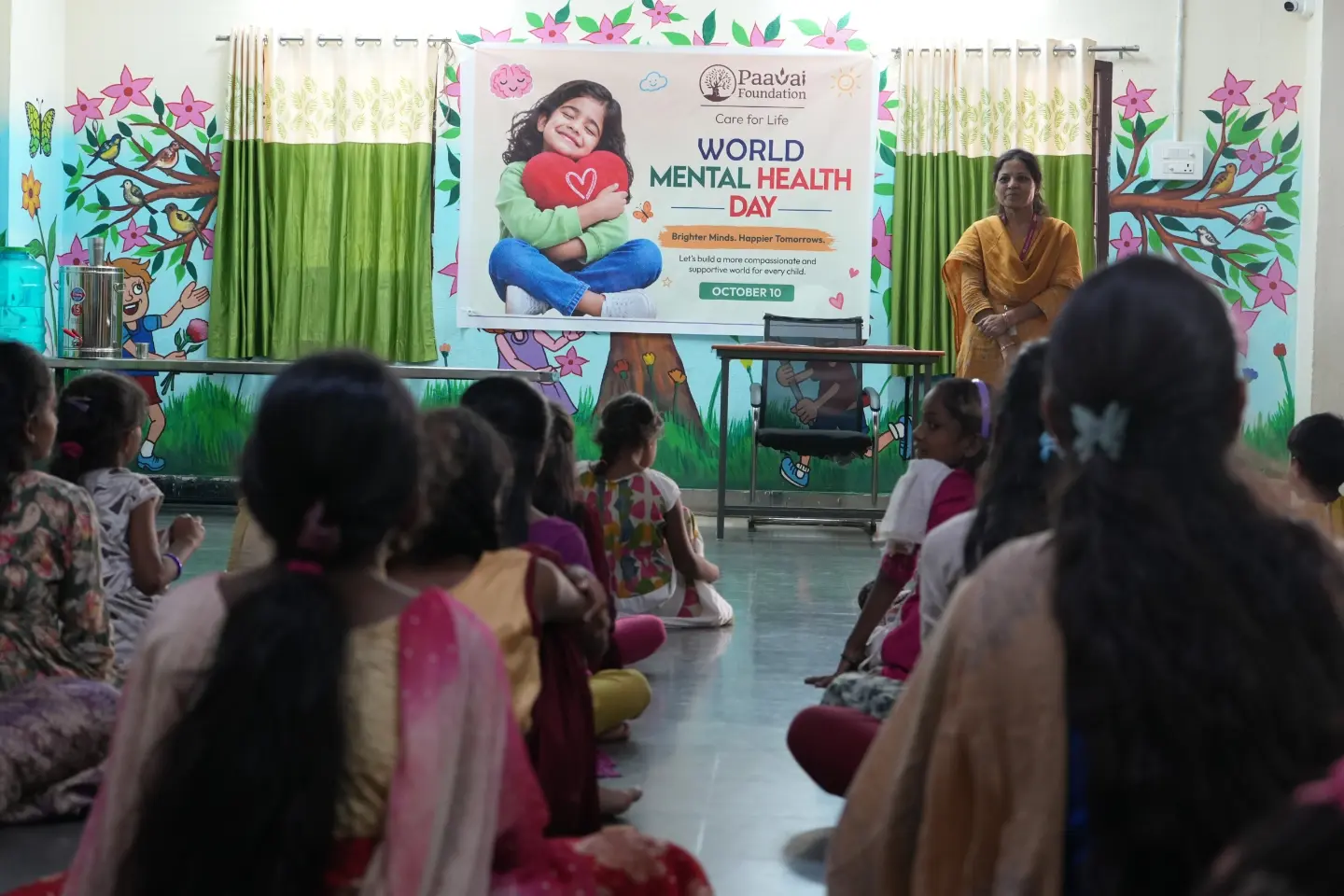
Our child care work through Paavai Abhayam is built around safe and stable living environments, consistent care, and the emotional security that everything else depends on. Within our work for children with intellectual disabilities, emotional and psychological well-being is named explicitly as a component alongside education, therapy and medical monitoring, for the reason set out above: children who cannot easily describe distress are the most likely to have it attributed to their disability rather than addressed.
Our elderly care work through Paavai Anbucholai connects to this more directly than it might appear.
Positioning elders as mentors and storytellers within child development work creates something institutional settings are chronically short of: consistent adult relationships that are not staff roles, not time-limited, and not dependent on anyone's employment contract.
Intergenerational contact is not a nice addition to a care setting. It is a partial answer to its central deficiency.
Across our programmes, continuity is the organising principle, which is why the standard we hold ourselves to is expressed as Care for Life. The wider framework is described in Paavai Community Connect 360.
We are not a clinical mental health service and nothing here should be read as a claim that we provide one. Children who need professional mental health care need qualified professionals.
Donate now to support child care, emotional well-being and long-term support work across Tamil Nadu.
What she would want you to know
Return to the child at the start.
She does not need to be described as broken, and she does not need to be described as inspirational. Both are ways of making her into something other than a child.
Care-experienced adults say, with striking consistency, that the pity was harder to bear than the circumstances, and that being treated as remarkable for surviving was its own kind of isolation.
What she needs is unglamorous and mostly within reach. Adults who stay. Honesty about her own life. Predictable days. Privacy. Someone who notices she is quiet.
Being asked what she thinks. Something she is good at. Her brother in the same building. And a world that treats her as a child to whom things happened, rather than as a category.
Most of that costs nothing. All of it requires somebody to remain long enough to provide it.
On World Mental Health Day 2026, the useful question for anyone connected to a child in care is not what can be given. It is whether you will still be there next year.
Care for Life.
FAQs
When is World Mental Health Day 2026?
World Mental Health Day 2026 falls on Saturday, 10 October. The date is 10 October every year, first observed in 1992 at the initiative of the World Federation for Mental Health.
Are all children in care orphans?
No. A substantial proportion of children in Indian child care institutions have at least one living parent and were placed because of poverty, illness, migration, disability in the household, or the belief that an institution offered education the family could not. The word is inaccurate for most and resented by many care-experienced people.
What emotional difficulties do children in care commonly face?
Rather than a list of conditions, it is more useful to think of the tasks they are managing: making sense of why they are there, divided loyalty towards birth family, sustained alertness learned in an unpredictable environment, repeated separations from staff and peers, stigma at school, almost no privacy, and a fixed exit at eighteen.
What signs of distress are most often missed?
The quiet ones. A compliant child who causes no trouble may have learned invisibility is safest. Recurring stomach aches and headaches with no medical cause, sleep problems normalised in a dormitory, and difficulty concentrating read as laziness. In children with disabilities, distress is frequently attributed to the disability rather than treated.
What helps most?
One consistent adult who remains over time is the strongest protective factor identified in resilience research. Alongside that: predictable routine, age-appropriate honesty about the child's own history, being consulted in decisions, something the child is good at, and maintained contact with family and siblings where it is safe.
Are donor visits to children's homes helpful?
One-off visits where strangers distribute items and take photographs are generally organised for the visitors' benefit and experienced by children as being looked at. Regular, sustained contact from the same person over a long period is valuable. Photographing children's faces for fundraising should be avoided.
What happens to children when they turn 18?
Care leavers typically face the loss of their residence, the adults they knew and their peer group simultaneously, with no family financing, no fallback household and no one to call about ordinary adult administrative problems. After-care provisions exist within the statutory framework and implementation varies.
How should teachers treat a child living in care?
As a child in the class rather than a case. Avoid identifying her status in front of peers, hold the same expectations held for others, and be aware that family-themed activities land differently.
Where can I get help for a child who is struggling?
Consult a qualified mental health professional, paediatrician or counsellor. India's national mental health helpline Tele-MANAS is available on 14416, and the child helpline 1098 operates round the clock.

Comments
Loading comments...
Leave a comment
Your email address will not be published. Only your name is shown with your comment.