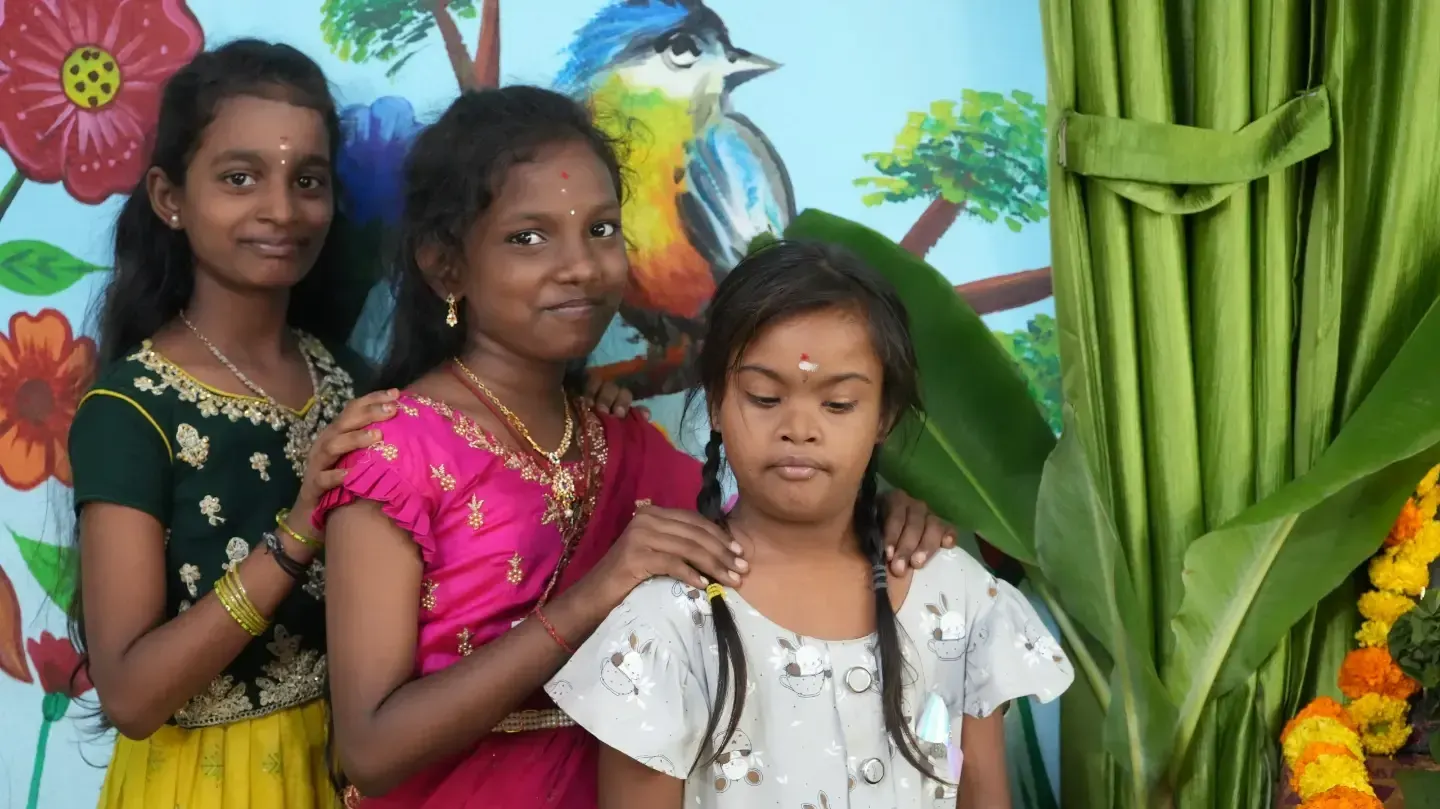
Most people picture a home for children with special needs by its equipment: ramps, rails, therapy rooms, a specially adapted bathroom.
Those things matter, and a home without them fails children in obvious ways. But almost nobody who grew up in one remembers the ramp. They remember whether the adults knew them. Whether mornings followed a pattern they could rely on. Whether anyone asked what they wanted for breakfast. Whether they were helped to do things or had things done for them. Whether they were ever bored, frightened, or embarrassed in front of others.
A building can be accessible and still not be a home. And a home can be modest and still be one.
This article walks through a home the way a child lives in it: through the day, and through the spaces where that day happens. At each point, it asks what turns care into home.
A note on language: "special needs" is the term many families search with, and we use it here alongside "disability", which is the term used in Indian law under the Rights of Persons with Disabilities Act, 2016. Every child is different. Nothing below is a substitute for professional assessment of a particular child.
First, what "safe" really means here
Safety comes first. It's also the word most often reduced to locked gates and supervision rotas.
For a child with a disability, safety has three layers, and a good home needs all of them.
Physical safety means premises that suit the children who live there. That includes step-free routes where wheelchairs are used, secure exits for children who may wander, safe storage of medicines and hazards, and an environment that has been checked for the specific risks of the specific children in it.
Protection from harm means a written child protection policy, background checks on every adult with access, supervision at night, clear rules on photography and visitors, and a reporting procedure every staff member knows. Children with communication difficulties or intellectual disabilities are more vulnerable to abuse precisely because they may not be able to tell anyone. So a home has to be built on the assumption that a child will not report harm, and has to be watching anyway.
Emotional safety means a child is not shouted at, mocked, restrained without need, or shamed for accidents. Her distress is treated as communication rather than misbehaviour. And she is never discussed in front of her as if she can't understand.
The third layer gets the least attention and does the most to determine whether a child is happy.
Morning: routine is not rigidity
For many children with intellectual disabilities, autism or sensory differences, a predictable day is the foundation everything else rests on. Knowing what comes next lowers anxiety, and lower anxiety makes room for learning, play and connection.
So a good home runs on routine. Waking, washing, dressing and breakfast happen in the same order and in roughly the same way each day. Visual schedules, picture cards or simple objects help a child who can't read a timetable know what's coming.
But routine should support the child, not suit the staff. The test is whether there's room for the individual. A child who needs more time to dress is given more time, not dressed by an adult to keep things moving. A child who wakes early is not made to lie still in the dark. A change is explained in advance, not sprung on her.
The bathroom: where dignity is won or lost
Personal care is the most intimate part of the day and the part where dignity is most at risk.
Many children with disabilities need help with toileting, bathing and changing, sometimes for life. How that help is given shapes how a child feels about her own body. Good practice is straightforward and easy to neglect when a home is short-staffed:
privacy every time, with doors closed and other children not present
help from the same small group of trusted adults wherever possible
telling the child what is about to happen before it happens
doing with the child rather than to her, and encouraging her to do every part she can
staff of the appropriate gender for older children's intimate care
A child who is washed quickly, in public view and in silence learns that her body belongs to whoever is handling it. That lesson is the opposite of what keeps children safe.
The learning room: special education that fits the child
Education for a child with a disability is not ordinary schooling made slower. It's teaching planned around one particular child.
That starts with an individual plan: an assessment of where she is now, realistic goals for the coming months, and a review with staff and family. Goals might be academic. They might equally be communication, recognising coins, travelling a short route independently, or staying calm through a change in routine. All of these count as learning.
It continues with trained special educators who adapt methods, materials and pace; communication support, including sign, pictures, gestures or devices for children who don't speak; and, wherever it is right for the child, inclusion alongside other children rather than permanent separation.
The legal framework matters here too. Under the Rights of Persons with Disabilities Act, children with benchmark disabilities are entitled to free education up to the age of eighteen, along with reasonable accommodation and support in school. What those entitlements are and how to claim them is set out in RPwD Act 2016 Explained.
The therapy room: support built into the week
Many children with disabilities benefit from therapy. Depending on the child, that may include physiotherapy, occupational therapy, speech and language therapy, behavioural support or psychological care.
What separates a supportive home from an adequate one is continuity. Therapy that happens once a month when a visiting specialist is available does far less than therapy built into the week and carried over into ordinary life. A good home makes sure caregivers know each child's goals, so that practising a grip, a word or a calming strategy happens at breakfast and bedtime, not only in the therapy room.
Health monitoring belongs here as well. Children who can't easily describe pain need adults who notice the signs: a change in eating, sleep, mood or behaviour. Pain or illness is often mistaken for "difficult behaviour", and a home that knows its children well catches it.
The courtyard: play, friendship and noise
A home that only cares for, teaches and treats a child has missed something important. Children need to play.
Outdoor space, adapted toys, music, art, sport, festivals, birthdays and ordinary mischief aren't extras. They're where friendships form, where a child finds out what she enjoys and is good at, and where she gets to be a child rather than a case.
A happy home is often a noisy one. A home where children with disabilities sit quietly in rows for most of the day isn't calm. It's under-stimulated, and the boredom shows up later as distress.
The sensory environment: what a child feels in a room
For children with autism or sensory processing differences, a room can be overwhelming in ways adults don't notice: fluorescent lights that flicker, constant noise, strong smells, crowding, unpredictable movement.
A considerate home pays attention to this. It offers natural light where possible, quiet spaces a child can retreat to, ways to reduce noise, and calm transitions between activities. It treats a child covering her ears or rocking as information about the environment, not a behaviour to correct.
An accessible living environment for children isn't only about wheelchairs. It's about whether every child, with her particular senses, can be comfortable in the space.
Evening: emotional support and connection
The end of the day is when worries surface. A child who has managed all day may fall apart at bedtime. A child who misses her family may feel it most in the evening.
Emotional support for children with disabilities is often overlooked, as if the disability were the whole story. These children feel loneliness, grief, frustration and fear like any child. Some have extra reasons to: past separations, previous care settings, and the daily experience of being treated as different.
What helps is ordinary: a familiar adult at bedtime, a predictable wind-down, comfort objects allowed, time to talk or simply sit together, and family contact maintained wherever it is safe and possible.
Night: the hours nobody photographs
Night is when supervision is thinnest and when vulnerable children are most at risk. It's also when seizures, breathing problems, toileting needs and nightmares happen.
A safe home has awake night staff where the children's needs require it, clear procedures for medical emergencies, and the same safeguarding rules at 3 a.m. as at 3 p.m. Ask any home about its night arrangements. The answer tells you a lot.
Families are part of the home, not visitors to it
For many children, a residential home is not instead of family. It sits alongside family. Parents may live far away, may be caring for other children, or may have reached the limit of what they can manage at home while still loving their child completely.
A good home keeps families involved. That means regular communication, a part in individual planning, help with understanding the child's needs and entitlements, and visits home for festivals where possible. The emotional and practical realities families face are described in Understanding the Needs of Children with Disabilities.
The people make the home
Every section above depends on one thing: trained, stable caregivers who know the children.
Children with intellectual disabilities and communication difficulties take time to trust adults, and they're deeply unsettled when those adults leave. High staff turnover undoes progress, routine and safety all at once.

The best equipped home with a revolving staff will serve children worse than a plain one where the same caregiver has been present for ten years.
That's why the least visible costs of a home matter most: salaries that keep good staff, training that keeps them skilled, and enough of them that no one is rushing through a child's bath.
Looking ahead from the start
A happy home for a child also prepares her for life after childhood. Many supports in India are built around the years up to eighteen, and then they stop. Life skills, assisted independence, decision-making and planning for guardianship and livelihood should begin long before a child's eighteenth birthday, not on it. The legal and practical side of that transition is explained in What Happens After 18? Guardianship, Livelihood and Adult Life for Children with Intellectual Disabilities.
Entitlements are also easier to secure early. A disability certificate and UDID card, available through the government's UDID portal, open access to many schemes. Support schemes for persons with autism, cerebral palsy, intellectual disability and multiple disabilities are administered by the National Trust, and wider scheme information is published by the Department of Empowerment of Persons with Disabilities.
Where our work sits
At Paavai Foundation, our work for children with intellectual disabilities is carried out through Paavai ID Care. It's built around lifelong rather than episodic support: safe and supportive living environments, special education and assisted learning, therapy, rehabilitation and functional support, continuous medical monitoring, emotional and psychological well-being, and the everyday life skills that build assisted independence.
In Tirupati, the Foundation runs an Integrated Special Children Home and intervention centre. It offers round-the-clock residential care in a home-like environment, therapeutic interventions tailored to each child's needs, early intervention, and outreach and guidance for families in the wider community.
We don't treat a building as the measure of care. The measure is whether the adults stay, whether each child is known, and whether her days have room for learning, play and dignity.
Support Paavai Foundation in Creating Safe and Supportive Environments for Children, ideally as a monthly contribution, because the costs that matter most in a home like this arrive every month.
What makes it home
Ramps, rails and therapy rooms make a building usable. They don't make it a home.
What does is quieter. It's a caregiver who knows how a particular child signals that she's in pain. It's a morning routine with time built in for a child to dress herself. It's a bathroom door that's always closed. It's a courtyard loud with play, a family that's still part of things, and an adult who's still there next year.
None of those show up in a photograph. All of them decide whether a child with special needs grows up cared for or just looked after.
Care for Life.
FAQs
What makes a good home for children with special needs?
Physical accessibility, strong safeguarding and emotional safety, a predictable routine with room for each child, individual education and therapy plans, dignified personal care, play and friendship, family involvement, and above all trained, stable caregivers who know the children well.
How is safety different in a home for children with disabilities?
Children with communication difficulties or intellectual disabilities may not be able to report harm, so a home has to assume they won't and watch carefully anyway. That means background checks for all adults, night supervision, clear rules on visitors and photography, and staff trained to notice signs of distress or pain.
Why is routine so important for children with special needs?
A predictable day lowers anxiety, especially for children with autism, intellectual disabilities or sensory differences. Lower anxiety leaves more room for learning and connection. Good routine still adapts to the individual child.
What does inclusive care for children with disabilities mean?
Care that treats each child as an individual, involves her in decisions about her own day, supports her to do as much as she can for herself, and wherever appropriate includes her alongside other children rather than keeping her permanently separate.
What is an accessible living environment for children?
One where every child can move, rest and take part comfortably. That includes physical access, and also sensory comfort such as natural light, quiet spaces, lower noise and calm transitions for children with sensory sensitivities.
Should families stay involved if their child lives in a residential home?
Yes, wherever it is safe and possible. Regular contact, a part in individual planning and visits home for festivals help children feel secure and keep the residential home as an extension of family rather than a replacement for it.
What entitlements should families of children with disabilities know about?
Disability certification and the UDID card, the right to free education and reasonable accommodation under the RPwD Act 2016, National Trust schemes for certain disabilities, and guardianship arrangements before a child turns eighteen.
How can I support a home for children with special needs?
Regular contributions to the home help most, because they fund trained staff, therapy, health care and daily living costs. Skilled volunteering, such as therapy, special education or counselling, offered consistently over time is also valuable.

Comments
Loading comments...
Leave a comment
Your email address will not be published. Only your name is shown with your comment.