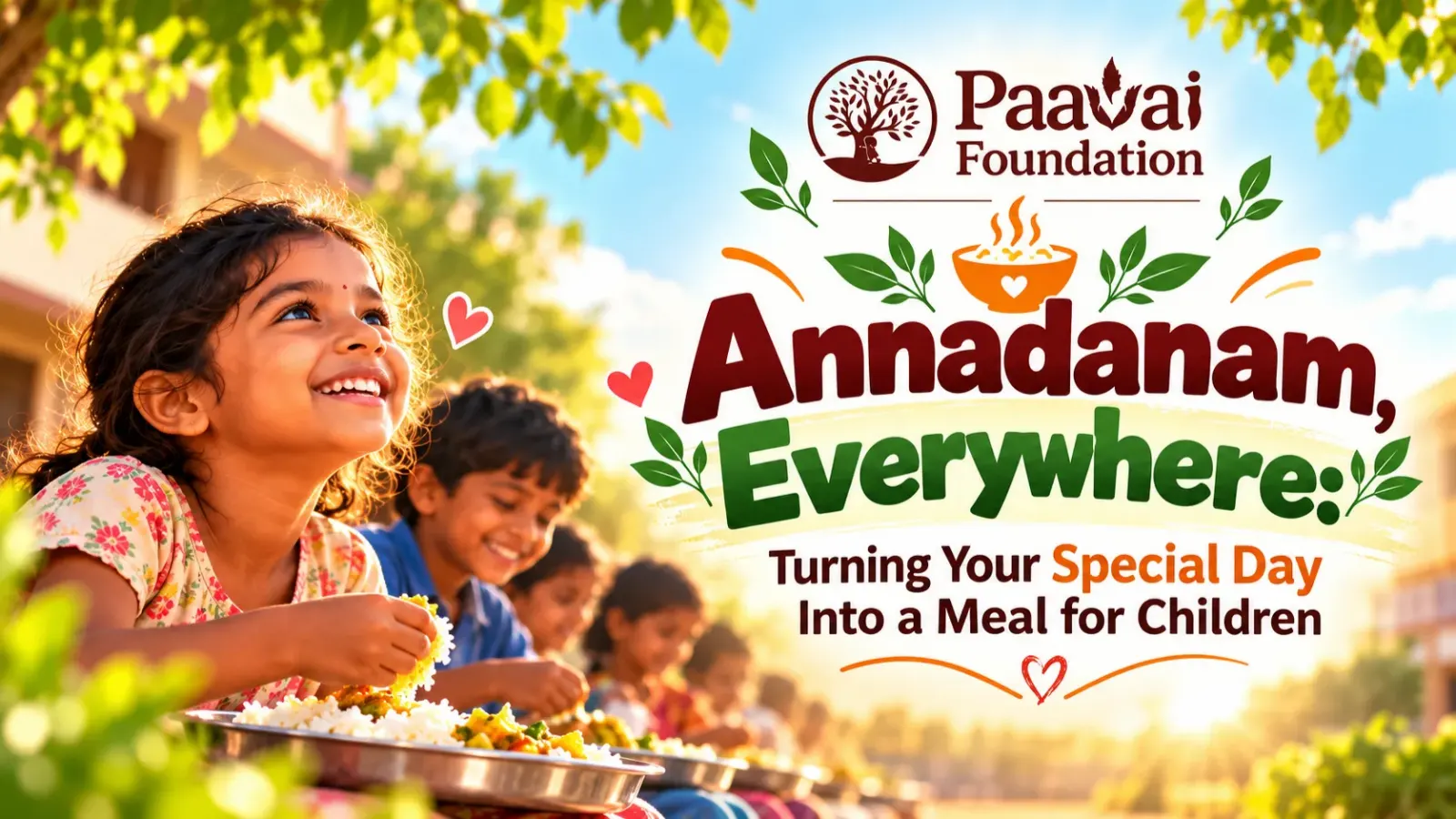
In many South Indian homes, there was always an extra plate.
A grandmother would cook a little more than the family needed, just in case. A visitor at lunchtime was never sent away hungry. On a birthday, a wedding anniversary, or the day a parent had passed, the family would arrange a meal for others: at the temple, in the village, sometimes simply at their own door.
Nobody called it a charity programme. It was just how special days were marked. Something good happened, or someone was remembered, and food was shared.
That habit has a name, and it's one of the oldest in Indian tradition: annadanam, the gift of food.
Most of us first meet annadanam at a temple, in long rows of people being served a warm meal. But the spirit behind it has always been wider than any one place. Annadanam happens wherever food is given freely, with love, to someone who needs it. Today, one of the most meaningful places to offer it is at a children's home, where growing children eat three meals a day, every day of the year.
This article is about that spirit, and how you can make it part of your own special days.
What annadanam means
The word joins two Sanskrit roots: anna, food or cooked grain, and dāna, a gift given freely. It's spelt in several ways. In Tamil Nadu, annadhanam is common. You'll also see anna dhanam, anna daanam and annadaanam. All of them mean the same thing: the gift of food.
Annadanam is often described as the greatest of gifts, and there's a simple reason for that. Most gifts depend on what the person receiving them happens to want. Food is different. When a hungry person has eaten well, the gift is complete. Nothing more is needed from that meal.
The same idea lives on in many traditions across India. The langar at a gurdwara and shared festival meals in communities of every faith all rest on the same belief: whoever is hungry should be fed, with respect, and without being asked who they are.
The spirit of annadanam, in four simple ideas
Annadanam has lasted for centuries because of a few principles that families have practised without needing to write them down.
Everyone is fed. No one has to prove they deserve the meal. Rich and poor sit in the same row and eat the same food.
The food is good. Annadanam isn't leftovers. It's food you would happily serve an honoured guest, prepared with care.
The giver stays humble. Traditionally, those who sponsor annadanam don't stand over the people eating or ask for thanks. Often the people who eat never know who paid for the meal, and that is part of its beauty.
The kitchen keeps going. Temple kitchens feed people every day, not once a year. Many families each give on their own special day, and together they keep the meals flowing.
These four ideas are worth remembering, because they travel well. They work just as beautifully outside the temple as inside it.
Annadanam, everywhere
Over generations, annadanam has been offered in many places. In temples and mathams. At wedding feasts where everyone in the village is welcome. During festivals. At family homes on remembrance days. On pilgrim routes for travellers.
A children's home belongs naturally on that list.
Children who live in residential care are fed every single day by the home's kitchen: breakfast before school, lunch, and dinner in the evening. The home buys provisions, pays the cooks and plans meals that keep children healthy. Food is one of its largest and most constant needs.
What makes annadanam at a children's home especially meaningful is who is eating. These are growing children. A good meal in childhood does more than satisfy hunger. It builds bones, supports a developing brain, strengthens immunity and shapes eating habits for life. Why the years before twelve matter so much is explained in Why Nutrition Before Age 12 Shapes a Child's Whole Life.
So when you offer annadanam to children, you're feeding a day, and you're also feeding a future.
Your special day, made into a meal
Almost any occasion worth celebrating can become an occasion for annadanam. Here are the days families most often choose, with a few ideas for each.
Birthdays
The most popular occasion of all, and for good reason. A birthday is about being grateful for another year, and sharing a meal is one of the most natural ways to say thank you for it.
Your own birthday: many people now sponsor a meal in place of, or alongside, a party.
Your child's birthday: a lovely way to begin teaching a child that celebrations can include others. Talk about it together at home, so your child understands where the meal is going and why.
A parent's birthday: a thoughtful gift for parents who already have everything they need.
Milestone birthdays
Some birthdays carry special weight in South Indian families. A 60th birthday (Shashtiabdapoorthi or Manivizha), a 70th, or an 80th is often marked with prayers, family gatherings and feeding others. Sponsoring annadanam for children is a beautiful way to honour an elder whose long life has nourished the whole family.
Wedding anniversaries
Couples often mark the years of their marriage by giving together. A first anniversary, a silver jubilee or a golden jubilee can each be made more meaningful with a meal for children, a quiet way of sharing your blessings.
Welcoming a new baby
The birth of a child, a naming ceremony or a first birthday has long been marked by feeding others. Welcoming a new life by nourishing other young lives is a tradition with a lovely symmetry.
Death anniversaries and memorial days
For many families, this is the most heartfelt occasion of all. Offering annadanam on a death anniversary, whether on a parent's tithi, a grandparent's remembrance day, or the anniversary of any loved one's passing, has long been one of the most important ways of honouring their memory.
A meal for children in their name continues their kindness into lives they never had the chance to meet. Families often say it turns a day of grief into a day of quiet gratitude.
Achievements and new beginnings
Exam results. A first job. A promotion. A new home. A recovery from illness. A business anniversary. Any moment you feel thankful for can be shared through a meal.
Festivals
Diwali, Pongal, Onam, Ugadi, Sankranti, Christmas, Eid. Festivals are a natural time for giving, and a meal for children adds warmth to any celebration.
For organisations
Companies, schools, clubs and community groups can mark a founding day, a milestone or an annual event with annadanam. It's a simple, meaningful way for a team to celebrate together.
Choosing your date
Fixed dates such as birthdays and anniversaries are perfect as they are. Simply book a little ahead so the kitchen can plan.
If your date is flexible, here's a small idea that makes a real difference. Children's homes tend to receive many special meals during big festivals and very few in ordinary weeks.

A special lunch on a quiet Tuesday in July is noticed and enjoyed just as much, and it means a great deal precisely because no one was expecting it.
Some families make it a yearly ritual: the same date every year, a meal for children, without fail. Over time, it becomes part of how the family remembers its own story.
How to offer annadanam for children
Arranging a meal is simple. A few thoughtful choices make it better for the children.
Step 1: Choose your occasion and date
Book a week or more ahead where you can, especially around festivals.
Step 2: Choose your meal
Breakfast, lunch or dinner, and whether it's a regular meal or a special one with festive dishes and a sweet. Lunch is usually the largest meal of the day.
Step 3: Sponsor through the organisation
The most caring way to offer annadanam at a children's home is to sponsor the meal, so the home's own kitchen prepares it. The cooks who feed the children every day know their needs, their tastes and their routine. The food is fresh, hygienic and served at the usual time to every child in the home.
Bringing cooked food from outside, however lovingly made, is usually less suitable. Food carried across a city in the heat carries risks, and food safety standards set by the Food Safety and Standards Authority of India apply to anyone serving food on this scale. Children may also have allergies, medical needs or special diets that only staff know about. A sponsored meal takes care of all of this for you. The practical details are covered further in Food Donation for Children: What Makes a Birthday Meal Meaningful for a Child?
Step 4: Let the kitchen plan the menu
The best birthday or memorial meal is a proper, nourishing meal with something special added: rice or chapati, dal or another protein, vegetables, curd, a festive dish and a sweet. Staff know what children enjoy and what suits the season.
Step 5: Dedicate it
Many families like to dedicate their meal: "In loving memory of Amma," "Celebrating our 25th anniversary," "On Arjun's 7th birthday, with love." A dedication keeps the occasion personal without asking anything of the children.
Step 6: Let the meal be enjoyed
In the true spirit of annadanam, the giver steps back. Responsible children's homes usually prefer that sponsors don't come to serve food, hold celebrations on site, or take photographs of the children. That isn't unfriendliness. It lets children enjoy a special meal as an ordinary good day in their own home, without becoming an audience for someone else's occasion.
Your gift is complete the moment the meal is served.
Annadanam with dignity
A few gentle principles keep annadanam true to its spirit.
Every child receives the same meal. No child is singled out or left out.
Children's health comes first. Staff adapt meals for any child with allergies, medical conditions or special diets.
No child is asked to perform. No thank-you speeches, songs or photographs in return for food. Annadanam has never been an exchange.
Gifts go to the home, not to individual children. This keeps things fair for children who live together.
Make it a tradition, not just a day
One meal on a special day is a real gift. Every child in the home eats something special that day, at no cost to the home's regular budget.
Children, of course, eat every day. The temple kitchens that have fed people for centuries kept going because many families gave regularly, each on their own special day, and some every month.
Many families who begin with a birthday or memorial meal go on to add a small monthly contribution, so their support continues through the year as well as on the day itself. Why steady giving does so much is explained in Monthly Giving vs One-Time Donation: Which Does More for a Child?
Before you give
Wherever you choose to offer annadanam, a little care goes a long way. Check that the organisation is registered. Many can be verified on the government's NGO Darpan portal. If it houses children, it should be registered under the Juvenile Justice framework, and information on that framework is published by the Ministry of Women and Child Development. Ask whether the sponsored meal is served to every child, and whether the organisation has a child protection policy. If you want to claim a tax deduction, confirm its 80G registration and keep your receipt.
Celebrate With Us
Paavai Foundation is an Integrated Child Development Foundation working across South India, with children's homes in Trichy, Hyderabad and Tirupati. Its work spans child care and protection, education, health, nutrition, disability inclusion, elderly care and community development, and its kitchens cook for children every day of the year.
Through Celebrate With Us, you can turn your special day into a meal for children. Birthdays, anniversaries, the birth of a child, achievements, corporate milestones and memorial days are all welcome. The meal is cooked in the home's own kitchen and served by its staff, just as annadanam has always been meant to be: given freely and received with dignity.
Eligible donations qualify for tax benefits under Section 80G of the Income Tax Act, subject to applicable rules.
Celebrate With Us – Make Your Special Occasion Meaningful
A meal that carries your day further
Somewhere today, a family is celebrating. A child is turning seven. A couple is marking twenty-five years together. A son is remembering his father.
And somewhere, a group of children is sitting down to lunch.
Annadanam brings those two moments together. It takes the happiness or remembrance of one family and turns it into a warm, generous meal for children who may never know whose day it was, and who will simply enjoy a good lunch, made with care.
That's the beauty of annadanam. It begins at the temple, it lives in our homes, and it can reach anywhere a child is waiting to be fed.
Annadanam, everywhere. Starting with your next special day.
Care for Life.
FAQs
What does annadanam mean?
Annadanam joins the Sanskrit words anna (food) and dāna (a gift given freely), so it means the gift of food. It's also spelt annadhanam, anna dhanam or annadaanam, and is often described as the greatest of gifts.
Can annadanam be done outside a temple?
Yes. Annadanam has long been offered at temples, mathams, weddings, festivals and family homes. Sponsoring a meal at a children's home carries the same spirit to growing children who need it every day.
How can I do annadanam on my birthday?
Choose a date and a meal, sponsor it through a registered organisation such as a children's home, and the home's kitchen will cook and serve it to every child. You can dedicate the meal to your birthday.
Can I offer annadanam on a death anniversary?
Yes. Annadanam on a parent's or loved one's death anniversary is a long-cherished tradition. A meal for children in their memory is a meaningful way to honour them.
Can I sponsor annadanam for a 60th birthday or Shashtiabdapoorthi?
Yes. Milestone birthdays such as a 60th, 70th or 80th are traditional occasions for feeding others, and a meal for children is a beautiful way to honour an elder.
How much does annadanam for children cost?
It depends on the organisation and the meal. Through Paavai Foundation's Celebrate With Us, a regular breakfast or dinner is ₹3,500 and lunch ₹4,500. A special meal is ₹5,500 for breakfast or dinner and ₹7,500 for lunch.
Can I bring food I cook myself?
It's usually better to sponsor the meal through the home's own kitchen. That keeps the food safe and fresh, takes care of children's dietary needs, and keeps the day running smoothly.
Can I attend and serve the meal myself?
Most responsible homes prefer that sponsors don't attend, so children can enjoy the meal as a normal good day without becoming an audience. In the spirit of annadanam, the gift is complete once the meal is served.
Is annadanam donation tax-deductible?
Donations to organisations with valid 80G registration may qualify for a deduction under the Income Tax Act, subject to conditions. Keep your receipt.
Can my company sponsor annadanam?
Yes. Companies, schools and community groups often mark founding days, milestones and annual events by sponsoring meals for children.
Comments
Loading comments...
Leave a comment
Your email address will not be published. Only your name is shown with your comment.