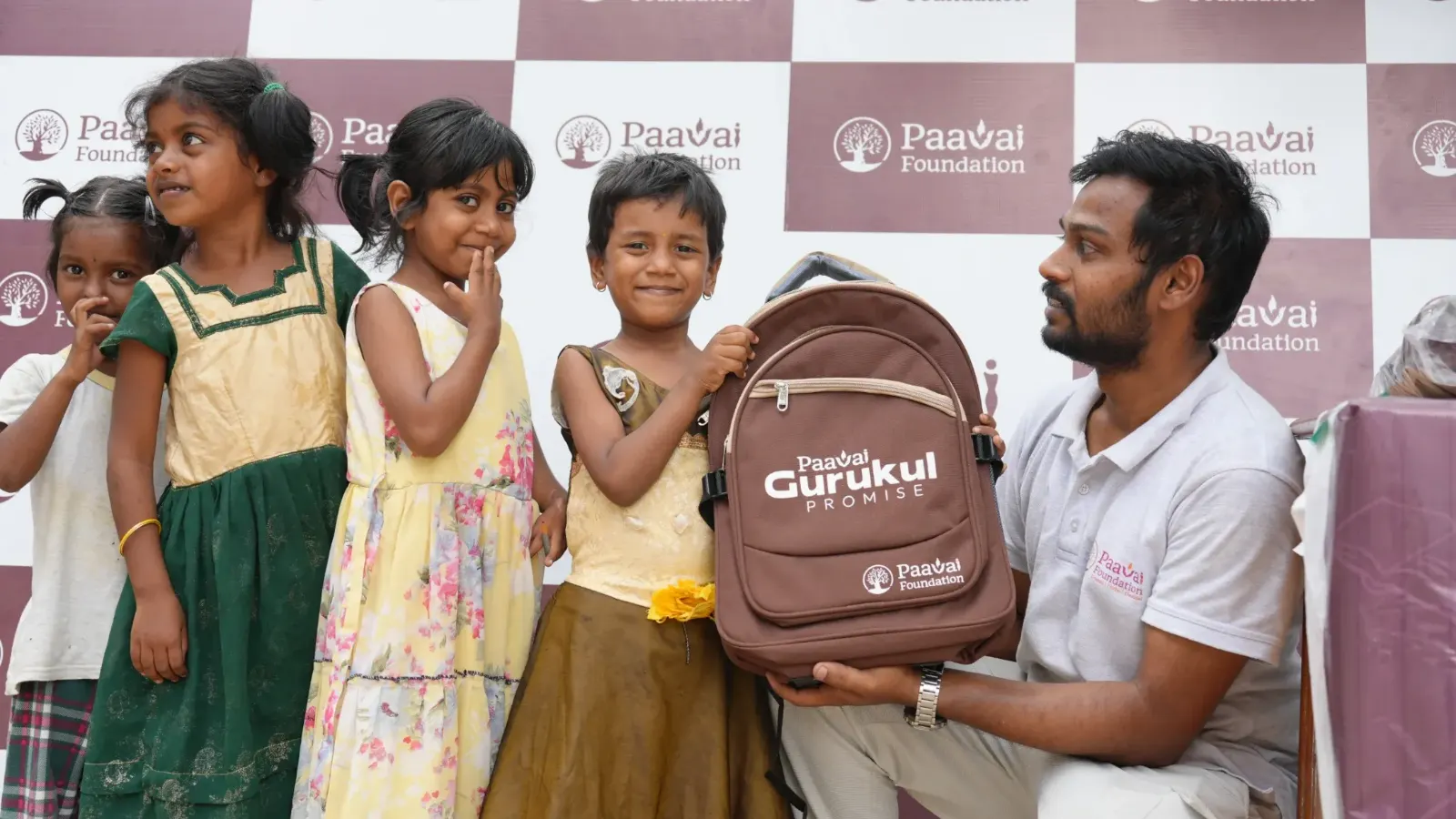
A colony in a mid-sized Tamil Nadu town collects for a government school every year.
The residents' association takes contributions in June, buys notebooks, bags and geometry boxes, and distributes them at a small function before the term begins. Photographs are taken.
Everyone feels good, and reasonably so — the money is real, the intention is sincere, and children who would otherwise start the year without materials do not.
The same colony has been doing this for eleven years.
In that time, nobody has asked the headmaster what the school's actual constraint is. Had they asked, they might have learned that the school has adequate notebooks, because a government scheme supplies them and that what it does not have is anyone to help the twenty or so children who reached Class 5 unable to read. Two retired teachers live in that colony. One of them walks past the school every morning.
This is not a story about wasted money. It is a story about the difference between generosity and effect, and about how often the second is available to a community that is already exercising the first.
Where the impulse to give runs into its limit
Indian communities are not short of giving. Religious institutions, caste and community associations, alumni networks, residents' welfare associations and neighbourhood collections move enormous quantities of money and material every year, most of it unrecorded and none of it reported as philanthropy.
What that giving often lacks is three things: information about what is actually needed, continuity beyond the moment of giving, and any mechanism for finding out whether it worked.
The result is a familiar pattern. Distribution happens where it is easy to organise. It clusters around festivals and calendar occasions.
It flows to whichever institution is most visible rather than whichever need is greatest. And it repeats identically for years without anyone checking whether the underlying situation has moved.
None of this makes giving pointless. Relief is necessary, and a child who eats today because someone paid for it does not need a lecture about systems. But social impact in communities requires something the annual collection does not, on its own, supply: a willingness to ask what would actually have to change, and then to stay long enough to find out.
What separates a contribution from a change
Six differences, and none of them require more money.
Ask before you give
The single most common failure in community giving is solving a problem nobody had. It happens because asking is awkward and assuming is easy.
The correction is straightforward. Before the collection, someone visits the school, the anganwadi, the health centre or the family and asks what the actual constraint is.

Frequently the answer is not the thing everyone assumed. A school may need a teacher's assistant more than it needs computers. A family may need help with a certificate application more than it needs a food parcel. A health centre may need transport more than equipment.
Asking costs one afternoon and changes what the money does.
Give the thing that is scarce, not the thing that is visible
Communities reliably fund what can be photographed: uniforms, notebooks, meals, equipment. These are genuinely useful and also the things most likely to be covered by an existing scheme.
What is chronically underfunded is everything that holds a programme together — trained staff, transport, follow-up visits, record-keeping, maintenance. A borewell without a maintenance arrangement is a borewell that will stop working. A computer room without a trained teacher and an electricity connection is furniture.
If you are giving as a group, consider deliberately funding the unglamorous part. Very few others will.
Stay past the handover
Nearly every failed community initiative failed after the inauguration. Somebody funded it, somebody built it, and then everyone went home.
Also Read: Building Stronger Communities: NGO Support for Children and Families in Pudukkottai
A commitment to return — quarterly, annually, in some form — changes the nature of the contribution entirely, because it creates accountability in both directions and allows problems to be caught while they are still small.
Give time and skill, not only money
This is where communities are most under-utilised and least aware of it.
A neighbourhood contains retired teachers, doctors, engineers, accountants, lawyers, tailors, electricians and people who know how government offices work. Each of those is a resource that money cannot easily buy for a small organisation or a government school.
Community volunteering in India tends to be imagined as a Sunday activity involving large groups and visible tasks. The more valuable version is narrower and more sustained: one retired teacher taking a reading group twice a week for a year. One accountant helping a small organisation with its filings. One person who understands the taluk office accompanying families through certificate applications.
An hour of the right skill, repeated, beats a day of general willingness.
Help people claim what they are already owed
This is the highest-leverage activity available to any community group, and almost nobody does it.
India has a dense architecture of rights and schemes. Pensions, insurance, nutrition support, housing schemes, scholarships, disability entitlements, maintenance rights for elderly parents. The gap is not policy. It is the distance between the entitlement and the person, and that distance is made of information, documentation, travel and language.
A child with a benchmark disability has the right to free education up to eighteen, to accessible learning materials, to a scribe and extra time in examinations, and to reserved seats in higher education — provided a certificate exists. Many families have never had the assessment done, because nobody told them it was possible.
A neighbourhood group that helps five families complete applications they did not know they qualified for has generated more lasting value than the same group's eleven years of notebook distribution, because the entitlement continues indefinitely and costs the group nothing to maintain.
Central scheme information is available through the MyScheme portal, which lets a household filter by eligibility, and state schemes through the relevant state government portal.
Coordinate with what already exists
Community effort duplicates constantly. Three groups fund the same accessible school while a harder-to-reach one nearby receives nothing. Everyone gives during the same festival month and nobody gives in March.
A single conversation between the groups active in a locality — who is working where, on what, and where the gap is — removes most of this waste. It is the cheapest intervention in this entire article and the one least often attempted.
Ways to support NGOs that are actually useful to them
If your giving goes through an organisation rather than directly, a few practices make a substantial difference at the receiving end.
Recurring beats one-time. A modest amount given monthly is worth considerably more to a programme than a larger one-off gift, because it allows a commitment to a child for a full school year rather than a single month. Predictability is what makes planning possible.
Unrestricted beats earmarked. Donors like directing money to specific visible items. Organisations need to pay trained staff, run transport, maintain buildings and keep records. Restricting every rupee to the photogenic parts quietly starves the parts that hold the work together. If you trust an organisation enough to fund it, trust it enough to allocate.
Verify once, properly. Check registration through the government's NGO Darpan portal, confirm 80G status if you intend to claim a deduction, and ask how long the organisation stays in a location and what outcomes it measures. Do this once, then stop treating every subsequent contribution as a fresh risk assessment.
Understand the tax position. Donations to organisations holding valid registration under Section 80G may qualify for a deduction, subject to conditions and limits. The mechanics, including what to keep and how to claim, are covered in Section 80G Explained: How Donations to NGOs Can Help You Save Tax in India.
If you are giving as a company, commit in years. A three-year programme partnership achieves what three annual grants of the same total value cannot, because only one of them permits planning. Requirements and options for corporate giving, including CSR obligations under the Companies Act, are set out in How Companies Can Support NGOs in India and Access Tax Benefits.
Ask for the results that went badly. An organisation willing to discuss what did not work is telling you something more useful than any impact figure. Vagueness dressed as scale is the warning sign.
Starting something in your own locality
For a group that wants to move from annual collection to sustained work, a workable sequence looks like this.
Pick one thing. Resist the temptation to address education, health, elderly care and environment simultaneously. A group of neighbours can do one thing properly. Doing four badly is the standard failure.
Find out what is actually needed. Talk to the school, the anganwadi worker, the health centre staff, the panchayat, and the households themselves. Expect the answer to differ from your assumption; that is the point of asking.
Work through what exists. Strengthening the government school your neighbourhood already has is almost always better than building something parallel. The school will still be there in twenty years.
Assign responsibility to named people. Vague collective commitment produces nothing. "Ravi is responsible for the reading group on Tuesdays and Fridays" produces a reading group.
Decide how you will know it worked. Not how many children attended, but how many can read a paragraph in March who could not in July. Pick a measure before you start, because choosing it afterwards guarantees you choose a flattering one.
Plan for the second year. Most community initiatives collapse when the person who started them loses enthusiasm or moves away. Deciding early who continues it, and how, is what separates a project from a habit.
Expect it to be dull. Sustained work is unglamorous by nature. The photographs from year three are considerably less impressive than the photographs from the inauguration, and year three is when it starts to matter.
Where our work sits
Paavai Foundation is an Integrated Child Development Foundation working across districts in Tamil Nadu including Tiruchirappalli, Madurai, Namakkal, Krishnagiri, Tiruvannamalai, Theni, Dindigul, Sivagangai, Karur, Tirupathur, Perambalur, Pudukkottai, Ramanathapuram and Virudhunagar, with presence extending into Telangana and Andhra Pradesh.
Our programmes span child protection and care, education, health and wellness, nutrition, disability inclusion, youth leadership, elderly care and district-level community development, structured to connect to one another because households do not experience their difficulties in separate categories. Paavai Community Connect 360 is the framework that holds this together at district level, working through pathways covering health, education, women's empowerment, environment and equality, and designed to operate through existing local systems rather than alongside them. The reasoning behind that design is set out at length in Paavai Community Connect 360: Transforming Communities Through Integrated Development, Inclusion, and Sustainable Impact.
We publish what we can substantiate and decline to publish what we cannot. In a sector where inflated figures are routine, we would rather describe our work accurately than quantify it impressively.
Guiding all of it is a phrase we treat as a standard rather than a slogan: Care for Life. It refers to duration.
Ready to contribute? Donate now to support child care, education, health, nutrition, disability inclusion and community development work, or volunteer with Paavai to contribute professional skills, time or expertise.
The retired teacher who walks past the school
Return to the colony from the opening.
Nothing that community was doing was wrong. Eleven years of collections, honestly gathered and honestly spent. Children received materials they needed. Nobody was deceived and nobody profited.
What was missing was a single question, asked once, of the one person who knew the answer.

The distance between giving and change is frequently that small. Not more money, not better intentions, not a grand initiative. An afternoon spent asking. A decision to fund the boring thing. A commitment to come back in six months. One retired teacher deciding to walk in through the gate she has passed every morning for a decade rather than past it.
Communities in India already give. The question is not whether we are generous. It is whether we are curious enough about what our generosity is doing.
FAQs
What is the difference between charitable giving and social impact?
Giving transfers a resource to meet an immediate need. Impact changes the conditions that produce the need. Both are necessary, but distributing goods repeatedly is not the same as changing a situation, however sincere the intention.
How can a residents' association or local group create real social impact in communities?
Pick one focus rather than several, ask the institution or families concerned what the actual constraint is before deciding, work through existing systems such as the government school or health centre rather than building parallel ones, assign responsibility to named individuals, decide in advance how you will measure success, and plan explicitly for the second year.
What are the most useful ways to support NGOs?
Recurring rather than one-time giving, unrestricted rather than fully earmarked funding, professional skills where you have them, multi-year commitments in the case of companies, and a willingness to fund the unglamorous operational costs that others avoid.
Is community volunteering in India only about weekend group activities?
No, and the group-activity version is usually the least valuable. Sustained, narrow contributions matter more: one retired teacher running a reading group twice a week for a year, one accountant handling a small organisation's filings, one person accompanying families through government office procedures.
What does it mean to help people claim entitlements?
Many households qualify for pensions, scholarships, nutrition support, housing schemes and disability entitlements they have never enrolled in, usually because of missing information or documentation rather than ineligibility. Helping a family complete an application creates value that continues indefinitely without further input.
How do I verify an organisation before supporting it?
Check registration on the NGO Darpan portal, confirm 80G registration if you intend to claim a deduction, ask how long the organisation works in a location, ask what outcomes it measures, and ask to visit or speak with programme staff.
Are donations to NGOs tax-deductible in India?
Donations to organisations holding valid registration under Section 80G of the Income-tax Act may qualify for a deduction, subject to conditions and limits. Always obtain a receipt and verify the registration independently.
Why do so many community initiatives fail after the first year?
Usually because responsibility was collective rather than assigned, no one planned for the departure of whoever started it, the initiative required maintenance nobody budgeted for, or the need it addressed was assumed rather than verified.