In the early 1990s, something happened in Pudukkottai that development workers still talk about.
A mass literacy campaign was running across the district. Alongside the reading classes, thousands of newly literate women learned to ride bicycles. It was not framed as a health initiative or a transport scheme. It was mobility, and mobility turned out to be the thing that mattered: a woman who could cycle could reach a market, a health centre, a training class, a bank, without waiting for someone to take her.
The detail worth holding on to is that this was not delivered to the district. It came from within it. The campaign worked because the women of Pudukkottai decided what they wanted from it.
That precedent is a useful place to begin any conversation about NGO work here, because it establishes something that outside organisations frequently forget. Pudukkottai does not need to be taught that community-led change is possible. It has already demonstrated it, on a scale that drew national attention.
What it needs is partners who understand the district as it actually is.
The district behind the statistics
Pudukkottai occupies a particular position in Tamil Nadu, and its geography explains a great deal about the difficulties its families face.
It was a princely state before Independence, ruled by the Thondaiman line, and became a separate district in 1974 after being carved out of neighbouring territory. That history left it with an unusual concentration of heritage — the Jain cave paintings at Sittanavasal, the fort at Thirumayam, the temple town of Avudaiyarkoil — and with an administrative identity that is younger than most Tamil Nadu districts.
Economically, it is agrarian and dry. Much of the cultivation is rainfed and dependent on the northeast monsoon, supported by the old system of tank irrigation that runs through this part of the state.
It has a coastal edge on the Palk Strait, where fishing communities live with a different set of risks entirely.
It has no large industrial base, which means household incomes rest on agriculture, daily wage labour, small trade and remittances from family members working elsewhere.
Two consequences follow, and both land on children.
The first is seasonality. Income arrives unevenly and depends on rain. A failed monsoon does not produce a gradual decline; it produces an immediate decision about what the household can no longer afford, and school-related costs are among the first things reconsidered.
The second is migration. Adults leave for work in Trichy, Chennai, Coimbatore and beyond, sometimes seasonally, sometimes for years. That reshapes households in ways that rarely appear in any dataset: children raised by grandparents, elderly people living alone for long stretches, and a parent who is providing financially while being entirely absent from a child's schooling.
Administrative information for the district, including block-level details and departmental contacts, is published by the Pudukkottai district administration.
What children and families here are actually up against
Any NGO in Pudukkottai doing serious work encounters the same set of interlocking problems. They are not unique to this district, but the combination is specific.
Education continuity, not enrolment. Tamil Nadu has strong enrolment figures and a school meal programme it pioneered decades before most states. Getting a child onto a register is not difficult. Keeping her there through a bad harvest, a family illness, a migration, or two years of quietly falling behind is the actual work. A child who leaves and returns three times has not received three years of education; she has received three restarts. Secondary school is where the losses concentrate, particularly for girls, and particularly where the school is far enough that distance becomes a reason.
Distance to healthcare. Primary health centres exist across the district, but specialist care does not. A family needing a paediatric specialist, a developmental assessment, a therapist or ongoing treatment for a chronic condition faces travel to Trichy or Madurai. For a household on daily wages, each visit costs the fare plus a day's earnings, which means treatment gets postponed until it becomes urgent.
Children with disabilities. This is the sharpest gap. Assessment services, special educators, therapy and rehabilitation are concentrated in cities. A child with an intellectual disability, autism or a specific learning disability in a Pudukkottai village may go years without being formally assessed, which means no certificate, and no certificate means no scholarship, no examination accommodation, no reserved seat and no social security. The absence of services produces the absence of diagnosis, and the absence of diagnosis then makes the need invisible in official data.
Elderly parents left behind. Migration leaves a significant number of older people living alone or with grandchildren, managing their own health with limited support and, in some cases, without reliable maintenance from children working elsewhere.
First-generation learners. A child whose parents did not complete schooling has no homework support and no household culture of print. She is not less capable. She is starting behind, and a school day designed for the average child does not account for it.
These arrive together, in the same household, which is why single-issue interventions underperform here.
What effective NGO support for families looks like in this district
Work that lasts in a place like Pudukkottai tends to share certain features. None are complicated; all are inconvenient.
It stays. Almost nothing worth doing shows results within a funding cycle. A child who joins an education programme in Class 3 tells you whether it worked when she is nineteen. Organisations that arrive for a project and leave produce activity, not change.
It works with the community rather than on it. The cycling campaign succeeded because the priority came from the women themselves. Programmes designed in an office and delivered to a village are maintained by nobody, because nobody asked for them.

It uses what already exists. The single highest-leverage activity available to a community development NGO in Pudukkottai is not building something new. It is connecting households to what they are already entitled to and have never claimed — a topic worth its own section below.
It builds local capacity. Every visiting professional eventually leaves. A trained community worker from the district does not, and she knows which household is in trouble long before an outsider would.
It measures outcomes rather than activity. Not how many children were enrolled, but how many were still enrolled two years later. Not how many attended a camp, but how many completed the treatment they were referred for.
It reaches the households that are hardest to reach. Remote habitations, families with a disabled child, elderly people living alone. These cost more per person to serve, which is precisely why they get left out.
The entitlements nobody is claiming
This deserves emphasis because it is where the largest gains sit and where the work is least visible.
India has a dense architecture of rights and schemes. The gap is not policy. It is the distance between an entitlement and the person who qualifies for it, and that distance is made of information, documentation, travel and language.
A child with a benchmark disability has the right to free education up to eighteen, to accessible learning materials, to a scribe and extra time in examinations, and to reserved seats in higher education — all of which require a disability certificate that many families have never obtained because no assessment was ever done. An elderly parent unable to maintain themselves can claim maintenance through a tribunal that decides within ninety days and costs nothing to approach. Households qualify for pensions, insurance, nutrition support and housing schemes they have never enrolled in.
Closing that gap requires no construction and no equipment. It requires someone to sit with a family, explain what they are owed, help complete the forms, and travel with them to the office. It is unphotogenic work and it is frequently the most valuable thing an organisation does, because the entitlement continues after the organisation has moved on.
State scheme information and departmental portals are available through the Government of Tamil Nadu.
How to identify a genuine NGO in Pudukkottai
Searching for NGOs in Pudukkottai produces lists. Lists are useful for finding names and close to useless for making a decision, because "best" is not a property an organisation has. It is a relationship between what an organisation does and what you want to change.
Once you know what you care about — education, health, child protection, disability, elderly care — these are the checks worth making.
Verify registration. Any credible organisation can give you its registered name, registration number and year of establishment. Many are listed on the government's NGO Darpan portal, maintained by NITI Aayog, and checking takes a minute.
Confirm tax exemption separately. If you intend to claim a deduction, ask for the 80G registration details and verify them through the Income Tax portal rather than relying on a claim made on a website. Ask for a receipt every time.
Ask about continuity. How long do you stay in a village? Do you work with the same children over years, or run events? A donation drive in December and a health camp in March are not a programme.
Ask about safeguarding. Any organisation working directly with children should have a written child protection policy, staff background verification, a clear reporting procedure and training for anyone in contact with children. Inability to describe these arrangements is significant information.
Ask to visit. A genuine child welfare NGO in Pudukkottai should be able to arrange a visit, a conversation with programme staff, or a detailed explanation of how a specific contribution is used.
Be wary of impressive round numbers. Trust an organisation that describes its work carefully over one that publishes large beneficiary counts with no methodology behind them.
A broader survey of organisations working across the state is available in Top 5 NGOs Working for Children in Tamil Nadu.
Where our work sits in Pudukkottai
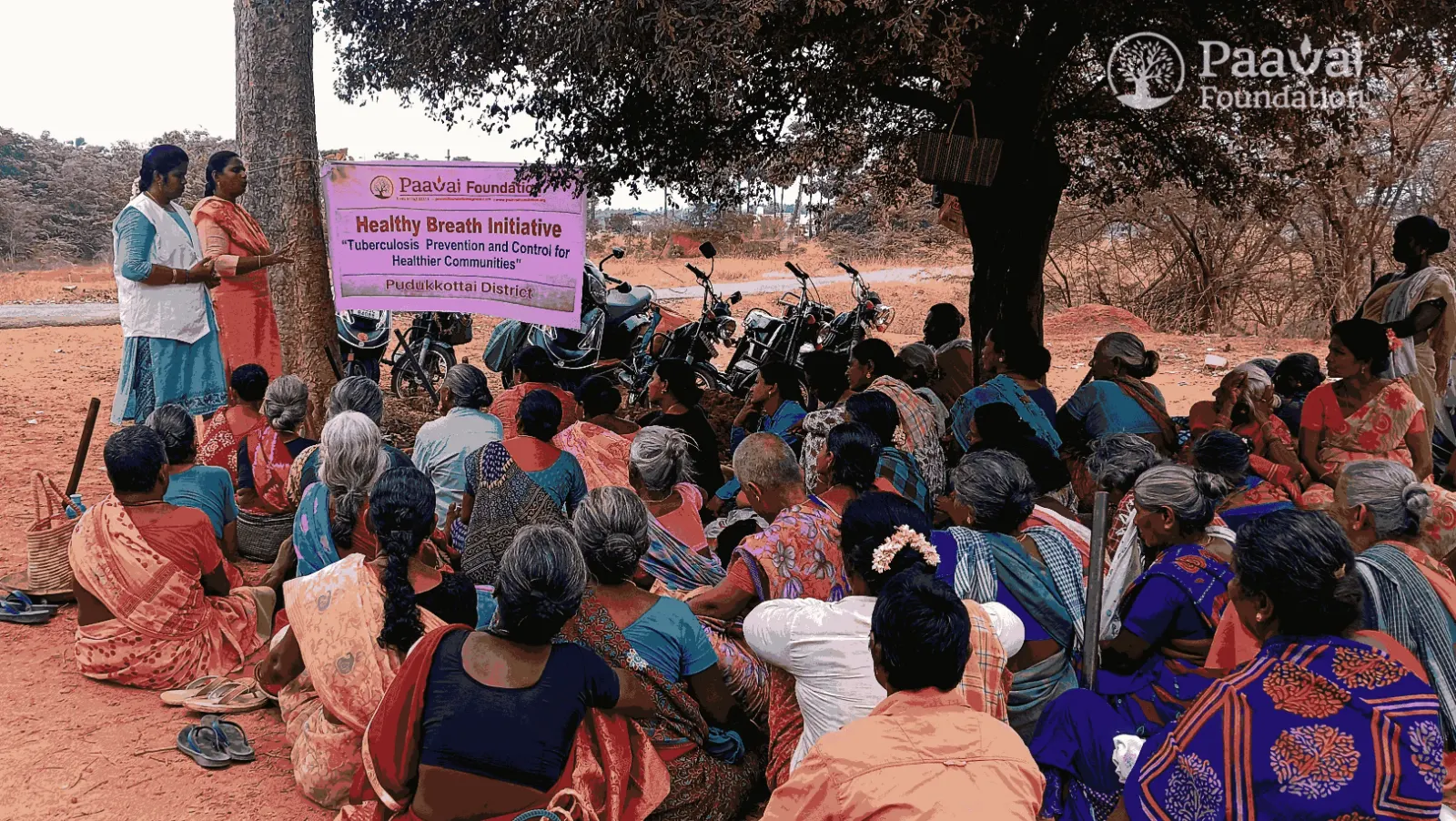
Paavai Foundation is an Integrated Child Development Foundation, and Pudukkottai is among the Tamil Nadu districts where our community development activity runs, alongside Tiruchirappalli, Madurai, Namakkal, Krishnagiri, Tiruvannamalai, Theni, Dindigul, Sivagangai, Karur, Tirupathur, Perambalur, Ramanathapuram and Virudhunagar, with presence extending into Telangana and Andhra Pradesh.
The word integrated in our description is doing deliberate work. Our programmes span child protection and care, education, health and wellness, nutrition, disability inclusion, youth leadership, elderly care and district-level community development, structured to connect to one another because households do not experience their difficulties as separate problems. A child who stops attending school because her mother is unwell and the family has lost a season's income is not an education case, a health case and a livelihood case. She is one child, and the response has to be built that way.
Paavai Community Connect 360 is the framework that holds this together at district level, working through pathways covering health, education, women's empowerment, environment and equality, and designed to operate through existing local systems rather than alongside them. The reasoning behind that design is set out at length in Paavai Community Connect 360: Transforming Communities Through Integrated Development, Inclusion, and Sustainable Impact.
We publish what we can substantiate and decline to publish what we cannot. In a sector where inflated figures are common, we would rather describe our work accurately than quantify it impressively.
Guiding all of it is a phrase we treat as a standard rather than a slogan: Care for Life. It refers to duration.
How you can help
Support for a district like this is most useful when it is predictable rather than large.
Give. A modest amount contributed monthly is worth considerably more to a programme than a one-off gift, because it allows a commitment to a child for a full school year rather than a single month. Donate now to support child care, education, health, nutrition, disability inclusion and community development work.
Give time or expertise. Teaching, medical, therapy, legal, accounting, design and technology skills are frequently scarcer in this sector than funds. Volunteer with Paavai to contribute what you know.
Give unrestricted where you can. Donors like funding the visible things — books, uniforms, meals. Organisations also need to pay trained staff, run transport and maintain records. Restricting every rupee to the photogenic parts of the work quietly starves the parts that hold it together.
Companies: think in years. A three-year programme partnership achieves things three annual grants of the same total value cannot, because only one of them permits planning.
Or simply pass information on. Telling a family in your village about an entitlement they did not know existed, or helping a parent complete a disability certificate application, changes something concrete and costs nothing.
The district already knows how this works
There is a version of writing about rural districts that treats them as sites of deficit — a list of what is missing, addressed to readers elsewhere who might send something.
Pudukkottai has earned a different framing. The literacy campaign here demonstrated, three decades ago and at considerable scale, what happens when a community sets its own priority and is given the means to act on it.

The bicycles were not the point. The point was that thousands of women decided what they needed and then went and got it.
That is the standard any organisation working here should be measured against. Not what was delivered, but what the community was enabled to do for itself, and whether it continued after the organisation stopped coming.
A stronger community is not one that receives more. It is one that has more of what it needs within reach: a school a child stays in, a health service that can be reached, a certificate obtained, an entitlement claimed, an elderly parent who is not alone.
That work is slow, unglamorous and rarely photographs well. Eighteen months later, the difference is visible.
Frequently Asked Questions
What does an NGO in Pudukkottai typically work on?
Common areas include education continuity and dropout prevention, child nutrition and health access, child protection, disability inclusion and special education support, women's empowerment, elderly care and helping households access government schemes and entitlements they qualify for.
How do I choose between NGOs in Pudukkottai?
Decide first what you want to support, then verify registration through NGO Darpan, confirm 80G status if you intend to claim a deduction, ask how long the organisation stays in a location, ask about child safeguarding policies, and request a visit or a detailed conversation with programme staff.
What are the main challenges facing children in Pudukkottai district?
Interruption to schooling caused by seasonal income and family migration, distance to specialist healthcare, very limited local access to disability assessment and special education, the position of first-generation learners without home support, and dropout risk at the secondary stage, particularly for girls.
Does Paavai Foundation work in Pudukkottai?
Yes. Pudukkottai is among the Tamil Nadu districts where Paavai Foundation's community development activity runs, alongside Tiruchirappalli, Madurai, Namakkal, Krishnagiri and others, with presence extending into Telangana and Andhra Pradesh.
How can I volunteer with an NGO in Pudukkottai?
Contact the organisation directly to ask what skills they currently need. Teaching, medical, therapy, counselling, legal, accounting and technology expertise are usually in shorter supply than general volunteering time.
Are donations tax-deductible?
Donations to organisations holding valid registration under Section 80G of the Income-tax Act may qualify for a deduction, subject to conditions and limits. Always ask for the registration details, verify them independently, and keep the receipt.
What is the most useful way to support families in a rural district?
Recurring rather than one-time giving, unrestricted rather than fully earmarked funding, professional skills where you have them, and multi-year commitments in the case of companies. Helping a single family claim an entitlement they did not know about is also more valuable than it sounds.
Why does integrated community development matter more in rural districts?
Because problems arrive connected. A child leaves school for reasons involving health, income, distance and family circumstances simultaneously. An organisation addressing only one of those addresses a fraction of the situation.