The dangerous moment in tuberculosis treatment is not the diagnosis.
It is somewhere around week eight. The cough has stopped. The night sweats have gone. The patient has put on a little weight, feels recognisably like himself again, and has four more months of tablets in front of him. He is also a daily-wage worker who has lost income for two months, and the tablets make him nauseous when he takes them on an empty stomach, which is most mornings.
He feels cured. He is not cured. And the treatment that would have finished the job is sitting in a blister pack he stops opening.
This is where India's tuberculosis effort is won or lost. Not in finding cases, though that matters enormously, but in the unglamorous business of keeping a person on a six-month regimen when everything in their life is arguing against it.
Incomplete treatment does not simply leave the patient where they started. It risks relapse, continued transmission within the household, and the development of drug resistance, which turns a curable illness into a far longer, costlier and more dangerous one.
Nutrition sits closer to the centre of this problem than most people realise.
A relationship that runs in both directions
The link between undernutrition and tuberculosis is one of the better-established relationships in public health, and it is circular.
Undernutrition weakens immune function, which makes a person more likely to progress from latent infection to active disease. Active disease then causes appetite loss, weight loss and nutritional depletion, which deepens the undernutrition. Each condition makes the other worse.

This matters for India specifically, because the country carries the world's largest share of tuberculosis cases, and because undernutrition is widely identified as the single largest contributing risk factor for TB in the Indian population. That is a different situation from countries where the dominant drivers are HIV, diabetes or smoking. A TB response designed for elsewhere will underweight the thing that matters most here.
Current global figures and country profiles are published by the World Health Organization.
What the evidence actually shows
For a long time, the nutrition and TB connection was accepted as obviously true and rarely tested directly. That changed with Indian research.
A large trial conducted in Jharkhand, published in 2023, examined what happened when food rations were provided to tuberculosis patients and their household contacts.
Also Read: Paavai Arogya: Building Health, Wellness, and Resilience for Vulnerable Communities
It reported meaningful reductions in TB incidence among the household contacts who received nutritional support, and improved outcomes among patients. The finding that drew international attention was that a food-based intervention, not a drug, produced results at a scale usually associated with pharmaceutical trials.
The implication for programme design is significant. Nutrition support for TB is not a compassionate add-on to the clinical work. On this evidence, it is part of the clinical work.
Two honest caveats. Trial conditions are not field conditions, and a ration delivered reliably in a study is not the same as a ration delivered reliably across a district. And no single study settles a question. But the direction of the evidence is clear enough that India's own policy has moved with it.
Why an empty stomach ends treatment early
The mechanism connecting nutrition to treatment completion is not mysterious, and it becomes obvious the moment you look at a patient's actual day.
Side effects are worse on an empty stomach. TB medication commonly causes nausea, appetite loss and gastric discomfort. Taken by someone who has not eaten properly, the discomfort is considerably sharper. A patient who feels sick every morning after taking tablets is a patient looking for a reason to stop.
Weight loss is read as treatment failure. A patient who is not regaining weight concludes the medicine is not working, particularly when the household is watching and forming its own view. Visible recovery sustains belief in the treatment. Its absence undermines it.
Income loss compounds everything. TB affects working-age adults disproportionately. A daily-wage earner too weak to work is a household without income, and a household without income eats less, which slows the recovery, which extends the period without income.
Stigma isolates. Households where TB is concealed do not get support from neighbours, and patients who fear disclosure skip follow-up visits at facilities where they might be seen.
Distance costs money. Monthly collection of medication and follow-up testing requires travel. For a household already down an earner, fares and lost hours are a real deterrent.
None of these are failures of willpower. They are the predictable results of asking a person to complete a demanding six-month course while their material circumstances deteriorate. Address the nutrition and the income shock, and you have removed two of the largest reasons people stop.
What the government already provides, and who is not getting it
India's TB response runs through the National Tuberculosis Elimination Programme, and it includes a nutrition component that a great many eligible patients never receive.
Ni-kshay Poshan Yojana provides direct benefit transfer for nutritional support to notified TB patients for the duration of their treatment. The monthly amount was increased from its original level, and the payment is made into the patient's bank account. The mechanism requires notification on the Ni-kshay system, bank account details and Aadhaar linkage, and this is precisely where eligible patients fall out: an unbanked patient, a patient whose notification was incomplete, or a patient nobody told about the scheme receives nothing at all.
Pradhan Mantri TB Mukt Bharat Abhiyaan, launched in 2022, created the Ni-kshay Mitra mechanism, under which individuals, organisations, companies and institutions can adopt TB patients and provide nutritional and other support for a defined period. It is one of the more genuinely well-designed community participation schemes in Indian public health, and it is underused relative to its potential.
Programme information is published by the Central TB Division, and the Ni-kshay Mitra registration route through the community support portal.
The pattern here is the one that recurs across almost every Indian entitlement. The policy exists. The money is allocated. The gap is between the scheme and the person, and it is made of information, documentation, banking access and travel. Helping one household complete a Ni-kshay registration it did not know about creates more value than most of what passes for health awareness work.
What a TB treatment nutrition support story actually looks like
Search for a TB treatment nutrition support story and you will find a recognisable genre: a named patient, a dramatic before-and-after, a precise weight gain, a completed course, a photograph.
Some of these are true. Many are constructed, and the constructed ones cause real damage, because they train donors to expect a tidy causal line from one intervention to one recovery. Actual recovery is rarely attributable that cleanly. A patient who completes treatment did so because the diagnosis was made, the medication was available, a health worker followed up, the household held together, the ration arrived, and the person decided to keep going. Nutrition support is one strand in that, and any organisation claiming sole credit is describing something that did not happen.
An honest TB treatment nutrition support story is therefore less satisfying and more useful. It sounds like this: a programme reached this facility, in this block, on these dates. It worked alongside the government system rather than parallel to it. It provided nutritional support and health awareness to patients and families. Whether a specific individual completed treatment because of it is not something the programme can claim, and does not claim.
That is a weaker headline. It is a far better basis for deciding where to put money.
It also points at what a meaningful community health impact story should contain: named locations, verifiable dates, the existing system it connected to, and an honest account of what the intervention can and cannot be credited with.
Nutri Heal: where our work sits
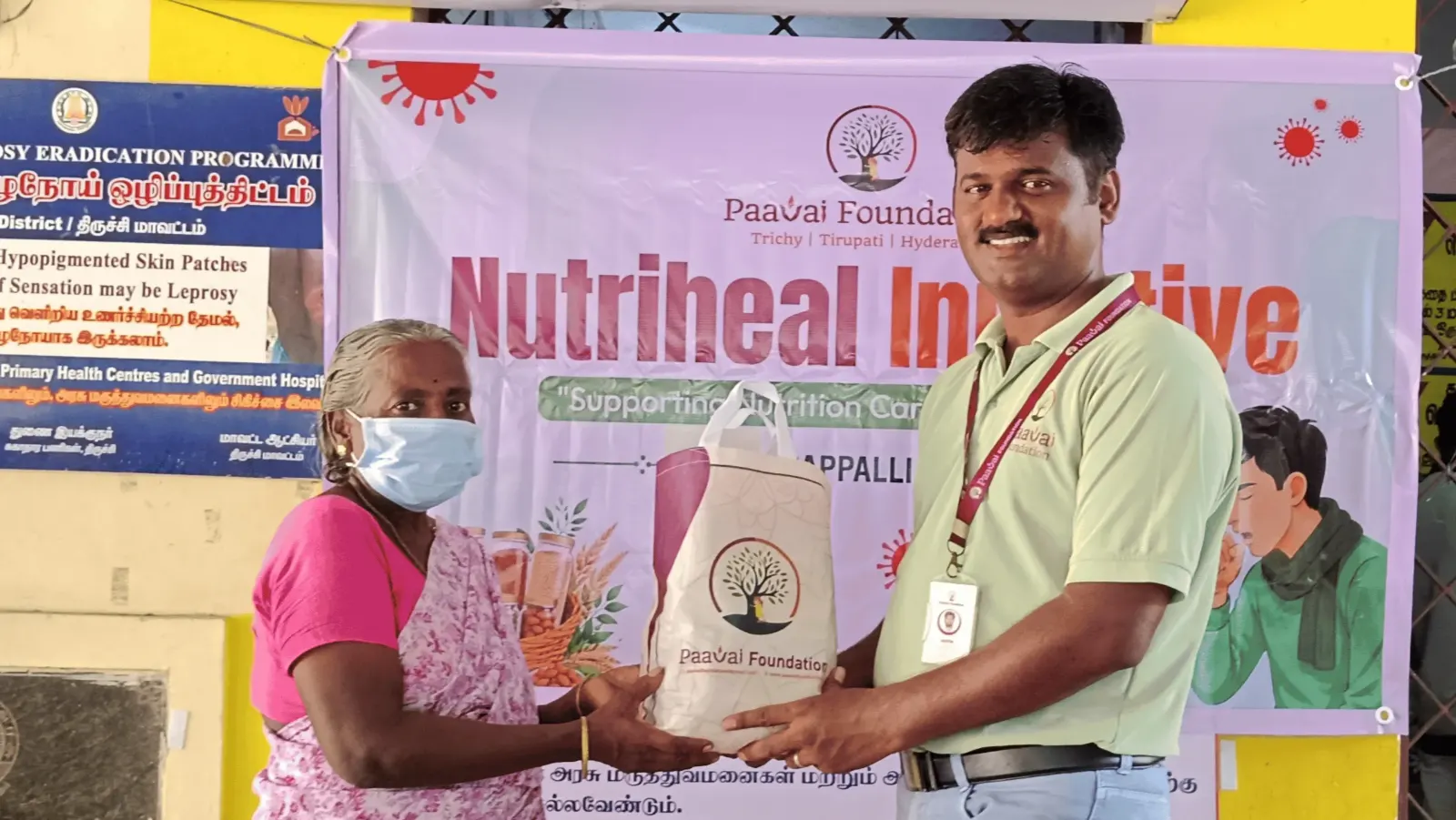
Paavai Foundation runs Nutri Heal, a community-based nutrition support initiative for tuberculosis patients, built on the understanding that recovery is not only a medical journey and that nutrition, family participation and community encouragement form part of the environment a patient recovers in.
The approach is deliberately non-parallel. Rather than establishing separate infrastructure, Nutri Heal outreach has been conducted through existing government health facilities — primary health centres, block-level facilities, government hospitals and medical colleges — so that nutrition support meets patients at the point where they are already accessing treatment.
Outreach has been conducted across districts of Tamil Nadu including Madurai, Karur, Ramanathapuram, Pudukkottai, Tiruchirappalli, Namakkal, Virudhunagar, Theni, Tirupathur, Tiruvannamalai, Sivagangai and Krishnagiri, engaging facilities such as the Kunichi Block Primary Health Care Centre in Tirupathur, Chengam Government Hospital in Tiruvannamalai, Kadamalaigundu and Samathuvapuram Primary Health Centres in Theni, Government Medical College and Hospital in Namakkal, the Primary Health Care Centres at Anthanallur and Kulumani in Tiruchirappalli, Thogaimalai in Karur, Government Hospital at Tirumangalam in Madurai, Tiruvegampet in Sivagangai, the TB Sanitorium in Pudukkottai, and Government Hospital at Bargur in Krishnagiri.
The full programme description, objectives and district-level detail are set out in Nutri Heal: Supporting TB Patients Through Nutrition, Care and Community Support.
Nutri Heal sits alongside our broader health work under Paavai Arogya, and within an integrated set of programmes spanning child care, education, nutrition, disability inclusion, elderly care and community development.
We publish what we can substantiate and decline to publish what we cannot. We do not claim that Nutri Heal cured anyone, and we do not publish beneficiary figures we cannot stand behind. What we can describe is where the work went, who it worked alongside, and what it set out to do.
Donate now to support community health, nutrition and TB patient support work across Tamil Nadu.
What families, employers and communities can do
Families. Encourage completion of the full course even after symptoms resolve, which is the single most important thing a household can do. Ensure medication is taken with food where advised. Support the patient's nutrition actively rather than leaving it to them at a point when their appetite is poor. Get household contacts screened. And treat the illness as an illness rather than a secret, because concealment removes every source of support the household might have had.
Employers, particularly small and informal ones. A worker who is allowed flexibility for six months returns as a worker. One who is dismissed becomes a household in crisis and frequently a patient who stops treatment.

Communities and organisations. The Ni-kshay Mitra mechanism exists precisely to let individuals, companies and institutions provide nutritional support to patients for a defined period. Registration is open and the route is published. This is one of the few places in Indian public health where a private individual can attach themselves directly to a specific, structured commitment.
Anyone at all. Tell someone about Ni-kshay Poshan Yojana. A notified patient who is not receiving the nutritional benefit they are entitled to is usually not ineligible; they are unregistered, unbanked, or uninformed. The broader argument for this kind of contribution — asking what is actually needed rather than giving what is easy to organise — runs through From Giving to Change: How Local Communities Can Create Lasting Social Impact.
Recovery is a six-month decision, made daily
Return to the man at week eight.
What determines whether he finishes is not his moral character. It is whether his household has enough food that the tablets do not make him sick every morning. Whether he regained enough weight to believe the treatment is working. Whether his employer held the job.
Whether a health worker followed up when he missed a collection. Whether the ₹1,000 he was entitled to actually reached his account. Whether anyone outside his family knew he was ill and asked how he was doing.
Change three or four of those and he completes the course. Change none and he becomes a relapse case, or a drug-resistant one, and a household where the illness passes to somebody else.
TB recovery in India is not primarily a medical problem any more. The drugs work, they are free through the public system, and the diagnostic network has improved substantially.
What remains is the harder, slower, less fundable work of making sure that a person who has been diagnosed can afford, physically and financially, to finish what they started.
Nutrition is not the whole of that. It is one of the few parts of it that a community can do something about directly.
FAQs
Why does nutrition matter in TB treatment?
The relationship runs both ways. Undernutrition weakens immune function and increases the risk of progressing to active disease, while active TB causes appetite loss and weight loss that deepen undernutrition. Adequate nutrition supports strength, weight recovery and general well-being during treatment, and makes it easier to tolerate medication.
Can nutrition support replace TB medicine?
No. Tuberculosis requires a full course of prescribed medical treatment. Nutrition support complements clinical care and never substitutes for it. Anyone with symptoms should consult a doctor or a government health facility.
Why do patients stop TB treatment early?
Usually because symptoms improve after a few weeks while the course continues for months, combined with medication side effects that are worse on an empty stomach, loss of income during illness, stigma, and the cost and time required for monthly follow-up. Stopping early risks relapse, transmission and drug resistance.
What is Ni-kshay Poshan Yojana?
A government scheme providing direct benefit transfer for nutritional support to notified TB patients for the duration of their treatment. It requires notification on the Ni-kshay system along with bank and Aadhaar details, which is where eligible patients most often fall out.
What is a Ni-kshay Mitra?
Under Pradhan Mantri TB Mukt Bharat Abhiyaan, an individual, organisation, company or institution can register as a Ni-kshay Mitra and adopt TB patients to provide nutritional and other support for a defined period.
What is Nutri Heal by Paavai?
Nutri Heal is Paavai Foundation's community-based nutrition support initiative for tuberculosis patients, conducted through existing government health facilities across districts of Tamil Nadu, focusing on nutrition support, health awareness, healthy practices, family participation and community care.
Which districts does the Nutri Heal TB patient support programme cover?
Outreach has been conducted across districts of Tamil Nadu including Madurai, Karur, Ramanathapuram, Pudukkottai, Tiruchirappalli, Namakkal, Virudhunagar, Theni, Tirupathur, Tiruvannamalai, Sivagangai and Krishnagiri, engaging primary health centres, block facilities, government hospitals and a government medical college.
How can families support someone with TB?
Encourage completion of the full course even after symptoms resolve, support nutrition actively during a period of poor appetite, ensure medication is taken as advised, get household contacts screened, and treat the illness openly rather than concealing it.
Is TB treatment free in India?
Diagnosis and treatment for tuberculosis are provided through the public health system under the National Tuberculosis Elimination Programme. Contact your nearest government health facility for current details.