A state-level average can hide more than it reveals.
Tamil Nadu as a whole has made visible progress in school enrolment, mid-day meals and health access. Yet any teacher who has worked in two different districts, or any health worker who has moved from one block to another, will tell you that the experience of being a child in Tiruvannamalai is not the same as being a child in Ramanathapuram. Soil, water, roads, distance to a secondary school, whether a parent migrates for work for three months a year, which language is spoken at home — all of these shape whether a child is safe, well-nourished, able to stay in school, and able to be heard.
This piece stays at that ground level. It does not attempt to rank districts or reduce them to numbers.
The source material for this profile Paavai Foundation own programme writing — describes a presence across 14 districts in Tamil Nadu by name, with community-level activity that extends further through health and nutrition outreach. That geography is the frame used here. The aim is to show what child care and education looks like when you look district by district, and why an integrated, continuous approach is needed rather than a single intervention.
Why a district map matters more than a state average
A district is where policy becomes a person. Schemes are designed at the state and centre, but they are claimed or missed at the block, in the panchayat, at the primary health centre and in the government school that a child can actually walk to.
Three realities make the district lens necessary.
First, continuity is local. Whether a child stays in school often depends not on willingness but on whether support holds without interruption across an academic year — the same place to study, someone noticing absence, help with learning before a small gap becomes a dropout. Paavai Foundation names this directly. Its education initiative, Paavai Gurukul, is built around uninterrupted access to formal education, academic mentoring and exposure to digital and future-ready learning, framed as a response to repeated interruption rather than to lack of ability.
Second, care is connected. A child who is hungry cannot learn, and a child who is unwell cannot attend. This is why Paavai describes itself as an Integrated Child Development Foundation guided by Care for Life. and by a Cradle-to-Career-to-Community model sequenced as CARE → EDUCATE → EMPOWER → LEAD.
Protection is treated as the precondition for education, and education as the precondition for participation. That sequence only works if health, nutrition, emotional well-being and family support are held together at the same address.
Third, delivery is through existing systems. In the Foundation's health and nutrition work, including Nutri Heal for tuberculosis patients and the Arogya Mobile Units, outreach is described as conducted with government hospitals and primary health centres at block level, not parallel to them.
That choice matters district by district, because the PHC in Kunichi is not the PHC in Thogaimalai, and the distance a family must travel in Bargur is not the distance in Anthanallur. Working through the system that will still be there in twenty years is what allows care to continue.
The 14 districts in view
Paavai Foundation stated community-development presence in Tamil Nadu spans 14 districts.
They are, as named in the source material: Dindigul, Sivagangai, Karur, Theni, Krishnagiri, Tiruchirappalli, Madurai, Tirupathur, Perambalur, Tiruvannamalai, Pudukkottai, Namakkal, Ramanathapuram and Virudhunagar. Telangana and Andhra Pradesh are described as extension geographies, but this piece remains with Tamil Nadu.
A second figure appears elsewhere in the same source material, stating community development activities across 20+ districts in Tamil Nadu. The distinction between formal programme presence and cumulative activity reach is not explained in the material, so this article stays with the 14 districts that are named explicitly and does not treat either figure as a beneficiary count.
To make the picture readable, the districts are grouped here into three contiguous belts. The grouping is geographic, not administrative, and is used to draw out what children and families tend to experience in each belt.
North: Tiruvannamalai, Tirupathur, Krishnagiri
This belt sits along the northern interior, where blocks like Chengam in Tiruvannamalai, Kandhili and Kunichi in Tirupathur, and Bargur in Krishnagiri appear in the Foundation's block-level health outreach.
Here, care and education are shaped strongly by distance and movement. Habitations can be scattered, secondary schools are not always within comfortable walking distance, and seasonal movement for agricultural or construction work can interrupt a child's year. A child who misses four weeks may return to find the class has moved on, and without follow-up, that absence hardens into disengagement.
What continuity means here is practical. It means someone notices the absence early, visits the home without judgment, helps the child catch up, and ensures the family knows what entitlements and support already exist at the PHC and the school. Paavai's Community Connect 360 model is described as district-wise planning with local implementation strategies and community participation, which in this belt translates to working with block facilities like Chengam Government Hospital and the Kunichi Block Primary Health Care Centre as entry points for health, nutrition awareness and referral — so that health and schooling are supported together rather than in separate visits from separate teams.
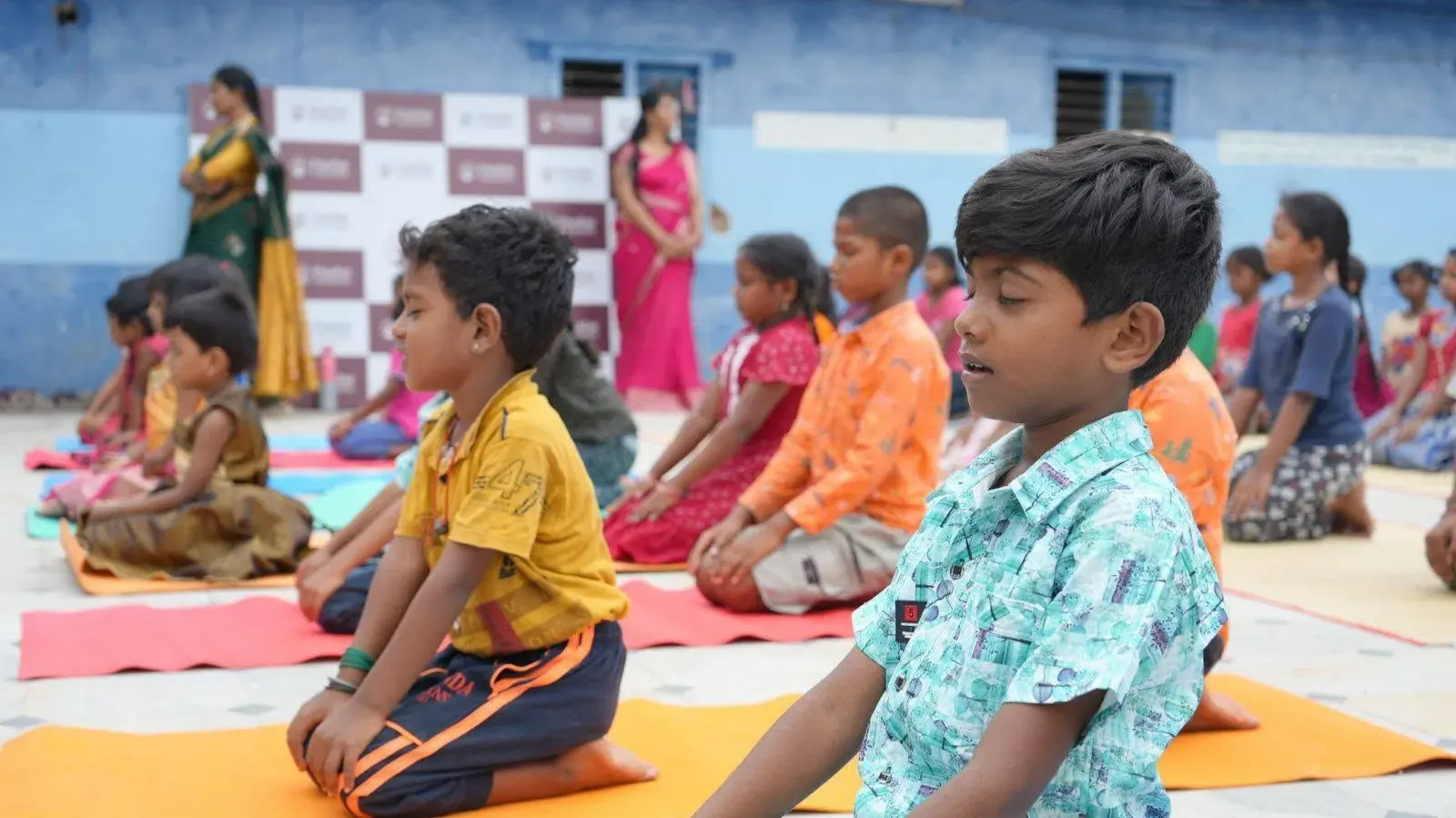
Education support in this context is less about adding content and more about protecting the year from breaking. Academic mentoring, learning reinforcement and inclusive attention to children who learn at different paces keep a difficult term from becoming a reason to leave.
Centre: Namakkal, Karur, Tiruchirappalli, Perambalur, Pudukkottai
The central belt is the Foundation's operational core. It includes Namakkal, where the Government Medical College & Hospital is named as a Nutri Heal outreach site, Karur with Thogaimalai block, Tiruchirappalli with Anthanallur block, Perambalur, and Pudukkottai with its TB Sanitorium.
Children here often live within a denser network of schools and health facilities than in the northern hills, but density does not automatically mean access. Classrooms can be crowded, support for children who need more time is stretched thin, and families navigating illness, debt or disability may still struggle to keep a child's education, health monitoring and nutrition steady at the same time.
This is where the integrated programme design is most visible in practice. Paavai describes nine connected initiatives rather than standalone projects. For a child in this belt, that connection might look like this: Paavai Abhayam providing the foundation of safe, stable, dignified care and emotional security; Paavai Arogya ensuring preventive healthcare, regular monitoring, mental well-being and wellness practices are treated as routine rather than as a response to crisis; Paavai Gurukul and Paavai Shishumithra together protecting continuous education, balanced nutrition and healthcare, physical development and creative growth, with discipline cultivated through structure rather than fear; and Paavai ID Care ensuring that for children with intellectual disabilities, special education, therapy, rehabilitation, health monitoring and life-skills support are delivered lifelong and together.
Pudukkottai, Tiruchirappalli, Karur and Namakkal also illustrate why block-level detail matters. Work described at PHC Anthanallur and PHC Kulumani in Tiruchirappalli, PHC Thogaimalai in Karur, and the Government Medical College & Hospital in Namakkal shows that “presence in a district” in practice means presence in specific blocks and facilities, over time, with referral and follow-up built in.
South: Madurai, Theni, Dindigul, Sivagangai, Ramanathapuram, Virudhunagar
The southern belt is diverse — from the urban density of Madurai and the foothill blocks of Theni to the coastal stretches of Ramanathapuram and the interior blocks of Sivagangai and Virudhunagar.
In Madurai, outreach is described at Government Hospital, Tirumangalam in Tirumangalam block. In Theni, at Kadamalaigundu PHC and Samathuvapuram Urban PHC in Mayildumparai and Theni blocks. In Sivagangai at PHC Tiruvegampet in Tiruvegampet block.
In Ramanathapuram at Government Hospital, Ramanathapuram in Ramanathapuram Block. In Virudhunagar at Virudhunagar and Aruppukottai facilities. Dindigul is listed as a core presence district and appears across the Foundation's wider community work.
What children face here varies, but the thread across these districts is that vulnerability rarely arrives as a single issue. A family may be managing a TB-affected adult, a child with irregular attendance, an elder who needs daily support, and a lack of clear information about hygiene, nutrition and available services — all at once.
Nutri Heal's nutrition support for TB patients during treatment, delivered alongside awareness building and family participation and explicitly described as complementing medical treatment rather than replacing it, is one example of addressing a household need that directly affects a child's ability to learn and thrive. The Zero Hunger Drive, Swachh Initiative and Arogya Mobile Units under Community Connect 360 are described as addressing food security, water, sanitation and hygiene awareness, and basic screening and preventive care in the same community frame.
An additional layer in this belt is intergenerational. Anbucholai Elderly Care, noted in the source material as launched in 2025 in collaboration with the Government of Tamil Nadu, is positioned as dignity across generations.
Elders are not placed outside child development but inside it, as mentors and storytellers, particularly in connection with girls. In districts where migration has thinned the presence of elders in daily life, that reconnection helps children gain a steady, patient presence and helps elders regain a role that protects their own well-being.
What is common across all 14 districts
For all the differences, four needs recur in near-identical words across the Foundation's programme writing.
Safety and dignity before measurement. The child protection and care work of Paavai Abhayam is described with emphasis on safe and secure living, nutritious food, medical care, hygiene and dignity support, and emotional care and counselling.
The phrase “dignity-first approach” recurs across child protection, disability and elderly care material. That is not decorative language. It is a way of saying that how care is given — privately, respectfully, with consent around photography and story — shapes whether a child can accept it.
Health as a continuous system. Paavai Arogya's description treats health as preventive, monitored and emotionally attentive, with therapy, rehabilitation and daily wellness where needed. The mobile units and PHC-linked outreach exist to make regular check-ups, awareness and referral possible without requiring a family to travel far or wait for a crisis.
Education as continuity, not just entry. The barrier named repeatedly is not that a child cannot be enrolled, but that enrolment is interrupted. Continuous academic support, mentoring, digital exposure and inclusive attention to different learning needs are framed as what keeps a child in school once they are in.
Voice and leadership as participation, not authority. The youth leadership work of Paavai Nayak is described as voice-first — that leadership begins when a young person is heard. Its components — confidence, communication, awareness of rights and responsibilities, decision-making and community participation — are not delivered as a single event but practised over months, which is why the same sequencing appears here: CARE → EDUCATE → EMPOWER → LEAD.
A word on what this picture cannot yet show
Any district-by-district picture should be honest about its limits. The source material this article is drawn from is Paavai Foundation's own programme and blog writing and its keyword plan.
It is authoritative on how the organisation describes its programme design, geography and philosophy, and it is intentionally thin on independently verifiable quantities. Registration numbers, founding year, beneficiary counts, audited financials and partnership details beyond the one named collaboration for Anbucholai do not appear in that material and have not been reproduced here.
That choice is deliberate. A ground-level picture should describe what is done and where it is done rather than invent figures to fill gaps.
Readers who need verification — for donation, CSR or research — should check the live website for transparency disclosures or ask the organisation directly for its registration credentials, tax status and most recent annual report and audited statements. The same standard the Foundation recommends for evaluating any non-profit is the standard it should be held to.
The Foundation also maps Community Connect 360 against all 17 Sustainable Development Goals.
In this article that alignment is presented as the framework the work is planned within, not as a quantified claim of progress against individual goals.
What steady support makes possible — and what it asks
If there is a single message that holds across Tiruvannamalai and Tirunelveli, Namakkal and Ramanathapuram, it is that children do not change because of a single distribution or a camp. They change when support does not stop.
A year of steady presence in one block allows trust to form. A second year allows a child who was silent to speak. A third allows a young person to make a decision about their own future with enough information to make it well. That duration is what the Foundation means when it uses the internal phrase Care for Life to describe its own standard. It is a commitment to stay, not to visit.
That kind of staying is not the work of an organisation alone. It depends on teachers, health workers, panchayat members, families and volunteers who are already in the district.
Community Connect 360 is explicitly described as collaboration with local stakeholders and institutions, with community awareness and participation built in. For a company or an individual wondering how to contribute, the most credible entry points described are straightforward: support children's education and nutrition, volunteer time and skills steadily rather than once, and explore partnership where the work aligns with the community's own priorities for health, learning and inclusion.
For families, the practices are smaller and closer to home: keep a child's schooling continuous by addressing absence early, treat health and nutrition as daily routines rather than reactions, and allow children — including girls — to be listened to and included in decisions in a way that builds confidence over time.
Staying with one place
There is a temptation to cover more ground — more districts, more numbers, more claims. Grassroots work teaches the opposite. To know Pudukkottai is to know which blocks you work in and which PHC you visit. To know Tirupathur is to know the road to Kunichi in a given season. To know a child is to have been present long enough that the child corrects you.
That is the value of a district-by-district view. It returns the conversation from the abstract state to the actual place where a child wakes, eats, walks to school, and is either noticed or missed.
Tamil Nadu's children do not live on average. They live in Chengam, in Thogaimalai, in Anthanallur, in Tirumangalam, in Bargur, in Ramanathapuram Block. Care that reaches the district and then continues to the block, and then remains, is what makes education hold.
Care for Life.