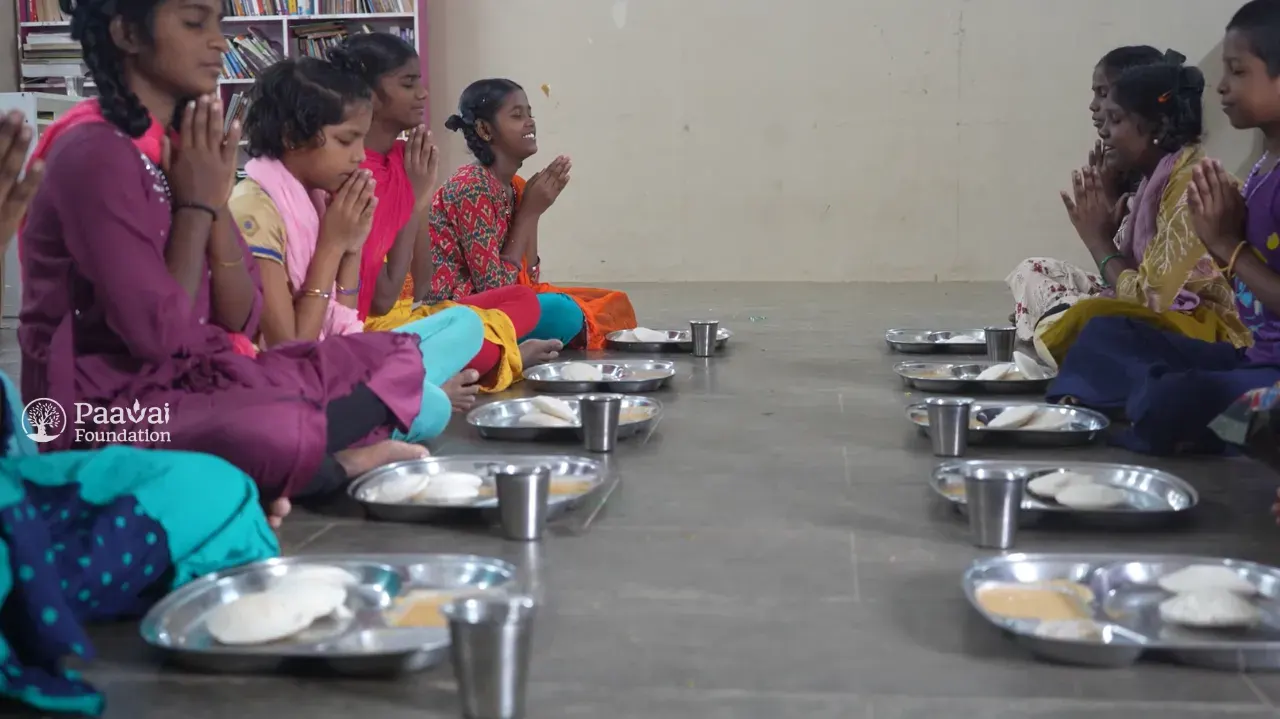
In most Indian villages, the question "did the child eat today?" has an answer, and the answer is usually yes.
She ate rice. She ate it at home in the morning and at school at midday and at home again at night. She was not hungry when she went to bed. By the standard most people hold in their heads when they think about hunger a child with an empty plate she is fine.
She is also, quite possibly, stunted. Her haemoglobin may be low enough to affect her concentration in class. Her immune system may be running below capacity. And thirty-five years from now, her risk of diabetes and cardiovascular disease will be higher than it should be, for reasons set in motion while she was eating three meals a day.
This is the shape of India's food problem now, and it is genuinely different from the problem the country faced two generations ago. Then, the question was whether there was enough food. India answered that question. The Green Revolution, a procurement system of extraordinary scale, and a public distribution network reaching hundreds of millions of people turned a famine-vulnerable nation into one holding buffer stocks.
What the country did not solve, and in some ways made harder, is the question of what is in the food.
What the day marks
World Food Day 2026 falls on Friday, 16 October. The date marks the founding of the Food and Agriculture Organization of the United Nations in 1945, and has been observed annually since 1981.
The FAO announces a theme each year, published on the FAO World Food Day page along with campaign materials. Recent themes have moved steadily away from production volume towards the quality, diversity and sustainability of food systems which is precisely the shift this article is about.
The day sits within a broader framework: Sustainable Development Goal 2, Zero Hunger, which targets not only an end to hunger but an end to all forms of malnutrition, explicitly including stunting, wasting and micronutrient deficiency. That distinction between hunger and malnutrition is the one most public conversation still collapses.
Calories are not nutrition
The central confusion is worth stating plainly.
Hunger is insufficient food. Malnutrition is insufficient or inappropriate nutrition, and it includes undernutrition, micronutrient deficiency and obesity simultaneously. A country can largely solve the first while the second persists, and India is close to being the clearest example in the world.
Three forms matter here.
Stunting low height for age reflects chronic undernutrition in early childhood. It is not primarily about current food intake; it reflects the cumulative effect of inadequate nutrition and repeated infection over the first years of life, and after roughly the age of two it is largely irreversible.
Wasting low weight for height reflects acute, recent undernutrition.
Micronutrient deficiency iron, vitamin A, zinc, iodine, vitamin B12, calcium is sometimes called hidden hunger, because it produces no visible emaciation. A child can be of normal weight, eating daily, and severely anaemic.
Anaemia in particular is a quiet disaster. It affects concentration, learning, physical capacity and, in adolescent girls and pregnant women, maternal and infant outcomes. A classroom of anaemic children looks like a classroom of inattentive children, and gets treated as one.
Information on India's nutrition programmes is published by the Ministry of Women and Child Development, and public health guidance by the Ministry of Health and Family Welfare.
Why a cereal-heavy diet persists
If the problem is dietary diversity, the obvious question is why households do not simply eat more varied food. The reasons are structural, not a failure of knowledge.
Cereals are cheaper per calorie than anything else. For a household budgeting at the margin, rice and wheat deliver the most energy per rupee. Pulses, eggs, dairy, fruit, vegetables, meat and fish all cost considerably more per unit of energy. A rational household under income pressure buys calories first.
The distribution system was built for grain. India's public distribution network procures, stores and distributes wheat and rice at enormous scale and remarkable reach. That architecture procurement, minimum support prices, warehousing, fair price shops is optimised for storable cereals. Pulses, vegetables, eggs and milk are harder to procure, store and distribute, so the system that reaches furthest delivers precisely the nutrients households already have most of.
Agricultural incentives follow the same logic. Where procurement guarantees exist primarily for cereals, farmers plant cereals. The cropping pattern reflects the procurement pattern, which reflects a policy designed when the objective was aggregate food availability.
Protein is expensive and culturally variable. Pulse prices have been volatile for years. Eggs, dairy, meat and fish face price, access and dietary-practice constraints that vary enormously by region and household.
Women eat last and least. In a great many households the sequence is men, then children, then the woman who cooked. This is not a marginal custom; it is one of the more significant drivers of anaemia among adolescent girls and women of reproductive age, and it transmits directly to the next generation.
And nutrition knowledge is thin. A household may know that food matters without knowing that iron absorption improves with vitamin C, that a cereal-and-pulse combination provides better protein than either alone, or that a child's first two years carry disproportionate weight.
Food that never gets eaten
Running alongside the nutrition problem is a loss problem, and it is substantial.
Post-harvest losses in India are significant, concentrated in exactly the foods the country needs more of. Grain stores reasonably well. Fruit, vegetables, milk, eggs and fish do not, and losses occur through inadequate cold chain, poor storage, transport delays, and the absence of processing capacity near production.
This is why nutritious food is expensive. It is not only that tomatoes cost more to grow than rice. It is that a meaningful share of the tomatoes never reaches anyone, and the price of what survives absorbs the loss.
There is a second kind of waste at the other end: food discarded at weddings, in hotels, at functions, in urban households and it is more visible and more frequently moralised about. Both matter. The post-harvest losses probably matter more, and attract far less attention because the loss happens where nobody is watching.
What India has built, and where it leaks
It is worth being clear that India's food security architecture is substantial, because critiques of it sometimes read as though nothing exists.
The National Food Security Act, 2013 created a legal entitlement to subsidised foodgrain for a majority of the population, along with maternity benefit and meal entitlements for children.
The public distribution system reaches an enormous number of households. Integrated Child Development Services and the anganwadi network provide supplementary nutrition, growth monitoring and early childhood support.

The mid-day meal programme, now PM POSHAN, feeds schoolchildren at a scale few countries attempt and Tamil Nadu pioneered school feeding decades before it became national policy. POSHAN Abhiyaan was established specifically to address malnutrition rather than hunger.
These are not small achievements. The leaks are at predictable points.
Exclusion by documentation. A household without a correctly linked ration card, or with an Aadhaar seeding problem, is a household entitled to food that is not receiving it. The entitlement exists; the access fails.
Composition. The system's reach is greatest for the nutrients households least need more of.
The child who is not at school. School feeding reaches children in school. A girl who stopped attending in Class 8 stopped receiving her meal in Class 8.
The first two years. The window that matters most for stunting is the one in which a child is least visible to institutions not yet in school, dependent on anganwadi coverage and household practice.
Migrant households. Portability has improved, but families moving for work remain among the most likely to fall through.
A substantial amount of nutrition work in India therefore consists not of providing food but of connecting households to food they are already legally entitled to and not receiving. It is unglamorous, it generates no photographs, and it is frequently the highest-value thing anyone does.
What a serious response looks like
Five shifts, in rough order of leverage.
Target the first thousand days. Conception to a child's second birthday is where stunting is determined and where intervention is largely irreversible after the fact. Maternal nutrition, exclusive breastfeeding, and adequate complementary feeding from six months do more than any later intervention. This is also where adolescent girls' nutrition belongs, since a depleted young woman becomes a mother with depleted reserves.
Shift from calories to composition. Protein quality, iron, vitamin A, zinc and dietary diversity, rather than quantity. In practical terms: pulses, eggs, milk, green leafy vegetables and fruit, and programmes assessed on what they deliver nutritionally rather than on how many plates were filled.
Fix access before adding programmes. A household that cannot use its existing entitlement does not need a new scheme. Ration card linkage, Aadhaar seeding, portability for migrants, scheme enrolment. Clearing these is cheaper and faster than building anything new.
Address the household distribution problem. Food arriving at a house does not guarantee it reaches the girl in it. Work on intra-household distribution and on women's nutrition specifically is among the most neglected areas in Indian nutrition.
Reduce post-harvest loss. Storage, cold chain and local processing make nutritious food cheaper by making more of it survive.
Where our work sits
At Paavai Foundation, nutrition runs through our programmes rather than sitting beside them, and this article explains part of why.
A child's nutritional status connects to her household's income, her mother's health, her school attendance and the healthcare her family can reach. Addressing one of those in isolation addresses very little, which is why our work spans child protection and care, education, health and wellness, nutrition, disability inclusion, youth leadership, elderly care and district-level community development, held together by the Paavai Community Connect 360 framework across districts in Tamil Nadu, with presence extending into Telangana and Andhra Pradesh.
The relationship between nutrition and disease outcomes is not theoretical in our work. Nutri Heal, our community-based initiative for tuberculosis patients, exists because nutritional status shapes how illness progresses and how recovery goes, and because a patient's ability to complete a six-month treatment course depends partly on whether the household has enough of the right food. The approach is described in Nutri Heal: Supporting TB Patients Through Nutrition, Care and Community Support, and the long-horizon argument that feeding a child properly is preventive medicine with a thirty-five-year lag in World Heart Day 2026: Why Adult Heart Disease Often Begins in a Childhood Without Enough Food.
Our work with adolescent girls through Paavai Shishumithra connects to the intergenerational point above: adolescent girls' nutrition is where the next generation's starting position is partly determined, and it is among the most neglected nutritional priorities in the country.
We publish what we can substantiate and decline to publish what we cannot, which is why this article contains no beneficiary figures for our own nutrition work.
Donate now to support child nutrition, health and community development work across Tamil Nadu.
A harder definition of food security
World Food Day produces a familiar set of messages. Do not waste food. Share with those who have less. Think of the farmer.
All reasonable. All insufficient, because they describe a scarcity problem that India has substantially moved past.
The food-secure future in the title of this article is not one in which every plate is full. It is one in which every plate contains iron, protein, vitamins and diversity, which is a considerably more expensive and more complicated proposition than filling it.
Getting there requires things that do not fit on a poster: procurement systems that handle perishables, cold chains that work, cropping incentives that reward diversity, documentation that does not exclude people from entitlements they hold, and household practices in which the girl is not the last to eat.
On World Food Day 2026, the useful question is not whether children in your district are going hungry. In most places, mercifully, fewer are than a generation ago.
The question is what is on the plate, who at the table gets the smallest share of it, and whether a child who is eating three times a day is actually being nourished.
FAQs
When is World Food Day 2026?
World Food Day 2026 falls on Friday, 16 October. The date marks the founding of the Food and Agriculture Organization of the United Nations in 1945 and has been observed annually since 1981.
What is the theme for World Food Day 2026?
The FAO announces a theme each year, published on its official World Food Day page along with campaign materials.
What is the difference between hunger and malnutrition?
Hunger is insufficient food. Malnutrition is insufficient or inappropriate nutrition, including undernutrition, micronutrient deficiency and obesity. A person can eat enough to feel full every day and still be malnourished.
What is hidden hunger?
Micronutrient deficiency iron, vitamin A, zinc, iodine, vitamin B12 that produces no visible emaciation. A child of normal weight eating daily meals can be severely anaemic.
What is stunting and can it be reversed?
Stunting is low height for age, reflecting chronic undernutrition and repeated infection in early childhood. After roughly the age of two it is largely irreversible, which is why the first thousand days matter so disproportionately.
Why do Indian diets remain cereal-heavy?
Cereals deliver the most calories per rupee, the public distribution and procurement systems are built around storable grain, agricultural incentives follow procurement, and pulses, eggs, dairy and vegetables cost considerably more per unit of energy.
What is the National Food Security Act?
The 2013 Act created a legal entitlement to subsidised foodgrain for a majority of the population, along with maternity benefit and meal entitlements for children.
Why do people miss out on food entitlements they qualify for?
Most commonly documentation: ration card linkage problems, Aadhaar seeding issues, portability gaps for migrant households, and incomplete scheme enrolment. The entitlement exists; access fails.
What are the first thousand days?
The period from conception to a child's second birthday, when nutrition has a disproportionate and largely irreplaceable effect on lifelong growth, cognitive development and metabolic health.
What is the most effective nutrition intervention?
Targeting the first thousand days, including maternal and adolescent girls' nutrition, and shifting focus from calorie quantity to dietary composition protein quality, iron, vitamin A, zinc and diversity.

Comments
Loading comments...
Leave a comment
Your email address will not be published. Only your name is shown with your comment.