There is usually a moment when a family stops explaining it away.
For months, sometimes years, the signs are absorbed into the ordinary business of ageing. Appa repeats a question, and someone answers it again. Amma forgets where she kept the keys, and everyone looks for them. She skips the medicine. He calls his granddaughter by his sister's name. Each incident on its own is nothing.
Then something happens that cannot be absorbed. A parent cannot find her way home from a street she has walked for forty years.
A father accuses his own daughter of stealing from him. A mother who has cooked the same sambar three thousand times stands at the stove and does not know what comes next.
And the family, quite suddenly, understands that this is not forgetfulness.
That moment is where this article begins, because it is where most Indian families actually enter this subject: late, frightened, and without information. What follows is intended to be practically useful for anyone in that position.
A note before you read on: this article provides general information and is not medical advice. Dementia has many causes, some of them treatable, and only a qualified doctor can assess an individual. If you recognise what is described here in a family member, please seek a medical opinion rather than acting on anything in this article alone.
The day, the month, and why people search for both
World Alzheimer's Day 2026 falls on Monday, 21 September. The date is fixed at 21 September every year, first observed in 1994 when Alzheimer's Disease International marked its tenth anniversary.
Since 2012, the entire month of September has been designated World Alzheimer's Month, extending what had been a single day into a longer campaign window. That change is the reason so many people search for the month rather than the date. Both are correct. The month is the campaign; the day is its focal point.
A few other names lead to the same place, and it is worth knowing which is which.
Alzheimer's Awareness Day is used interchangeably with World Alzheimer's Day. Same date, informal name.
Alzheimer's Awareness Month is where genuine confusion begins, because the answer depends on where you are. Internationally, and in India, September is the month. In the United States, November is National Alzheimer's Disease Awareness Month, a separate designation dating from the 1980s. Neither is wrong. If you are reading an American article in November or an international one in September, this is why the dates appear to contradict each other.

Purple is the colour most commonly associated with Alzheimer's and dementia awareness, which is why campaigns, ribbons and lit-up buildings in September tend towards it.
For anyone planning a hospital programme, a school activity or a community event in India, September is the month to work with, and 21 September the day to build it around.
What "Alzheimer's awareness" is actually for
Awareness campaigns can feel decorative. This one is not, and it helps to be specific about what it is trying to change.
The purpose is narrow. It is not primarily about research funding or medical breakthroughs. It is about stigma and delay.
In a great many families, dementia is never named. It is described as old age, as stubbornness, as a mind that has become weak.
In several Indian languages, the available vocabulary for cognitive decline slides quickly towards words meaning madness, so families avoid the word and therefore avoid the doctor.
That silence delays diagnosis by years, isolates the person, leaves the family caring in the dark, and means treatable causes go untreated.
Awareness work, done properly, changes four things: whether a family recognises the signs early enough to act, whether they believe a diagnosis is worth seeking, whether the person is included in community life afterwards or hidden, and whether the caregiver receives any support at all.
Naming a thing is the beginning of dealing with it. That is what the day and the month are for.
Dementia and Alzheimer's are not the same thing
This confuses almost everyone, and the distinction is worth getting right because it affects what a doctor will investigate.
Dementia is not a single disease. It is an umbrella term for a set of symptoms — decline in memory, thinking, language, judgement and the ability to perform everyday activities — severe enough to interfere with daily life.
Alzheimer's disease is the most common cause of dementia. According to the World Health Organization, it accounts for somewhere between 60 and 70 per cent of cases.
Other causes include vascular dementia, which follows problems in the blood supply to the brain and is often linked to stroke, high blood pressure or diabetes; dementia with Lewy bodies; and frontotemporal dementia, which frequently begins with personality and behaviour changes rather than memory loss and is often mistaken for a psychiatric problem.
Some conditions that look like dementia are treatable and reversible: thyroid disorders, vitamin B12 deficiency, depression in older adults, medication side effects, infections.
This is the single strongest argument for seeing a doctor early rather than assuming the worst.
A proportion of families who go in fearing Alzheimer's come out with a deficiency that can be corrected.
The WHO dementia factsheet carries current global figures, including the estimate that more than 55 million people worldwide live with dementia, with close to 10 million new cases each year.
Ordinary ageing, and something else
Families lose a lot of time to this question, so here is the practical difference.
Ordinary ageing means forgetting a name and recalling it an hour later. Dementia means not recognising a person you have known for decades.
Ordinary ageing means misplacing your spectacles. Dementia means putting them in the refrigerator, and then having no way to retrace how they got there.
Ordinary ageing means occasionally forgetting which day of the week it is. Dementia means losing track of the season, the year, or where you are.
Ordinary ageing means needing help with a new phone. Dementia means being unable to follow a recipe you have made all your life.
The distinguishing feature is not that something is forgotten. It is that the forgetting interferes with daily functioning, and that it is progressive.
Alzheimer's symptoms in elderly parents: what families usually notice first
Families rarely notice memory first. They notice something is off, and identify it as memory only in hindsight.
The signs below are the ones most commonly reported, and any of them appearing persistently is a reason to consult a doctor.
Repetition. The same question asked several times in an hour, or the same story told to the same listener repeatedly, without awareness of the repetition.
Difficulty with familiar tasks. Cooking a known dish, operating the gas stove, handling money, taking the right tablets at the right time.
Confusion with time and place. Getting lost on a familiar route. Not knowing the date, the season, or which house they are in.
Word-finding trouble. Long pauses mid-sentence, substituting a general word for a specific one, calling a watch "that round thing", losing the thread of a conversation.
Poor judgement. Giving large sums of money away, dressing in woollens in May, neglecting hygiene in a person who was always particular about it.
Misplacing things and accusing others. This one causes enormous family pain. A person who cannot remember where she put her gold chain concludes it was taken, and the accusation usually lands on whoever is closest, which is usually the person providing the most care.
Withdrawal. Stepping back from temple visits, conversations, card games, phone calls to relatives. Often read as depression, and sometimes it is both.
Personality and mood change. Suspicion, irritability, anxiety, fearfulness, or apathy in a person who was none of those things. Families frequently find this harder to bear than the memory loss itself, because it feels like the person is being replaced.
Alzheimer's disease typically progresses gradually, through early, middle and late stages, over a period of years. The pace varies considerably between individuals, and no one can tell a family exactly what their timeline will be.
Why Indian families wait so long
Delayed diagnosis is close to universal here, and the reasons are cultural and structural rather than a matter of families not caring.
"It is just old age." Memory loss is treated as a natural and inevitable part of growing old, so nobody thinks to consult anyone. It is not inevitable. Dementia is a medical condition, not a stage of life.
Reputation. Marriages in the family, the standing of the household and the dignity of the person all get weighed against seeking help. Many families conclude that the safest course is to say nothing.
"There is no cure, so what is the point?" There is no cure. There is a great deal of point. Diagnosis allows treatable causes to be ruled out, allows symptoms and risk factors to be managed, allows the family to plan financially and legally while the person can still participate in decisions about their own life, and allows everyone to stop attributing behaviour to bad temper.
Distance from specialists. Geriatricians, neurologists and memory clinics are concentrated in large cities. A family in a rural block may face a full day of travel and lost wages to reach an assessment, which is a significant deterrent when the perceived benefit is uncertain.
Nobody is looking. Routine health checks for older adults in India rarely include cognitive screening. Blood pressure and sugar get checked. Memory does not.
The person hides it. In the early stages, many people are aware something is wrong and work hard to conceal it, avoiding situations that expose the difficulty. Families often discover afterwards how long this had been going on.
Getting a diagnosis, and what comes after
Start with the family doctor or a general physician, who can rule out reversible causes and refer onwards. Assessment usually involves history from the family as much as from the patient, cognitive testing, blood tests and often brain imaging.
Take someone who knows the person well to the appointment. A person with dementia may present as entirely composed for twenty minutes and give confident, incorrect answers. The family's account of daily functioning is frequently the most important information in the room.
Public geriatric care is available through the National Programme for Health Care of the Elderly, which supports geriatric services at district hospitals and community health centres. Information on the programme and on public health services for older adults is published by the Ministry of Health and Family Welfare.
On the legal side, two things are worth knowing. The Maintenance and Welfare of Parents and Senior Citizens Act, 2007 places a legal obligation on children and heirs to maintain parents and senior citizens, and provides tribunals for redress, which matters in families where care is being refused or property has been transferred under pressure.
Separately, whether a person with dementia qualifies for disability certification depends on assessment against the conditions specified under current law; families should ask the certifying authority directly rather than assume either way.
Our complete guide to the RPwD Act 2016 sets out how certification and entitlements work.
Do the financial and legal paperwork early, while the person can still express their wishes and give valid consent.
Bank access, property matters and decisions about future care become far harder once capacity has declined, and families that postpone this almost always regret it.
The daily work of caring for an elderly parent with dementia
Most dementia care in India happens at home, performed by relatives with no training. These are the principles that caregivers and clinicians most consistently report as helpful.
Simplify the environment. Remove loose rugs and clutter that cause falls. Improve lighting, especially at night, since confusion often worsens after dark. Keep frequently used objects in the same visible place. Label doors if that helps. Secure the gas connection, the front gate and access to stairs. If wandering is a risk, an identity card or bracelet with a phone number sewn into clothing is a simple precaution that has prevented a great many crises.
Protect the routine. Predictability reduces anxiety more reliably than almost anything else. Meals, medicines, bathing, walks and sleep at the same times each day. Big changes in surroundings, including well-intentioned trips to relatives' homes, are often deeply disorienting.
Change how you speak. Short sentences. One instruction at a time. Say the person's name before speaking. Give plenty of time for a reply without filling the silence. Offer two choices rather than an open question, so "tea or coffee" rather than "what would you like to drink". And avoid testing: "do you remember who I am" is an examination the person will fail, and the failure hurts them.
Do not argue with the reality. If your mother says she must go to school, or asks for a parent who died decades ago, correcting her produces fresh grief each time. Respond to the emotion underneath rather than the factual error. Ask about the person she is looking for. Redirect gently to an activity. This feels dishonest to many Indian families raised on respect and truthfulness. It is kindness, not deception.
Expect the hard behaviours, and look for triggers. Agitation, suspicion, accusations, refusing to bathe, restlessness in the late afternoon and evening, and disturbed sleep are common and are symptoms of the condition, not deliberate difficulty. They frequently have identifiable causes: pain, constipation, a urinary infection, hunger, over-stimulation, too many visitors, a new medication. Investigate before escalating.
Keep the person doing things. Folding clothes, sorting vegetables, watering plants, singing familiar songs, prayer, looking through old photographs. Taking every task away in the name of care accelerates decline and removes dignity. The aim is to adapt the task, not withdraw it.
Keep grandchildren in the room. Children often manage this better than adults, because they are less invested in the parent the person used to be. Contact across generations is good for both sides, and a household where an elder with dementia is hidden away teaches children something you would not choose to teach them.
The caregiver nobody asks about
In most Indian households, one person absorbs almost all of this. Very often a daughter or a daughter-in-law, frequently while also running the home and sometimes while holding a job.
Relatives who visit for two hours offer opinions on how it should be done.
The person doing it seven days a week is asked how the patient is, and never how she is.
Caregiver exhaustion is not weakness. It is a predictable outcome of an unrelenting, unpaid, round-the-clock role with no rota and no end date, made harder by grief for a parent who is present and unreachable at the same time.
Depression, anxiety, sleep loss, neglected health and financial strain are all common among family caregivers, and they eventually compromise the care itself.
A few things genuinely help. Divide the load explicitly, with named responsibilities rather than vague offers, including from family members living elsewhere who can take on finances, paperwork and calls.
Take breaks, even short ones, without treating rest as a betrayal. Find other caregivers, because the isolation is often worse than the work, and hearing that someone else's father also accuses people of stealing is enormously relieving. Ask for help early, before you are at the end of your capacity.
The national helpline for senior citizens, Elderline 14567, run under the Ministry of Social Justice and Empowerment, offers information, guidance and referral support. Details of it and of other senior citizen welfare schemes are available from the Department of Social Justice and Empowerment.
Marking the day, and what a community can do
Dementia is usually framed as a family matter. It is also a neighbourhood one, and community elder care makes more practical difference than most people assume.
A shopkeeper who recognises a confused customer and phones the family instead of turning her away. Neighbours who understand why an elderly man knocks on the wrong door at midnight and respond with patience rather than complaint.
A temple or residents' association that keeps including someone whose behaviour has become unpredictable. A younger neighbour who sits with a parent for two hours so the daughter can sleep.
For institutions wanting to mark the month, the most useful activities are the least ceremonial. A memory screening camp at a primary health centre. A session for residents' association members on recognising early signs.
A caregiver support meeting, which in most Indian towns does not exist and would be attended the moment it did. A school programme connecting students with older residents, which does more for stigma than any poster.
None of that requires funding or expertise. It requires knowing what dementia is, which is exactly what World Alzheimer's Day 2026 exists to spread.
Where our work sits
At Paavai Foundation, care for elderly people is not treated as a separate department from our work with children. It is treated as part of the same continuum, and that choice is deliberate.
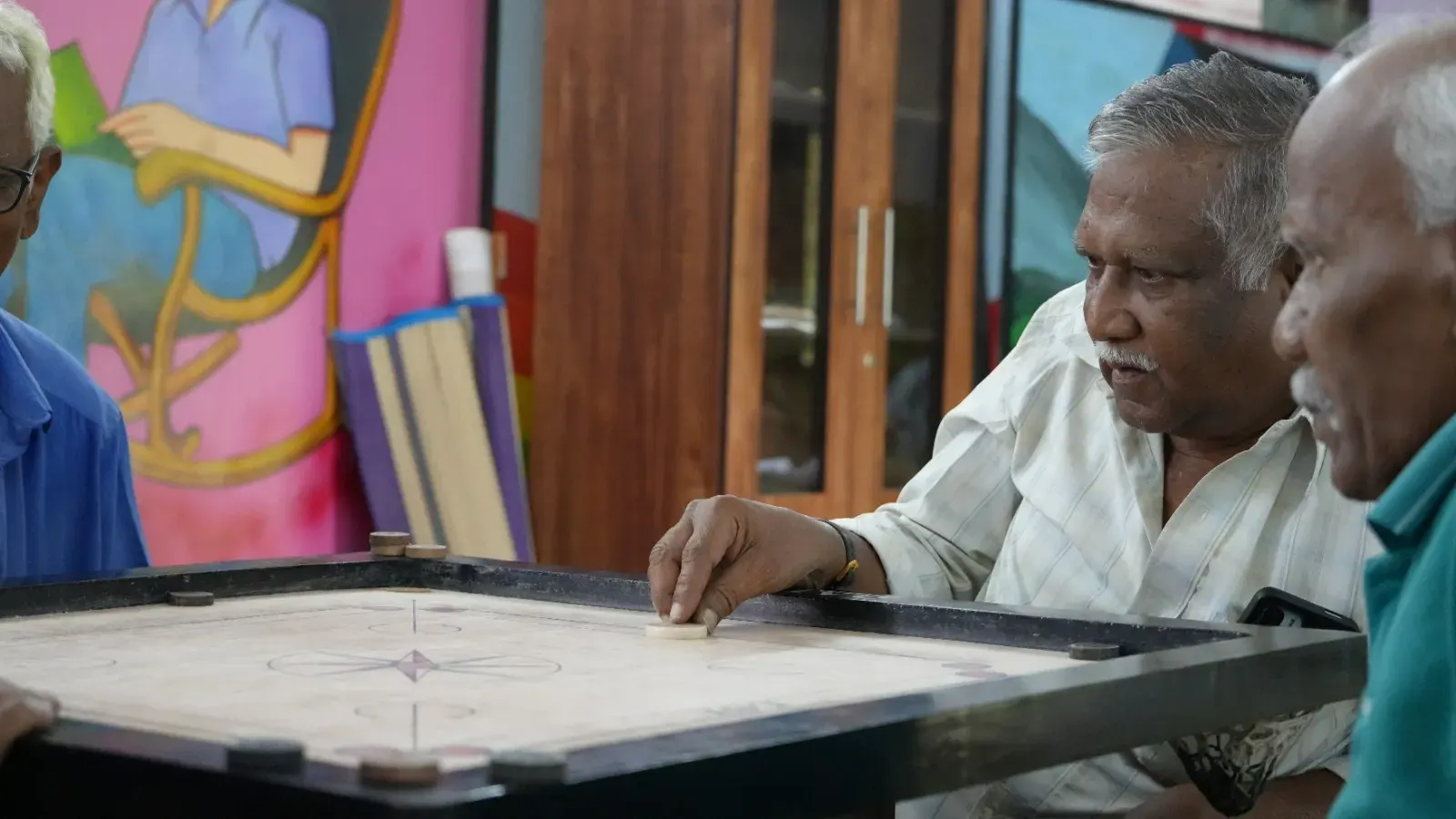
Paavai Anbucholai, our elderly care initiative, is built around intergenerational care: elders positioned as mentors, storytellers and custodians of values within our child and girl development work, rather than as a separate group receiving assistance.
The programme includes dignified residential and day-care support, nutritious meals and wellness, medical monitoring and emergency access, elder-led mentorship, storytelling and cultural transmission, bonding between elders and girls, and group activity including light fitness, yoga and counselling.
It was launched in 2025 in collaboration with the Government of Tamil Nadu.
The reasoning behind that design, and what dignity for elders looks like in daily practice, is set out at greater length in Anbucholai Elderly Care: Honoring Elders as Mentors, Preserving Dignity Across Generations.
We are not a dementia specialist service, and this article should not be read as a claim that we provide clinical care.
What we can contribute is presence, companionship, nutrition, health monitoring and the kind of community elder care that keeps older people connected to the life of a place rather than removed from it. For a person in the earlier stages of cognitive decline, being known and included is not a small intervention.
Support elderly care through donation, volunteering or partnership, and help extend senior citizen support to families who are managing this alone.
A person, not a diagnosis
The hardest part of this illness is not forgetting. It is the reversal.
The parent who taught you to read cannot follow a sentence. The mother who ran a household of twelve cannot decide what to wear.
The father who made every decision in the family now needs permission to leave the house. And your role turns inside out, in a culture that gives you no preparation whatsoever for becoming the parent of your parents.
What families who have been through it say, almost without exception, is that the person is still there.
Not continuously, and not in the way they were. But in a hand that recognises yours, a song remembered when language has gone, a look of relief at a familiar face. Recognition may fail long before feeling does.
That is worth holding on to when the work is hardest. You are not managing a condition. You are accompanying a person, for as long as they need you, in the way they once accompanied you.
Care for Life.
FAQs
When is World Alzheimer's Day 2026?
World Alzheimer's Day 2026 falls on Monday, 21 September. The date is 21 September every year, first observed in 1994.
What is World Alzheimer's Month?
World Alzheimer's Month is the whole of September, designated since 2012 to extend the campaign beyond a single day. World Alzheimer's Day on 21 September remains its focal point.
Is Alzheimer's Awareness Month in September or November?
Both, depending on where you are. Internationally and in India, September is World Alzheimer's Month. In the United States, November is National Alzheimer's Disease Awareness Month, a separate designation. This is why dates appear to conflict across different sources.
What is Alzheimer's Awareness Day?
Alzheimer's Awareness Day is an informal name for World Alzheimer's Day, observed on 21 September.
What colour represents Alzheimer's awareness?
Purple is the colour most commonly associated with Alzheimer's and dementia awareness campaigns.
How can I support Alzheimer's awareness?
Practical options include organising a memory screening camp, running a session for a residents' association or workplace on recognising early signs, starting a caregiver support meeting, arranging intergenerational activities between schools and older residents, or simply talking openly about dementia within your own family so it stops being a subject nobody names.
What is the difference between dementia and Alzheimer's disease?
Dementia is an umbrella term for symptoms involving decline in memory, thinking and daily functioning. Alzheimer's disease is the most common cause of dementia, accounting for roughly 60 to 70 per cent of cases according to the WHO. Other causes include vascular dementia, Lewy body dementia and frontotemporal dementia.
What are the early Alzheimer's symptoms in elderly parents?
Commonly noticed early signs include repeating questions or stories, difficulty with familiar tasks such as cooking or handling money, confusion about time and place, trouble finding words, poor judgement, misplacing items and accusing others of theft, withdrawal from social activity, and changes in mood or personality.
Is memory loss a normal part of ageing?
Some slowing is normal. Dementia is not. The distinguishing feature is whether the difficulty interferes with everyday functioning and whether it is progressive. Forgetting a name briefly is ordinary; being unable to follow a lifelong recipe is not.
Can dementia be cured?
There is currently no cure for Alzheimer's disease. However, some conditions that resemble dementia, including thyroid disorders, vitamin B12 deficiency, depression and medication side effects, are treatable and reversible. This is why early medical assessment matters even when families assume nothing can be done.
How do I care for an elderly parent with dementia at home?
Keep the environment simple and safe, protect a predictable daily routine, use short sentences and offer limited choices, avoid correcting or testing the person, look for physical triggers behind agitation, and keep the person involved in adapted everyday activities rather than removing all tasks.
Where can families in India get help?
Start with a general physician for assessment and referral. Public geriatric services are supported through the National Programme for Health Care of the Elderly at district hospitals and community health centres. The national helpline for senior citizens, Elderline 14567, provides information, guidance and referral support.
What legal protections exist for elderly parents in India?
The Maintenance and Welfare of Parents and Senior Citizens Act, 2007 places a legal obligation on children and heirs to maintain parents and senior citizens, and provides tribunals for redress. Families should also complete financial and legal arrangements early, while the person can still express their wishes.