There is rarely a single moment when an elder is left behind.
More often, it happens slowly.
A son moves to a city for work. A house that once had five voices has two. Meals are still cooked, but no one asks whether the food suits an aging stomach. Medicines are bought when someone remembers. The phone rings less often.
The elder is still at home. Still respected in words. But they are no longer part of the daily rhythms that make a person feel needed.
The International Day of Older Persons, observed every year on 1 October, brings this quiet drift into view. It is not about blaming families. Most families are doing their best under real pressure. It is about asking what care should look like as growing older in India changes alongside family structures.
The Quiet Way Elders Are Left Behind
When we hear "left behind," we often imagine abandonment. In many Indian homes, the reality can be much quieter and less visible.
Distance Without Departure
Migration for work can mean that elders continue living in their village or ancestral home while their children live in another district, state or city.
Contact becomes periodic. Help arrives when there is a crisis, but daily companionship gradually disappears.
Presence Without Participation
An elder may live with their family and still feel excluded from decisions about the kitchen, children, finances or the household.
Being cared for is not the same as being included.
When an older person is no longer consulted, they can begin to feel that they are being managed rather than valued.
Care Without Companionship
Physical needs may be met. There may be food, medicines and a room to stay in.
But loneliness can remain.
Many elders spend long hours alone, with television becoming their main company. Conversations may focus on health complaints rather than memories, interests, opinions or stories.
Health Needs That Go Unnoticed
Vision changes, hearing difficulties, unsteady movement, poor nutrition, untreated pain and sleep problems can develop gradually.
Because these changes happen slowly, households may begin treating them as a normal part of aging.

Regular health monitoring and someone paying attention to daily wellness can help identify concerns earlier.
None of this necessarily comes from a lack of love.
It can come from stretched schedules, migration, limited space, financial pressure and a lack of community support that would allow families to care for elders without carrying everything alone.
Why 1 October Matters
The International Day of Older Persons is a United Nations observance that encourages attention to aging as part of development.
For India, this conversation is increasingly relevant as people live longer while family structures continue to change.
The traditional joint household once distributed many aspects of elder care among several adults. As family structures and living arrangements change, that support cannot always be assumed.
At the same time, our understanding of healthy aging has expanded.
Growing older is not simply about resting. It can involve nutrition, movement, medical monitoring, mental well-being, social connection and a continued sense of purpose.
That makes dignity a practical question.
Dignity means more than respectful words.
It means having food suited to an older person's needs. It means having a safe environment in which to live and move. It means access to healthcare without having to repeatedly depend on someone to make the journey possible.
It also means having someone to talk to who genuinely listens.
And perhaps most importantly, it means having a reason to get up in the morning.
When these things disappear, an elder is not simply growing older. They risk becoming disconnected from the life happening around them.
What We Lose When We Stop Listening to Elders
Elderly care is often described as something we provide to older people.
But it can also be understood as a relationship that communities risk losing.
Elders carry more than memories.
They carry ways of speaking, singing, cooking, farming, resolving disagreements and celebrating traditions that may never appear in a textbook.
In many families, an elder can be the person who knows which story calms a child, which proverb steadies a teenager, or which recipe has been passed down through generations.
When elders are sidelined, children can lose access to this form of everyday education.
They may gain information without gaining the same connection to family history and community.
This is where intergenerational care becomes important.
When elders and children share stories, meals, activities and responsibilities, both generations can benefit.
A child gets the opportunity to learn from a patient presence that is not necessarily evaluating them.
An elder gets a meaningful role beyond simply receiving care.
They can become mentors, storytellers and cultural contributors.
That sense of purpose and belonging can be an important part of dignity in later life.
Paavai Foundation's Intergenerational Approach
Paavai Foundation describes its guiding philosophy as "Care for Life."
Its broader approach is described as "Cradle-to-Career-to-Community" — reflecting the idea that care does not belong to only one stage of life.
Within this approach, elderly people are connected with child development rather than treated as a completely separate concern.
The goal is to strengthen relationships between generations so that children can learn from elders while elders continue to have meaningful roles within the community.
What Does Dignified Elderly Care Actually Look Like?
Good elderly care does not always require one major intervention.
Often, it is a collection of small and consistent practices that protect both health and self-respect.
1. A Safe and Steady Living Environment
Whether an elder lives at home, in a day-care setting or in residential support, the environment should be clean, accessible and predictable.
Familiar routines, help with daily activities when needed and respect for privacy can help an older person maintain confidence.
2. Nutrition and Wellness as Daily Care
Healthy aging requires more than occasional special meals.
Regular, balanced nutrition, attention to appetite changes and opportunities for appropriate movement, light fitness or yoga can make wellness part of everyday life.
3. Medical Care Before a Crisis
Regular monitoring, timely check-ups, access to primary healthcare and support with medicines and follow-ups can be especially important for elders experiencing mobility, vision or hearing difficulties.
The goal is to make healthcare part of routine care rather than something that begins only during an emergency.
4. Emotional Well-Being as Essential Care
Loneliness and emotional distress should not be treated as secondary concerns.
Counselling, patient listening, opportunities to talk about grief or worry, and group activities can help restore companionship and connection.
Mental well-being is part of elderly care — not an optional extra.
5. Purpose and Connection
Perhaps one of the most important elements is giving elders opportunities to contribute.
They can share skills, tell stories, guide younger people, participate in cultural activities and become part of community gatherings.
Care should allow an elder to remain a contributor, not only a recipient.
And these practices do not have to replace families.
They can support families by creating community resources that make care less isolated.
How Paavai Foundation Approaches Elderly Care
Within the Paavai Foundation programme ecosystem, elderly care is positioned as part of its broader intergenerational approach.
The initiative Anbucholai Elderly Care focuses on dignity across generations.
Its stated components include:
Dignified residential and day-care support
Nutritious meals and wellness
Medical monitoring and emergency access
Group activities
Light fitness and yoga
Counselling
Elder-led mentorship
A particularly important element is elder-led mentorship.
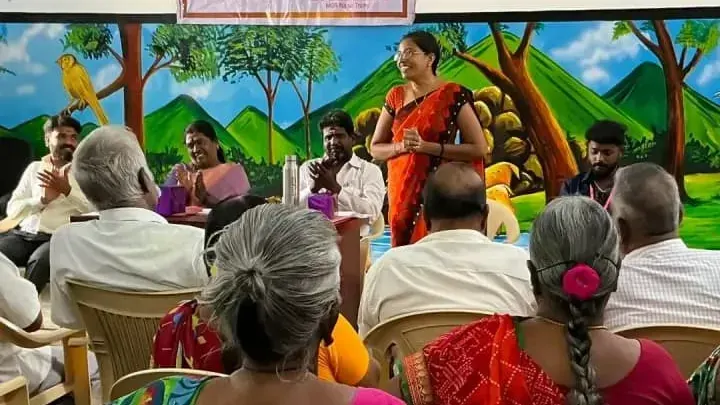
Elders can participate as storytellers and cultural transmitters, including through connections with girls supported by the Foundation's child-development work.
This creates an intentional intergenerational relationship:
Children receive guidance. Elders receive purpose. Communities become more connected.
The source material notes that Anbucholai was launched in 2025 in collaboration with the Government of Tamil Nadu.
The programme's delivery is described as grassroots, working through existing community systems rather than creating parallel structures.
This connects with Paavai Community Connect 360, the Foundation's district-level community development approach.
The framework brings together areas such as health access, nutrition, water and hygiene, environmental action and inclusion.
These are also the areas that can directly affect an elder's everyday quality of life — from access to healthcare to the availability of community spaces and people who notice when someone is becoming isolated.
The larger idea is simple:
A community that cares for its elders is also strengthening the environment in which children grow.
What Families and Communities Can Do Without Turning Care Into Guilt
Most families do not need another lecture about respecting elders.
They need practical ways to turn respect into everyday action.
Keep Elders Inside the Day, Not Only Inside the House
Ask for their opinion about a household decision.
Invite them to eat together.
Take a short walk together.
Let them sit with children during homework or storytelling.
Inclusion can happen in minutes.
Make Health a Routine, Not a Reaction
Support regular check-ups.
Maintain a simple record of medicines and appointments.
Pay attention to changes in appetite, sleep, hearing, vision or mobility.
Small changes can be easier to address when they are noticed early.
Protect Companionship
A short daily conversation can matter.
A weekly visit from a neighbour, volunteer or family member can matter.
Participation in an elders' group or intergenerational activity can matter.
The goal is not to fill every hour. It is to make sure isolation does not become the default.
Support the Caregiver Too
Elder care can sometimes fall heavily on one family member.
Sharing responsibilities, arranging respite where available and recognising the caregiver's effort can help prevent burnout.
Supporting the elder also means supporting the person providing the care.
Let Elders Contribute
Ask them to tell a family story.
Let them teach a recipe.
Ask them to guide a child.
Invite them to repair, create, teach or mentor where appropriate.
Purpose should not disappear simply because someone has reached old age.
None of these actions need to come from guilt.
They are ways of making care a shared responsibility.
A Different Way to Mark 1 October
The International Day of Older Persons 2026 should not have to end with a single event.
Speeches, celebrations and awareness programmes can bring attention to the issue.
But continuity is what makes care meaningful.
If you know an elder who seems quietly isolated, consider starting something that continues beyond October.
A weekly meal together.
A regular health check.
A scheduled phone call.
A monthly gathering.
An hour where children listen to elders tell stories.
The important question is not only:
"What can we do for older people on 1 October?"
It is:
"What can continue after 1 October?"
Dignity in old age is not a special kindness.
It is part of the same promise of care that communities make throughout life.
Care for the child.
Care for the family.
Care for the elderly.
When these relationships remain connected, an elder is not simply someone who needs care.
They remain part of the circle — with experiences to share, people to guide and a meaningful place within the community.
Conclusion
Being left behind does not always look like abandonment.
Sometimes it looks like fewer conversations.
Sometimes it looks like decisions being made without asking.
Sometimes it looks like a room in the same house becoming an entire world.
The International Day of Older Persons 2026 gives us an opportunity to notice these quieter forms of isolation and think differently about elderly care.
Dignified care means more than providing food, medicine and shelter.
It means companionship.
It means participation.
It means healthcare and wellness.
It means safety.
And it means purpose.
The work of Paavai Foundation reflects this broader idea through its focus on integrated development and intergenerational connection.
Through initiatives such as Paavai Anbucholai, the emphasis is not only on caring for elders but also on recognising what elders can continue to give to younger generations.
Because elderly care and child development do not have to exist in separate worlds.
A child can learn from an elder.
An elder can find purpose through a child.
A family can receive support from its community.
And a community can become stronger when generations remain connected.
This International Day of Older Persons 2026, perhaps the most meaningful question is not whether we remember our elders.
It is whether we continue to make space for them in everyday life.
Care for Life. Every Life.