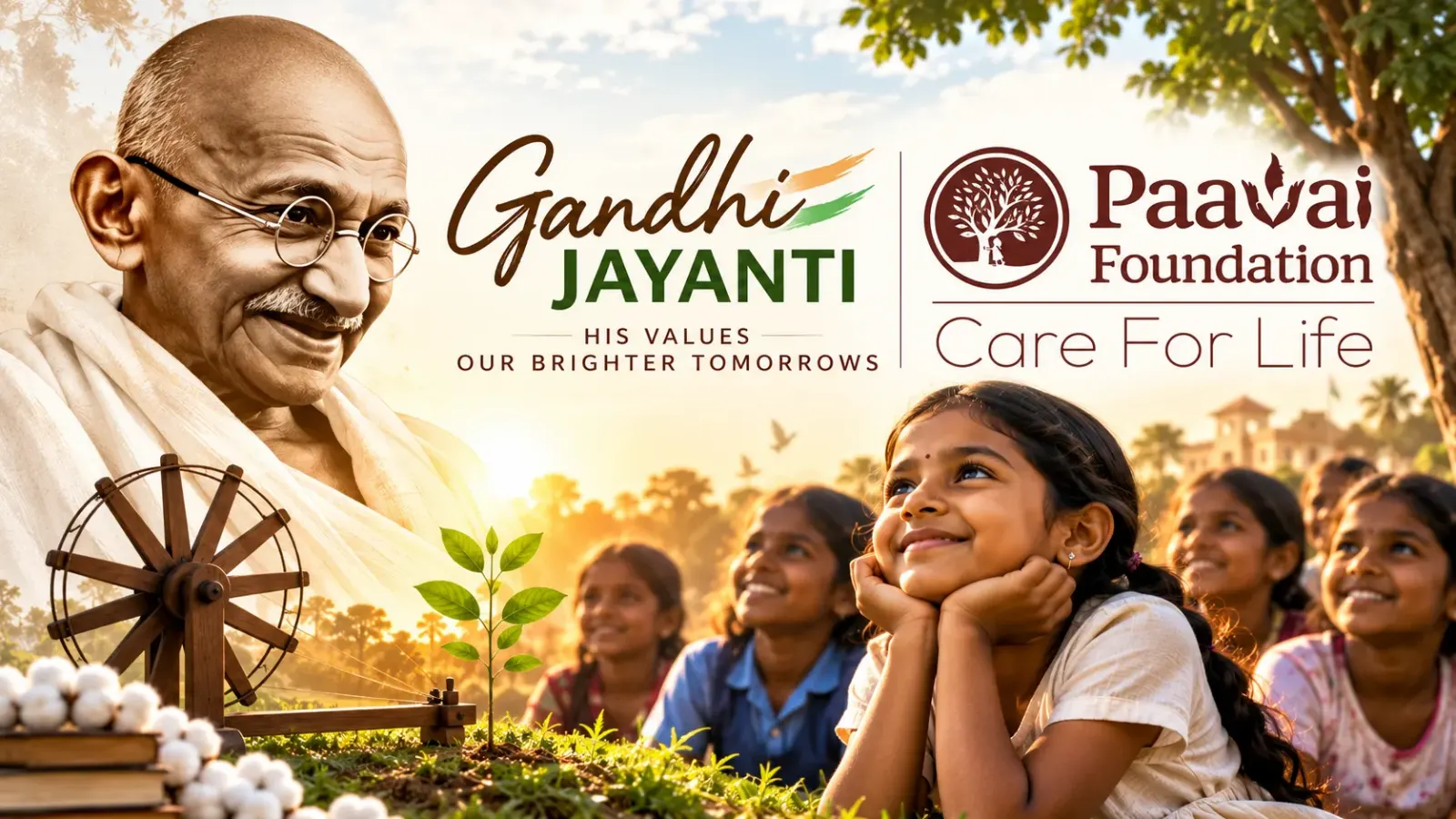
Every 2 October, the same images return.
A freshly cleaned statue, a garland, a speech about truth and non-violence, a distribution programme with a banner. By 3 October, most of it is packed away.
Gandhi would have understood the ritual and distrusted it. He was not an advocate of spectacle. He was an advocate of daily practice — spinning a little every day, cleaning one's own surroundings, listening to the person considered least important in the room, working where you are rather than where you are seen.
If Gandhi Jayanti 2026 is to mean anything beyond ceremony, it is worth asking what service looks like when no one is watching. Not the event, but the routine. Not the announcement, but what happens in the weeks when there is nothing to announce.
That is where grassroots work lives.
What Gandhi meant by service
Gandhi's ideas about service were practical, almost stubbornly so.
He spoke of Sarvodaya — the welfare of all — not as charity for the poor but as a way of organising life so that no one's dignity depends on another's pity. He spoke of trusteeship — that what we hold, we hold in trust for those who have less. He spoke most simply about the last person in line, and whether what we do reaches them.
None of these are ideas for a stage. They are tests for ordinary days.
Do we do work that the person in the next village would recognise as useful? Do we treat means as seriously as ends? Do we measure work by whether it continues after we leave?
An organisation that takes these questions seriously will rarely look impressive in photographs. Its work will look like continuity.
What grassroots work really looks like from the ground
From a distance, community work appears to be events — a camp, a drive, a day of action. From the ground, it is almost entirely maintenance.
It is place-specific. Grassroots work is not done for a district. It is done in a particular block, with a particular primary health centre, a particular government school, a particular anganwadi that has been there for years. Paavai Foundation describes its community work this way, through a district and block-level presence and through outreach conducted with government hospitals and primary health centres rather than in parallel to them. The address matters, because trust is held at the address, not at the organisation's head office.
It is relationship-dependent. The first visit is rarely where anything changes. The fifth or sixth is when a mother asks the question she did not ask earlier, when a teacher explains which child has not come regularly, when an elder agrees to join a group activity. Paavai's framing of its model as Cradle-to-Career-to-Community and as CARE → EDUCATE → EMPOWER → LEAD is an acknowledgment of that sequence. Protection makes learning possible. Learning makes confidence possible. Each stage hands off to the next only if the people stay long enough for the handoff.
It is unspectacular by design. The most important parts of a community programme often look like nothing. Daily attendance taken and followed up. A meal provided again. A check-up scheduled and then followed through. A referral that is tracked until completed. Help for a family to claim an entitlement they already qualify for but have not been able to access. None of this photographs well. All of it is what keeps a child in school or an elder in care beyond a single distribution.
It works through existing systems. Work that builds its own island works while funding lasts and fades when funding leaves. Work that strengthens the government school, the panchayat, the primary health centre — the institutions a village will still have in twenty years — produces something that can continue. That is also why much of Paavai's health and nutrition outreach, including Nutri Heal for tuberculosis patients and the Arogya Mobile Units, is described as community-based and delivered through existing government facilities. The support complements medical treatment and hygiene awareness; it does not replace the system.
Why spectacle is tempting — and why it harms
This is not an argument against visibility. Organisations need to be seen to be supported. But there is a difference between being visible and being performative.
Spectacle requires that work be compressed into a single day, a large number and a clear image. Grassroots work does not compress. A child's education is not changed by being enrolled once, but by being supported continuously when attendance wavers. Health is not secured by one camp, but by preventive care, regular monitoring and follow-up that happens when there is no camp. Dignity for an elder is not a felicitation on a stage, but a daily place where they are expected and useful — as Paavai's Anbucholai Elderly Care frames elders as mentors and storytellers inside child development, not as a separate audience to be served.
When service is organised for the photograph, three things quietly break: the child learns that care is an event that comes and goes, the community learns that attention arrives from outside, and the organisation learns to optimise for what looks good.
Gandhi's alternative was to optimise for what continues when no one is looking. That is a harder standard to meet, and a more honest one to claim.
Lessons from Paavai Foundation's community approach
Paavai describes itself as an Integrated Child Development Foundation guided by Care for Life. Every Life. The integration is not a tagline. It is the choice to treat human development as continuous rather than categorical — so that a child who needs protection also receives education, health and family support together rather than in sequence.
That choice is expressed in nine programmes that are designed to connect: Paavai Abhayam for protection and care, Paavai Gurukul for uninterrupted education, Paavai Arogya for health and well-being, Paavai Shishumithra for balanced child development, Paavai ID Care for lifelong care for children with intellectual disabilities, Paavai Nayak for youth voice and leadership, Anbucholai Elderly Care for intergenerational dignity, Nutri Heal for nutrition support during TB treatment, and Paavai Community Connect 360 as the district-level community development umbrella that holds seven sub-interventions — from SDG outreach and Zero Hunger work to Swachh, Green Bhoomi, Equality Pathway and Disaster Response.
Community Connect 360 is the clearest expression of Gandhi's test applied to the method. Its sub-interventions — health access, food and nutrition security, water and sanitation awareness, environmental action, inclusion, and emergency relief — are not one-day drives. They are described as district-wise planning, local implementation and community participation over time. The Foundation also maps this work against the full Sustainable Development Goals framework, not as a claim of progress on seventeen goals, but as the framework it works within.
The alignment with Gandhi Jayanti is not symbolic. It is practical: dignified, regular work done with the community's own institutions, with children, elders and families held in the same view.
How to mark this Gandhi Jayanti
If you are part of an organisation, a school, a company team or a neighbourhood group wondering how to observe 2 October without spectacle, a few practices are more Gandhian than any banner:
Stay in one place longer. Choose a single community, school or health centre and commit to it for a year rather than visiting five places once. Ask the local workers what already exists and what would help them do their work more easily.
Make one routine rather than one event. A fortnightly study support hour, a monthly health follow-up, a weekly intergenerational story circle with elders. Publish the schedule and keep it.
Treat dignity as method. Ask for consent before photographs. Do not use a child's distress to raise funds. Let people describe their own lives in their own words. Pay the people who do the quiet work fairly.
Volunteer with the expectation of being taught, not just helping. Community service that begins with listening — to teachers, ASHAs, panchayat members, parents and children — lasts longer than service that begins with a plan made elsewhere.
Spectacle fades after the day. Service stays when it is built into someone's week.
Gandhi did not ask others to do great things occasionally. He asked them to do small things daily without needing applause. That is what grassroots work asks too. It is not visible every day, which is exactly why it works.
Care for Life. - not as a line for a poster, but as the decision to still be there after the garlands have been cleared.