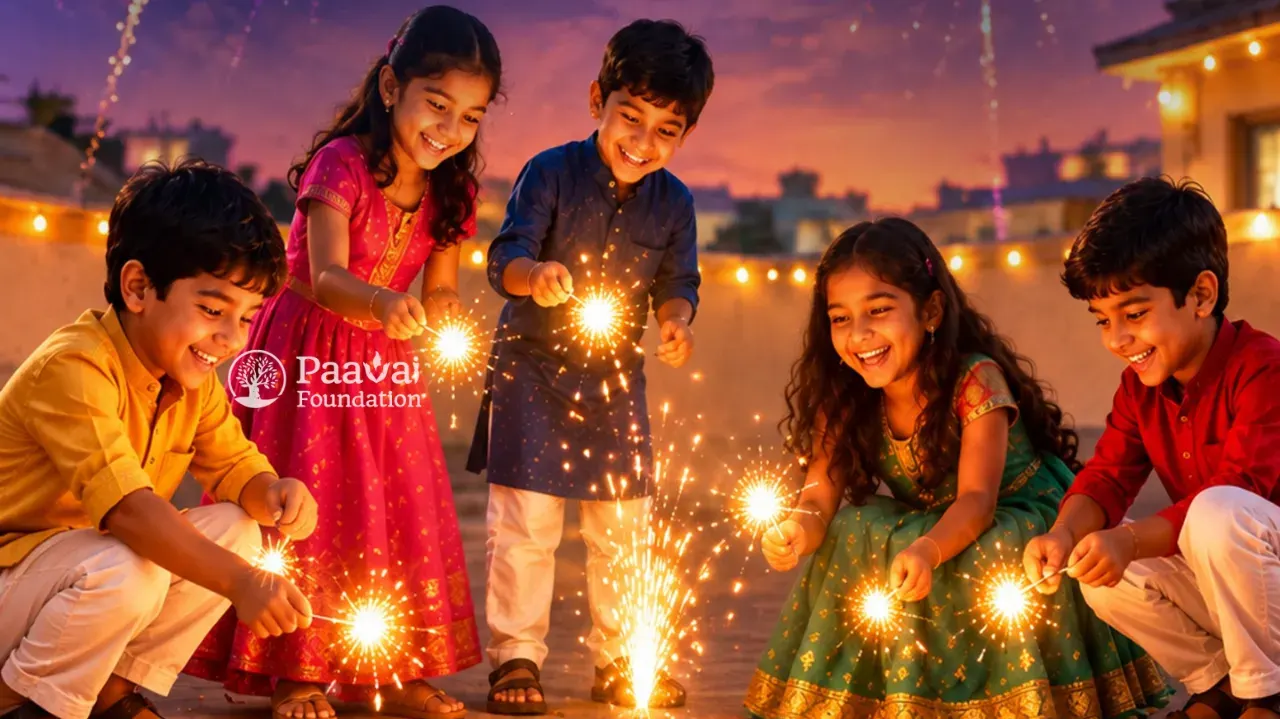
Every family has its own Diwali rituals. The rangoli at the door before sunrise. The oil bath and new clothes. The plates of murukku and laddu sent to neighbours. The diyas lined along the wall as evening falls. Somewhere in most of those rituals there's also an older one: sharing.
Diwali has always been a festival of giving. Sweets go to the people who work in and around our homes. New clothes go to those who might not buy them for themselves. Lamps are lit so that no corner, and no one, is left in darkness.
This year, Diwali falls on Sunday, 8 November 2026. If part of your celebration includes wanting to donate for children who are growing up without the full warmth of a family festival, this guide is for you. It covers eight practical ways to do that, each one designed to be genuinely useful to children and kind to their dignity.
Before the ideas: what children in care actually need at Diwali
Children who live in children's homes celebrate Diwali too. They draw rangoli, light lamps, eat sweets and look forward to the day like any other child. A good home makes sure of that.
What festival giving can add is something extra: a special meal, new clothes, books, a better-equipped home, and the reassurance that people they've never met care about them.
What children in care don't need is to become part of someone else's celebration. Many homes receive requests at Diwali to visit, distribute gifts by hand, take photographs, or burst crackers with the children.
The intention is kind, and responsible homes usually decline. Children in care are often cast as the audience for other people's generosity, and they notice. They need their festival to feel like their own.
So the best Diwali donations share one feature. They reach children through the home itself, as part of an ordinary, happy festival day.
Idea 1: Sponsor a Diwali festive meal
Food sits at the heart of Diwali, and a special meal is one of the simplest and most joyful gifts you can give.
The best way to do this is to sponsor the meal through the home's own kitchen rather than bringing food yourself.
The cooks who feed the children every day know their tastes, their health needs and any allergies or special diets. The food is fresh and hygienic, and every child receives the same meal at the usual time.
A good Diwali meal adds festive dishes and a sweet to a proper, nourishing meal. It shouldn't replace that meal with sugar and fried snacks.
At Paavai Foundation, festive meals can be sponsored through Celebrate With Us.
Tip: Book early. Many homes receive several festive meal requests for Diwali week. If your date is flexible, a festive meal a few days before or after the festival is enjoyed just as much.
Idea 2: Give new clothes, the right way
New clothes are among the most treasured parts of Diwali for any child. For children in care, a new outfit chosen just for them carries real meaning.
The kindest way to give clothes is through the home, not directly to individual children. Staff know each child's size, age, preferences and needs, and they make sure every child receives something. That avoids the hurt of some children getting new clothes while others watch.
A few principles help:
Give new, not used, for the festival. Gently used clothing can be useful at other times, but Diwali clothes should feel special.
Let the home choose. A contribution towards clothing lets staff buy the right sizes and styles, often with the children having some say.
Think practically too. School uniforms, warm clothing for the coming winter and footwear are often just as valuable as festive outfits.
Idea 3: Share sweets, made safely
No Diwali is complete without sweets, and children in care should enjoy them as much as anyone.
The safest approach is to fund sweets prepared in the home's kitchen or bought from a trusted, hygienic source by the home itself. Packaged sweets from unknown sources, especially milk-based ones that spoil quickly, can be a real health risk around festival time, when demand is high and quality varies. Food safety standards set by the Food Safety and Standards Authority of India apply to anyone preparing or selling sweets, and a home feeding many children has to be careful.
Two more thoughts. Sweets work best as part of a festive meal rather than in large quantities on their own. And some children may have diabetes or other conditions that limit sugar, which home staff will plan around.
Idea 4: Light a lamp of learning with books and school supplies
Diwali celebrates the victory of light over darkness, and few gifts carry that meaning as clearly as learning.
Books, educational kits and school supplies make thoughtful Diwali gifts because they last well beyond the festival. Ideas include:
age-appropriate storybooks for a home's reading corner
notebooks, geometry boxes, art supplies and school bags
educational kits for students preparing for board exams
funding for tuition support or a learning resource
As with clothing, it's best to ask the home what's needed, or contribute so staff can buy it. A home may already have plenty of notebooks but need a reference book for a student in Class 10.
Idea 5: Turn your corporate Diwali gifting into a gift for children
Every year, companies across India spend on Diwali gift hampers for employees, clients and partners. Many of those hampers are quickly forgotten.
A growing number of businesses now redirect part of that budget towards children. Instead of a dry-fruit box, clients and staff receive a card saying a contribution has been made in their name to support children's meals, education or care. It's a gift with a story, and one people remember.
This works well for:
businesses looking for meaningful corporate Diwali gift alternatives
teams who want to make a collective contribution
families who'd rather give in place of exchanging presents among relatives
If your company runs a formal CSR programme, festival giving can also start a longer partnership. The difference between a one-time festival gift and a sustained CSR commitment is worth thinking through with your finance team.
Idea 6: Give in someone's name
For many families, Diwali is also a time of remembering: grandparents who lit the first lamp in the house, parents who taught us the festival's rituals, loved ones we celebrate without this year.
A Diwali donation dedicated in someone's name is a meaningful way to honour them. You might give:
in memory of a parent or grandparent
in honour of an elder who still celebrates with you
as a gift for a friend or relative who already has everything
in your children's names, as their first Diwali gift to others
A dedication keeps the gift personal without asking anything of the children who benefit.
Idea 7: Give a gift that lasts beyond the festival
Diwali lasts a few days. Children's needs last all year.
One of the most valuable things you can do this Diwali is start a small monthly contribution. A regular amount, even a modest one, helps a home pay for the things that don't stop after the festival: daily meals, staff salaries, school fees, health care and electricity.
Festival giving tends to arrive in a rush in October and November, then fade away. A monthly donation keeps the light on through the quieter months, when children still need just as much care. Why regular giving does so much is explained in Monthly Giving vs One-Time Donation: Which Does More for a Child?
You might think of it as lighting a diya that keeps burning long after Diwali.
Idea 8: Share your time and skills after the festival
Not every gift has to be material. If you have a professional skill such as teaching, counselling, medicine, design, IT, finance or the arts, it may be one of the most valuable things you can offer.

The best time to start is after Diwali, when the festival rush is over and homes can plan properly. Skill-based volunteering works best when it's regular, structured and sustained, and roles involving children usually require screening and a longer commitment. Behind-the-scenes and digital roles, such as design, writing, accounts or IT, can often be done from home.
At Paavai Foundation, professionals can register their skills and interests through the volunteer page and be matched with opportunities in their district.
What to avoid this Diwali
A few well-meaning gestures can make Diwali harder for children in care. Here are some gentle reminders.
Don't give firecrackers to children. Diwali sees many burn and eye injuries every year, and children are especially at risk. Homes that celebrate with lights, lamps and rangoli rather than crackers are protecting the children in their care.
Don't ask to visit and celebrate in person. Responsible homes usually decline visits during the festival, and that's a sign they take children's well-being seriously.
Don't take or ask for photographs of children. Children's privacy matters, especially those in care.
Don't hand gifts to individual children. Give through the home so every child is included.
Don't drop off cooked food or sweets unannounced. It can't be safely served, and it disrupts the day.
Involve your own children
Diwali is a lovely time to help your own children understand giving.
Let them help choose what your family gives this year. Talk together about how children in other homes celebrate the festival too, and what might make their day special. Let your child set aside part of their own Diwali money, if they want to. Explain why you give through the home rather than visiting.
These small conversations help children learn that celebrations can include others. They also learn that giving is about the person receiving, not about being seen to give.
Before you donate for children this Diwali
A little care makes sure your gift reaches children well.
Check the organisation's registration. Many NGOs can be verified on the government's NGO Darpan portal.
Ask how the gift will be used. Will every child receive it? Is the meal cooked in the home's own kitchen?
Ask about child protection. A responsible organisation should have a written policy, including rules on photographs and visitors.
Keep your receipt. Donations to organisations with valid 80G registration may qualify for a tax deduction, subject to conditions and limits. You can check an organisation's registration through the Income Tax Department.
Give early. A donation made a week or two before Diwali gives the home time to plan meals, buy clothes and prepare.
If you live outside India and want to give this Diwali, ask the organisation how it can accept your contribution, since the rules differ depending on how and where you give.
Diwali with Paavai Foundation
Paavai Foundation is an Integrated Child Development Foundation working across South India. It runs children's homes in Trichy, Hyderabad and Tirupati, and community programmes across Tamil Nadu, Telangana and Andhra Pradesh. Its work covers child care and protection, education, health, nutrition, disability inclusion, elderly care and community development.

This Diwali, you can help the children in its care celebrate the festival with good food, warmth and belonging, through a festive meal, a contribution towards their needs, or a monthly gift that lasts all year.
Share Diwali With a Child: Diwali With Paavai
Let the light reach further
Diwali reminds us that light is meant to be shared. One lamp lights another without losing anything of its own flame.
This year, as you light the diyas at your door, think of a child somewhere who'll also be celebrating. Perhaps with a special lunch on the day. Perhaps in a new shirt. Perhaps with a storybook she'll read again and again. She may never know who made it possible, and that's the most generous kind of giving.
Wishing you and your family a joyful, safe and bright Diwali.
Care for Life.
FAQs
When is Diwali in 2026?
Diwali 2026 falls on Sunday, 8 November, with Lakshmi Puja that evening. Timings vary by city, so check your local Panchang. In many parts of South India, Deepavali is marked with the early-morning oil bath on Naraka Chaturdashi.
What are the best Diwali donation ideas for children?
Sponsor a festive meal, give new clothes through the home, fund sweets made safely, give books and school supplies, redirect corporate Diwali gifting, give in someone's name, start a monthly contribution, or volunteer your skills after the festival.
Where can I donate for children this Diwali?
Choose a registered organisation that works directly with children, such as a children's home. Check its registration, ask how your gift will be used, and give through the organisation rather than to individual children.
Can I visit a children's home and celebrate Diwali with the children?
Most responsible homes decline festival visits so children can celebrate in their own way, without becoming an audience. Giving through the home is the kinder alternative.
Can I donate firecrackers to children for Diwali?
It isn't recommended. Firecrackers cause many burn and eye injuries to children each year. Lamps, lights and rangoli are safer ways to celebrate.
Is a Diwali donation tax-deductible?
Donations to organisations with valid 80G registration may qualify for a deduction under the Income Tax Act, subject to conditions and limits. Keep your receipt.
Can my company donate instead of giving Diwali gifts?
Yes. Many businesses now redirect part of their Diwali gifting budget to children's causes, often sending clients and employees a card saying a contribution was made in their name.
How much does it cost to sponsor a Diwali meal for children?
Through Paavai Foundation's Celebrate With Us, a regular breakfast or dinner is ₹3,500 and lunch ₹4,500. A special festive meal is ₹5,500 for breakfast or dinner and ₹7,500 for lunch.
Should I donate before or after Diwali?
For festival meals and clothes, a week or two before Diwali gives the home time to plan. For ongoing support, a monthly contribution that starts at Diwali helps all year.
Comments
Loading comments...
Leave a comment
Your email address will not be published. Only your name is shown with your comment.